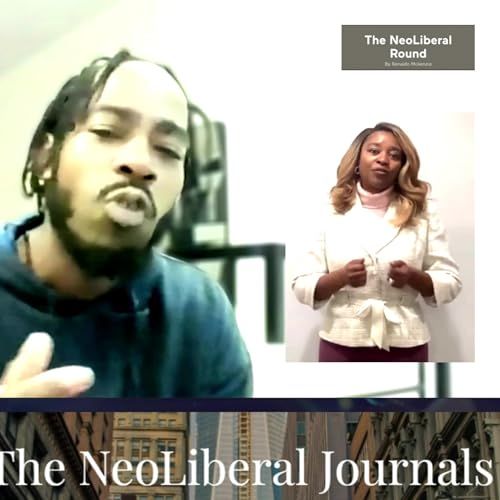
The NeoLiberal Round Podcast Por Renaldo Mckenzie arte de portada

The NeoLiberal Round

The NeoLiberal Round

De: Renaldo Mckenzie
Escúchala gratis

Life is about people/how people relate. Yet life is what we make it or allow others to make of it for us creating privileges. The Neoliberal Round is a think tank exploring life. We're interdisciplinary and dynamic; concerning ourselves with global issues and problems so as to serve the world today to solve tomorrow's challenges, by making popular what was the monopoly. We will be bold and deliberate in our reflections on truths, lifting up issues of ethics/human values. Visit The Neoliberal, https://theneoliberal.com. Donate here: https://donate.stripe.com/7sYcN48uybAA2OEb9V93y06Renaldo Mckenzie Política y Gobierno
Episodios
  • COMMENTARY: FOOLING AMERICANS ON APRIL FOOLS' DAY: TRUMP'S APRIL FOOLS' DAY SPEECH ON THE IRAN WAR
    Apr 2 2026

    In this commentary, we share Donald Trump’s address to Americans on April Fools’ Day—a speech that felt less like leadership and more like theater.

    Trump attempted to justify the war using clichés, hypothetical fears, and ideology wrapped in familiar half-truths. It was All Fools’ Day, after all, and he seemed intent on playing the American public—recycling epithets that have grown tired, predictable, almost mundane.

    He claimed that former President Barack Obama was “buying Iran’s respect” by sending them cash. But this is misleading. The funds returned to Iran were their own—previously seized by the United States. Under the agreement, Iran limited its uranium enrichment, and in return, the U.S. released those funds. Trump omitted these critical details.

    Instead, he offered a narrative fit for spectacle rather than substance.

    He further asserted that war was necessary because Iran was preparing to attack the United States—developing capabilities that posed an imminent threat. Yet no evidence was presented. No proof. No urgency grounded in fact.

    It raises a deeper question—one that echoes beyond this moment: is power only permissible in the hands of the United States and Israel? And when other nations—especially those in the Global South, often Black and Brown nations—seek to develop, modernize, and assert themselves, are they automatically labeled a threat?

    This is not merely about security—it is about dominance. About who is allowed to rise, and who must remain contained.

    At its core, this is the logic of unfair competition—the very argument explored in Renaldo McKenzie’s upcoming book, Neoliberal Globalization Reconsidered: Unfair Competition and the Death of Nations, set for release on May 1.

    Listen to the full commentary and engage with the argument.

    Renaldo McKenzie is also the author of Neoliberalism, Globalization, Income Inequality, Poverty and Resistance.

    Contact us at info@theneoliberal.com
    Visit: https://theneoliberal.com or https://renaldocmckenzie.com

    Subscribe on any podcast Stream. Fin yours by visiting https://anchor.fm/theneoliberal

    Support our work: https://donate.stripe.com/7sYcN48uybAA2OEb9V93y06

    Más Menos
    18 m
  • The Real American Crisis is not Merely Political—it is Moral
    Mar 31 2026

    On the contrary, the real American crisis is not merely political—it is moral. We are confronted with a President whose character appears fractured, whose words and actions often stand in contradiction.

    It is not enough to say, as Republican strategist Stuart Stevens suggests, that “an entire political movement chose him.” That may be true, but it does not absolve the deeper concern. Democracy may explain how power is acquired, but it does not justify how it is exercised.

    If a leader is perceived as hypocritical and duplicitous—saying one thing while doing another—then trust becomes an impossible currency. And without trust, diplomacy falters.

    How can adversaries, such as Iran, take seriously the promises of a man whose actions disrupt his own negotiations? To speak of peace while advancing conflict is to erode credibility on the world stage. No one bargains confidently with inconsistency.

    In one moment, Trump claims to be negotiating with Iran to end the war, while in the next he contemplates putting boots on the ground. Reports indicate that just before military action against Iran, diplomatic channels had been engaged regarding its nuclear program—yet, without warning, strikes followed. Even now, the language of negotiation persists alongside the shadow of force.

    Is it wishful thinking to believe that Iran—or anyone—can trust the United States under such conditions?

    Even traditional allies in NATO and the European Union have shown signs of unease—questioning commitments and recalibrating expectations—after treaty disruptions, territorial rhetoric, and sweeping tariff threats. When consistency falters, confidence follows.

    Indeed, this is the deeper problem.

    And yet, perhaps this is not new.

    History reminds us that humanity has long wrestled with its own contradictions. In the biblical account, the crowd chose Barabbas—a criminal—over Jesus. They freed one they feared and condemned one they did not understand. It was not simply a political decision; it was a reflection of human frailty.

    Two thousand years later, the pattern feels hauntingly familiar.

    We are still choosing.
    Still weighing spectacle over substance, impulse over integrity.

    Perhaps nothing has changed—or perhaps the burden has always been ours to bear.

    For nations do not collapse in a single moment of chaos; they erode in the quiet compromises we justify, the contradictions we excuse, and the character we overlook.

    And if we continue to choose power over principle, spectacle over substance, then the crisis is not the President.

    The crisis is us.

    By Rev. Renaldo McKenzie, Author of Neoliberalism, Globalization, Income Inequality, Poverty and Resistance

    Reference:

    Start Stevens, Political consultant Stuart Stevens recalls when Republicans made character an issue for the president, in Mississippi Today, published March 27th, 2026,


    This is available in The Neoliberal Post at https://renaldocmckenzie.com and https://theneoliberal.com

    Donate to us at: https://donate.stripe.com/7sYcN48uybAA2OEb9V93y06

    Más Menos
    7 m
  • The Interview With Dr. Nelva Lee, Candidate for the Superintendent of Georgia Schools
    Mar 29 2026

    Host Renaldo McKenzie welcomes Dr. Nelva Lee to the Show and begins by asking her to share her story, and to elaborate on some of her statements made on an initial off-camera interview:

    1. On Trade Schools, Certifications & Funding

    You praise trade certifications as a pathway to economic mobility—but certifications themselves often require funding, materials, and institutional support.

    Follow-up:

    If certifications still carry costs, how does your model truly reduce reliance on student loans rather than simply shifting where the financial burden sits? Are you advocating for state-funded certification pathways, public-private partnerships, or employer-sponsored pipelines—and how would that be implemented at scale?

    2. On AI, the Future of Work & Apprenticeships

    Trade schools traditionally respond to current workforce demands—but how does your vision prepare students for a future shaped by AI, automation, and rapidly evolving industries?3. On Georgia’s Current Success

    Georgia is often ranked highly in workforce readiness—so what, specifically, is missing? What gap do you see that others may be overlooking?4. On Funding, Equity & the Reality of Inequality

    You emphasize quality education for all, but we know that funding disparities often mirror income and geography. How do you plan to equalize access in under-resourced communities without simply redistributing already limited funds?5. On DEI—From Critique to Replacement

    Dr. Nelva critiques DEI—but critique alone is a shadow unless it casts a new shape.

    Follow-up:

    You’ve expressed concern that some DEI frameworks prioritize identity over merit—but how do you address systemic inequities that are themselves rooted in identity, history, and access?

    You mentioned empowerment and outcomes—can you point to examples where DEI has failed, and what specifically would you do differently to ensure those same communities are not left behind?6. On Leadership & Personal Responsibility

    You speak about creating opportunity systems—do you see yourself not just as a policymaker, but as someone actively responsible for generating those opportunities? What does that look like beyond policy—what are you building, right now, that reflects that vision?

    Dr. Nelva shares her passion and her drives, hopes, and dreams. The episode was sharp to the point; Dr. Nelva held nothing back and was intriguing and interesting. This was a powerful episode.


    Available on any podcast stream. Find your stream by visiting our main platform: https://anchor.fm/theneoliberalEmail us at info@theneoliberal.comCall us 445-260-9198.This episode is brought to you by The Neoliberal Round by Renaldo McKenzie in Association with The Neoliberal CorporationVisit The Neoliberal at https://theneoliberal.com and https://renaldocmckenzie.comThe Neoliberal Round is a (503 (c1) - Registered Non-Profit. You may donate to us via cash App $renaldomckenzie or via Stripe: https://donate.stripe.com/7sYcN48uybA...Your donations will help us to grow the Podcast and provide information about community free of cost.

    Más Menos
    27 m
Todavía no hay opiniones