Episodios

  • Episode 53: Spotlight on Surgical Oncology
    Apr 12 2026

    In this episode, surgical oncologist Dr. Seth Concors of Emory’s Winship Cancer Institute discusses the role of the surgical oncologist within the multidisciplinary care team for neuroendocrine cancer. We explore what surgical oncologists do, why NET-specific experience matters, how surgical decisions are made, and what patients can expect during a surgical consultation. The conversation highlights coordination across care teams, common patient concerns, and the importance of informed decision-making and second opinions, offering practical guidance for patients and caregivers navigating surgical care in neuroendocrine cancer.

    TOP TEN QUESTIONS

    Understanding the Surgeon’s Role

    1. What is a surgical oncologist, and what kind of training does that involve? How is a surgical oncologist similar to—or different from—other types of surgeons? Patients may hear the term “HPB surgeon.” What does that mean, and how can a patient tell if their surgeon is an HPB surgeon?

    2. When a patient is looking for a surgeon, how can they find someone who is the “right fit” for them? How can patients know whether a surgeon has experience with the specific operation they may need—such as a Whipple procedure, liver surgery, or lung surgery? How important is it for a surgeon to be familiar with neuroendocrine tumors specifically?

    3. What should patients expect at their first appointment with a surgical oncologist? What key information are you usually trying to communicate during that first visit? What questions do you encourage patients and caregivers to ask their surgeon?

    4. How often should patients expect to see their surgical oncologist, and at what points in their care?

    Surgical Decision-Making

    5. How do you determine whether someone is a surgical candidate? What is the typical goal of surgery for neuroendocrine tumors?

    6. If someone is not a surgical candidate initially, does that mean surgery is off the table forever? Are there treatments that can help make surgery possible in the future? How many NET surgeries can someone safely have over their lifetime?
    Can major surgeries—such as extensive liver resections—affect eligibility for future treatment options?

    Multidisciplinary and Coordinated Care

    7. How do surgical oncologists work within a multidisciplinary care team for NET patients?
    How do you collaborate with providers at different institutions, such as a local oncologist working with a NET specialty center?

    8. What is your perspective on second opinions, specifically for neuroendocrine cancer?

    9. Many patients worry about carcinoid crisis during surgery. How do you address and manage those concerns?

    Preparing for Surgery

    10. Patients often ask how they can best prepare—physically and emotionally—for surgery. What guidance do you typically offer?

    BONUS: What research is currently being done involving neuroendocrine surgery?


    ABOUT THE SPEAKER

    Seth Concors, MD, is an academic surgical oncologist at Emory University and the Winship Cancer Institute, where he serves as Associate Program Director for both the General Surgery Residency and the Complex General Surgical Oncology Fellowship, and Director of the Surgical Oncology Research Fellowship. He leads Emory’s Peritoneal Surface Malignancy and Neuroendocrine Tumor surgical programs, with clinical and research interests focused on gastrointestinal neuroendocrine tumors, cytoreductive surgery/HIPEC, and survivorship outcomes. Dr. Concors is actively involved in national surgical societies, including SSO, SSAT, NANETS, ACS, and ECOG-ACRIN, and his work emphasizes multidisciplinary collaboration, prospective outcomes research, and surgical education. He is committed to advancing patient-centered cancer care while mentoring the next generatio

    For more information, visit NCF.net.

    Más Menos
    1 h y 1 m
  • Episode 52: "Spotlight on Genetic Counselors" with Samantha Greenberg, PhD, MS, MPH, CGC
    Feb 3 2026

    ABOUT THIS EPISODE

    Who is a genetic counselor, and who should see one? How do they fit into the neuroendocrine cancer care team? In this episode, Samantha Greenberg, PhD, MS, MPH, CGC, Director of the UT Southwestern Genetic Counseling Program, demystifies genetic counseling and testing for NET patients and their families. She explains what to expect before, during, and after a consultation—and how results can impact care, family members, and future planning.

    TOP TEN QUESTIONS

    Role & Training

    1. What is a genetic counselor? What training is required? What’s your role in the care team?

    Genetic Counseling & NETs

    2. How are genetic counselors involved in NET care?

    3. Who should get genetic testing? Do all NET patients need it?

    • What if more than one family member has NET?
    • Do you also see family members without a diagnosis?

    4. How does one’s age play a role?

    Testing Basics

    5. Genetic vs. genomic vs. NGS—what are these terms?

    • How do patients know they’re getting the right test?

    6. Walk us through a genetic counseling consultation—before, during, after.

    Results & Implications

    7. What if the results are positive? How do you guide patients and families?

    • What if the results are negative or inconclusive? How accurate are tests?

    8. What is a “variant of unknown significance”?
    9. Can environment or toxins cause hereditary mutations?

    Practical Guidance

    10. How can patients find the right genetic counselor? Do they need to be someone who specializes in neuroendocrine cancer?

    ABOUT THE SPEAKER

    Samantha Greenberg, PhD, MS, MPH, CGC

    Pronouns: she/her series

    Director, UT Southwestern Genetic Counseling Program

    Assistant Professor

    School of Health Professions

    Samantha Greenberg is the founding program director of the UT Southwestern Genetic Counseling Training Program. She received her Master of Science degree in genetic counseling and public health from the University of Michigan after teaching middle school science with Teach For America in Tulsa, Oklahoma. She recently completed her Ph.D. at the University of Utah. As a cancer genetic counselor, Greenberg has provided clinical care across a variety of indications and facilitated the development of multidisciplinary teams and genetics clinics for patients with prostate cancer, von Hippel-Lindau syndrome, and paraganglioma/pheochromocytoma. She is the co-director of the paraganglioma program at UT Southwestern, which recently received a Center of Excellence designation from Pheo Para Alliance. Her passion for raising awareness on the genetics of neuroendocrine tumors stems from working with patients and a curiosity for how to optimize identification of patients with hereditary risk.

    For more information, visit NCF.net/podcast/52

    For more information, visit NCF.net.

    Más Menos
    1 h y 3 m
  • Episode 51: "Highlights of the 2025 NANETS Symposium" with Dr. Will Pegna
    Dec 21 2025

    ABOUT THIS EPISODE

    In this special annual episode, OHSU medical oncologist Dr. Guillaume (“Will”) Pegna joins us once again to break down the highlights from the 2025 North American Neuroendocrine Tumor Society (NANETS) Multidisciplinary NET Medical Symposium. He walks us through the latest clinical trial results and emerging research—covering PRRT, non-PRRT therapies, liver-directed treatments, and new biomarkers—and explains what these updates mean for the NET patient and caregiver community.

    ABOUT DR. PEGNA

    Dr. Pegna is a medical oncologist who specializes in the care of adults with neuroendocrine tumors (NETs). He is additionally interested and experienced in the management of rare tumors, including pheochromocytomas, paragangliomas and adrenocortical carcinomas as well as other gastrointestinal cancers.

    Dr. Pegna is actively involved with clinical trials and cancer research to improve survival and quality of life for cancer patients and to better understand the biology of these diseases. He specializes in the use of chemotherapy, immunotherapy and multidisciplinary approaches to cancer care. Dr. Pegna finds it rewarding to help patients understand their disease, providing treatment options based on each individual patient, and supporting them through their treatment journeys.


    Visit NCF.net/podcast/51 for more information

    For more information, visit NCF.net.

    Más Menos
    1 h y 12 m
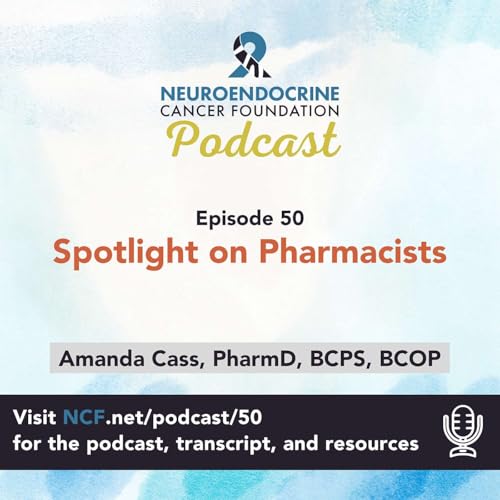
  • "Spotlight on Pharmacists" with Amanda Cass, PharmD, BCPS, BCOP
    Nov 28 2025

    ABOUT THIS EPISODE

    Who is a pharmacist, and how are they involved in the care of neuroendocrine cancer patients? In this episode, Dr. Amanda Cass, a clinical pharmacist in the Thoracic Oncology Clinic at Vanderbilt Medical Center, explains the unique role pharmacists play—why they’re sometimes called “doctor,” how they support patients starting treatments such as cabozantinib and CAPTEM, and practical tips for staying organized, managing side effects, and navigating medication costs.


    TOP TEN QUESTIONS

    Getting to Know the Pharmacist

    1. What exactly does a pharmacist do, and what training do they go through?

    2. Why are pharmacists sometimes called “doctor,” and how is that different from a physician?

    3. What role does a pharmacist play on the cancer care team?

    4. How are pharmacists involved in caring for neuroendocrine cancer patients, both directly and behind the scenes?

    How Pharmacists Support Treatment

    5. How can a pharmacist help when someone is starting a new treatment for neuroendocrine cancer? Walk us through an example with Cabozantinib: how do you guide patients in understanding it, taking it, and managing side effects?

    6. Walk us through another example with CAPTEM (capecitabine and temozolomide): how do you guide patients in understanding it, taking it, and managing side effects?

    Practical Tips for Patients

    7. What are some simple ways to stay organized, like keeping a medication list or symptom journal?

    8. What practical tips do you share with patients about tracking and managing side effects at home?

    Access and Communication

    9. Who can patients talk to about medication costs or financial assistance?

    10. How does someone find a pharmacist to talk to, and is it important to find one with neuroendocrine cancer experience?


    ABOUT AMANDA CASS

    Dr. Cass is a clinical pharmacist in the Thoracic Oncology Clinic at Vanderbilt University Medical Center. She received her Doctorate of Pharmacy from the University of Kentucky College of Pharmacy in 2016 and subsequently completed her Pharmacy Practice Residency at Grady Health System and became a Board Certified Pharmacotherapy Specialist in 2017. In 2018, she completed her Oncology Pharmacy Residency at the University of North Carolina Medical Center.

    Dr. Cass's previous research interests included opioid use in non-metastatic cancer patients after curative treatment and albumin effects on oxaliplatin related toxicities. Her current areas of interest are molecular mutations and use of targeted therapies in NSCLC, immunotherapy in SCLC, and global oncology care.

    Dr. Cass is the preceptor for the Outpatient Thoracic Oncology Rotation.

    For more information, visit NCF.net/podcast/50

    For more information, visit NCF.net.

    Más Menos
    55 m
  • "Understanding Carcinoid Syndrome & GLP-1 Drugs in Neuroendocrine Tumors" with Dr. Joseph Dillon
    Nov 22 2025

    ABOUT THIS EPISODE

    Carcinoid syndrome can be confusing and often difficult to diagnose. In this episode, Dr. Joseph Dillon, Endocrinologist and Director of the University of Iowa Neuroendocrine Multidisciplinary Tumor Clinic, explains what carcinoid syndrome is, how it’s diagnosed, and the various ways it can be treated. He highlights key symptoms, testing, and treatment approaches—including somatostatin analogs and telotristat—and discusses how to distinguish carcinoid syndrome from other causes of diarrhea and flushing.

    In the second half of the episode, Dr. Dillon shares insights from his separate line of research on GLP-1 receptor agonist weight-loss drugs (such as Ozempic® and Mounjaro®) and their potential implications for neuroendocrine tumor patients. (Note: this topic is unrelated to carcinoid syndrome.)

    TOP TEN QUESTIONS

    1. What is carcinoid syndrome?
    2. Who is affected by carcinoid syndrome? How does someone know if they have carcinoid syndrome?
    3. What are the tests for carcinoid syndrome? How is carcinoid syndrome distinguished from other causes of my symptoms? *Could the tests be negative, but someone can still have carcinoid syndrome?
    4. Can someone have no evidence of neuroendocrine tumors and still have carcinoid syndrome?
    5. For those who have carcinoid syndrome, what additional tests should they have?
    6. Why should carcinoid syndrome be treated? What are the possible issues if it is not treated?
    7. How is carcinoid syndrome treated? *What is on the horizon for carcinoid syndrome treatment?
    8. Can carcinoid syndrome be prevented or detected early?
    9. Is there anything people can do to prevent or lessen carcinoid syndrome symptoms? Are there any factors that worsen carcinoid syndrome, such as age, weight or other diseases?
    10. You recently published a study discussing the possible risks of using certain weight loss drugs in people with neuroendocrine cancer. Could you tell us more about this study? What was the drug, and what did you find? What does it mean? What do you want the NET patient community to understand about your recent findings?

    ABOUT DR. JOSEPH DILLON

    Dr. Dillon is a Professor of Medicine in the Division of Endocrinology at the University of Iowa Hospitals and Clinics. He directs the University of Iowa Neuroendocrine Multidisciplinary Tumor Clinic. This was the first and only US NET Clinic to be recognized as a Center of Excellence by the European NET Society. He is also the Director of the PheoPara Alliance Center of Excellence at University of Iowa. His clinical practice is entirely focused on the care of people with neuroendocrine tumors, both carcinoid type and paraganglioma. He has participated in clinical trials and publications related to diagnostic and therapeutic nuclear agents and drug therapies in this population. Prior to focusing on NET he made important discoveries in the field of GLP-1 which are now becoming of importance to NET patients taking popular weight loss drugs.

    For more information, visit NCF.net/podcast/49

    For more information, visit NCF.net.

    Más Menos
    1 h y 9 m
  • "NEN Treatments: Focus On DLL3" with Dr. Rohit Thummalapalli
    Oct 6 2025

    ABOUT THIS EPISODE

    DLL3 is emerging as a promising new target for neuroendocrine cancers. In this episode, Dr. Rohit Thummalapalli, medical oncologist at Memorial Sloan Kettering Cancer Center, explains what DLL3 is, how it works, who might benefit, and what current clinical trials are teaching us. He breaks down the science, treatment options, and future directions in a way that is clear, approachable, and designed to help patients and families better understand this developing area of care.

    TOP TEN QUESTIONS

    Understanding the Basics

    1. What is immunotherapy? How does immunotherapy work?

    2. What is DLL3? How does it work in the context of neuroendocrine cancer?

    3. How is DLL-targeted therapy similar to or different from other types of immunotherapy? Is there evidence that one works better than another?

    Indications, Use, Access & Availability

    4. When is DLL3 used in neuroendocrine cancers?

    • What types of neuroendocrine cancer might express DLL3?
    • How does someone know if this is a potential treatment option for them?
    • At what point in a patient’s treatment journey might DLL3 be considered?
    • How and where DLL3 is available for neuroendocrine cancer patients? What are other ways, if any, to access DLL3?

    Testing for DLL3 Expression

    5. How does someone find out if their tumors express DLL3 receptors?

    • How & where is DLL3 expression tested? It it tested through tissue samples, imaging, or something else?
    • Is there a minimal level of DLL3 expression that is required to receive the treatment? (Does the threshold vary by trial?)
    • Does the level of DLL3 expression differ by institution?
    • Does the level of DLL3 expression predict how well someone might respond to treatment?
    • Can the tumor expression of DLL3 vary from tumor to tumor? Can it vary over time, meaning can tumors gain or lose expression?
    • Do you measure the DLL3 expression following treatment?

    Treatment Considerations

    6. How effective is DLL3-targeted therapy in neuroendocrine cancers? What is the goal of treatment with DLL3 – shrinkage, stabilization, symptom relief? How long is it expected to work? How do you measure the response to DLL3 treatment?

    7. Can DLL3 be combined with other therapies?

    Decision-Making and Patient Counseling

    8. How do you decide when to offer DLL3 for someone with neuroendocrine cancer?

    • What factors or prior treatments might make someone ineligible for DLL3 therapy?
    • Could receiving DLL3 exclude a patient from other treatments or clinical trials?

    9. How do you counsel patients who are considering DLL3?

    • What should they know about how the treatment is given, possible side effects, and what’s known (or unknown) about long-term safety?
    • What should one expect in terms of frequency of visits, hospitalization and side effects?
    • Can someone still work while receiving DLL3?

    Looking Ahead

    10. What are the key questions you hope to answer about DLL3 in the next year? What do you hope to learn over the next 3 to 5 years?

    ABOUT DR. ROHIT THUMMALAPALLI

    Rohit Thummalapalli is a gastrointestinal medical oncologist and assistant attending physician at Memorial Sloan Kettering Cancer Center specializing in clinical care and research in patients with neuroendocrine and biliary tract cancers. Originally from Florida, Dr. Thummalapalli completed medical training at Harvard and Johns Hopkins before arriving at MSK as a medical oncology fellow in 2021, and started on faculty in 2024.

    For more information, visit https://www.ncf.net/podcast/48

    For more information, visit NCF.net.

    Más Menos
    56 m
  • "Spotlight on Endocrinology" with Dr. Run Yu
    Oct 6 2025

    ABOUT THIS EPISODE

    Every provider on a multidisciplinary neuroendocrine cancer (NET) team brings a distinct and valuable perspective. In this episode, UCLA endocrinologist Dr. Run Yu sheds light on the unique role of the endocrinologist. He explains what endocrinology is, which types of NETs may require an endocrinologist's care, and how endocrine issues intersect with NET management. Dr. Yu also explores the “endocrine” side of neuroendocrine—discussing key concerns related to diabetes, thyroid, parathyroid, and adrenals.

    TOP TEN QUESTIONS

    1. What is an endocrinologist? What training is involved?

    2. Since there is “endocrine” in neuroendocrine, would NET patients need to see an endocrinologist? When should one see an endocrinologist?

    • What is your role with your medical team?
    • How is an endocrinologist different from a medical oncologist?
    • If someone with neuroendocrine cancer needs to see an endocrinologist, does that person need to specialize in neuroendocrine cancer?

    3. If someone sees both an endocrinologist and a medical oncologist, what do you do and what does the medical oncologist do? How are treatment decisions made or coordinated? (Who is the “quarterback?”)

    4. Who orders the somatostatin injections? Are they done through the oncologist or endocrinologist? What if I need something else to control my neuroendocrine cancer symptoms?

    5. What are hormonal issues? How do I know if my neuroendocrine tumor produces hormones?

    6. What hormone tests do you check?

    7. What tumor markers do you check? How do you interpret them?

    8. When might endocrine issues arise with neuroendocrine cancer?

    • Thyroid
    • Parathyroid
    • Adrenal

    9. How do hyperglycemia and diabetes issues relate to neuroendocrine cancer?

    • What is hyperglycemia, pre-diabetes and diabetes?
    • Is diabetes inevitable with NET?
    • Is diabetes inevitable with somatostatin analogue therapy?
    • Does metformin potentially slow down NET tumor growth?
    • What monitoring do you recommend?

    10. When does one encounter hypoglycemia with neuroendocrine cancer?

    • What is insulinoma? What is the treatment?

    BONUS: What is on the horizon for neuroendocrine cancer that you’re most optimistic about?

    ABOUT DR. RUN YU

    Run Yu, MD, PhD, received his MD degree from Peking Union Medical College in Beijing and his PhD degree in pharmacology from the University of Rochester in New York. Dr. Yu completed an endocrine research fellowship, an internal medicine residency, and a clinical endocrinology fellowship at Cedars-Sinai Medical Center.

    Dr. Yu’s clinical and research interests include diabetes, thyroid, and endocrine tumors and syndromes.

    Dr. Yu enjoys describing novel clinical findings in endocrinology.

    For more information, visit https://www.ncf.net/podcast/47

    For more information, visit NCF.net.

    Más Menos
    59 m
  • "Spotlight on Advanced Practice Providers (NPs & PAs)" with Tiffany Valone
    Jul 19 2025

    ABOUT THIS EPISODE

    Neuroendocrine cancer care typically involves a multidisciplinary team which sometimes involves an Advanced Practice Provider (APP). In this episode, Moffitt Physician Assistant Tiffany Valone clarifies the role of an APP in neuroendocrine cancer.

    TOP TEN QUESTIONS

    1. What is a NP/PA/APP? -Are you a doctor? How are you different from or similar to a doctor? - How is your role similar to or different from a nurse practitioner?
    2. How did you enter the neuroendocrine cancer or NET world? How did you learn about neuroendocrine cancer? Could you be considered a NET expert?
    3. What is your role in the neuroendocrine cancer world? What is your role with your medical team?
    4. If I go to your institution to see a neuroendocrine cancer expert, how is it determined which provider I will see?
    5. If I see you (or another NP/PA), would I also see a doctor? If yes, when/how? If not, why/why not and how does this work? What does a “team approach” mean?
    6. Who goes over scan results? Is this something you can do?
    7. Who orders my scans and treatments?
    8. If I have a question or concern, who do I communicate with and what’s the best way to communicate?
    9. How are your recommendations communicated with someone’s local oncologist?
    10. What advice do you have for patients when they receive differing opinions?

    *Bonus: How do you continue to learn and keep up to date with neuroendocrine cancer? What recommendations would you have for patients who would like to encourage their local oncologists or APPs to learn about neuroendocrine cancer?

    ABOUT TIFFANY VALONE

    Tiffany Valone is a Physician Assistant and Manager of the GI and Senior Adult Advanced Practice Providers at Moffitt Cancer Center in Tampa, FL. She started her career at Moffitt in 2006 in GI medical oncology focusing on treating patients with colorectal and pancreaticobiliary cancers. A few years into her career she joined Dr. Jonathan Strosberg to help with his growing neuroendocrine practice. For the past 16 years she has been an integral provider within this multidisciplinary team. She was awarded Moffitt’s Advanced Practice Provider of the Year in 2012 and the North American Neuroendocrine Tumor Society’s AHP/APP of the Year in 2024. She is also a member of Moffitt's APP Professional Clinical Ladder Executive Committee and spearheads Moffitt’s APP Grand Rounds lecture series. She has a passion for teaching and mentoring new providers in the NET field. She has given presentations on NETs and other GI malignancies at both state and national conferences. In her spare time, she enjoys traveling with her husband and three children or relaxing at the beach.

    For more information, visit https://www.ncf.net/podcast/46

    For more information, visit NCF.net.

    Más Menos
    38 m