Episodios

  • Why India’s Energy Transition Is a States Story | ft. Neelima Jain
    Apr 2 2026

    As India’s energy transition accelerates, much of the real momentum is happening at the state level, where policy meets implementation. From electricity markets and regulatory design to industrial decarbonization and green growth, states sit at the center of how policy translates into action. But what does it take to drive large scale change within these systems?

    We present a special series exploring the changes shaping state-level transitions. How can incentives be aligned across institutions, political and economic realities managed, and programs designed to be both ambitious and implementable? And as clean energy becomes increasingly cost competitive, what is shaping the choices states make today?

    For the first part of the series, we spoke with Neelima Jain, Director of Industrial and Trade Policy at the India Energy and Climate Center at UC Berkeley. With experience spanning consulting, government, and global think tanks, she has played a key role in shaping and implementing some of India’s most significant energy efficiency and transition efforts, including scaling up UJALA and advancing international energy cooperation.


    Full transcript of the episode is available in English

    Presented by 101Reporters

    Neelima Jain is on LinkedIn and Twitter.

    Follow TIEH podcast on Twitter, Linkedin & YouTube

    Our hosts, Shreya Jai on Twitter, Linkedin & Dr. Sandeep Pai on Twitter, Linkedin

    Más Menos
    58 m
  • Risks to Rewards: Tale of building an RE company in India | ft. Parag Sharma
    Mar 18 2026

    What does it take to build companies from the ground in a novel sector in India?

    In this conversation, Parag Sharma, Chief Executive Officer at Resolven (formerly Zelestra), reflects on a three-decade journey from growing up in a thermal power plant campus to building gigawatt-scale renewable businesses.

    Drawing from his experience across engineering, consulting, and entrepreneurship, he explains how India’s renewable energy market matured into one of the world’s largest investment destinations. The discussion explores the forces shaping the sector today, from global investor confidence and competitive bidding to the evolving balance between solar, wind, and battery storage.

    As India races toward ambitious clean energy targets, the conversation also looks ahead: what will define the next generation of renewable companies? From disciplined bidding and smart project development to hybrid energy solutions and emerging opportunities in green hydrogen, data centers, and AI-driven energy demand.

    Mr. Sharma is the former Founder and CEO of O2 Power, previously served as COO at ReNew Power, and currently holds leadership roles as President of the Wind Independent Power Producers Association (WIPPA) and Chairperson of the Confederation of Indian Industry (CII), Northern Region.


    Full transcript of the episode is available in English.

    Presented by 101Reporters

    Parag Sharma is on LinkedIn

    Follow TIEH podcast on Twitter, Linkedin & YouTube

    Our hosts, Shreya Jai on Twitter, Linkedin & Dr. Sandeep Pai on Twitter, Linkedin

    Más Menos
    40 m
  • Fact Finders in the era of Global Disorder and Climate Crisis | ft. Mitali Mukherjee
    Mar 5 2026
    At a time when wars dominate headlines, climate disasters intensify, and newsrooms themselves face funding cuts and political pressure , who tells the story, and how, matters more than ever.In a conversation that is both personal and structural, we spoke with Ms. Mitali Mukherjee, Director, Reuters Institute for the Study of Journalism, UK. Having led a distinguished career as a business journalist, and now heading one of the world’s leading centres for journalism research and policy engagement, she brings both newsroom experience and a global institutional perspective to the discussion. Drawing from her experience in India’s broadcast media landscape to the structural shifts reshaping academic and research institutions worldwide, she reflects on what it means to report and research in an era defined by disruption.This conversation looks beyond the daily news cycle to understand the structural forces shaping journalism today. From social defunding and the changing business models of media to the difficulty of sustaining consistent, in-depth climate reporting in an increasingly saturated media environment, we discuss what it takes to support independent journalism and research in uncertain times, and why it continues to matter. Further Reading:• Reuters Institute for the Study of Journalism's Climate Change and News Audiences Report 2025 • Climate related projects from our journalist fellows• Samuel Thomas and his project on the farmer herder crisis • Niko Efstathiou and his project on wildfires and misinformation • A paper jointly worked on with Dr Anthony Feinstein on the stress and distress faced by climate change journalists • Details about Mitali’s book Crypto Crimes: Inside India's Best-Kept Secret • The Digital News Report Full transcript of the episode is available in English.Presented by 101ReportersMitali Mukherjee is on LinkedIn.Follow TIEH podcast on Twitter, Linkedin & YouTubeOur hosts, Shreya Jai on Twitter, Linkedin & Dr. Sandeep Pai on Twitter, Linkedin
    Más Menos
    54 m
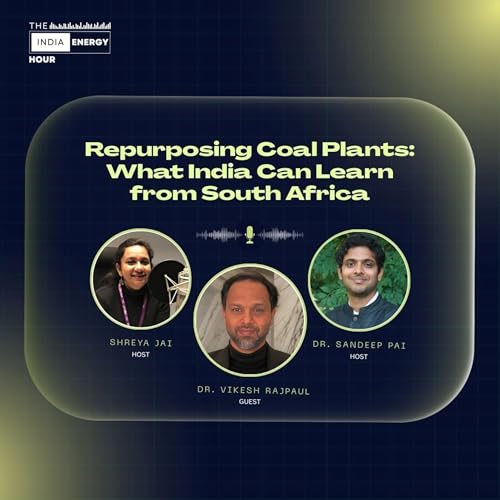
  • Repurposing Coal Plants: What India Can Learn from South Africa | ft. Dr. Vikesh Rajpaul
    Feb 12 2026

    The repurposing of coal power plants is an underexplored challenge as many countries, including India, strive to achieve net-zero targets. Some countries in the Global South, such as South Africa, have more experience with coal power plant repurposing than India.

    To understand what Indian coal-fired power plant owners can learn from the South African experience, we interviewed Dr. Vikesh Rajpaul, General Manager, Just Transitions at Eskom Holdings SOC Limited. With over three decades of experience at Eskom—the largest supplier of electricity in South Africa—Dr. Rajpaul has worked across a wide range of functions, including renewables and research.

    Full transcript of the episode is available in English.

    Presented by 101Reporters

    Dr. Vikesh Rajpaul is on LinkedIn.

    Follow TIEH podcast on Twitter, Linkedin & YouTube

    Our hosts, Shreya Jai on Twitter, Linkedin & Dr. Sandeep Pai on Twitter, Linkedin

    Más Menos
    51 m
  • What 2026 holds for India's Energy Transition | ft. Richa Mishra
    Jan 29 2026

    India’s energy economy has started 2026 on both a chaotic and a promising note. Last year’s storms of trade wars and the disarray of the country’s energy supply chain have spilled into this year as well. But 2025 was also the year India crossed the threshold of 50 per cent non-fossil fuel power generation capacity and took promising steps in nuclear energy. This year has commenced with policy shifts in the long languishing power distribution sector and trade deals with focus on sustainable development.

    To guide through this maze of varied developments which would impact India’s energy transition and security, we spoke with Richa Mishra, seasoned energy journalist and author. Ms Mishra has been writing on the energy sector for more than two decades and has first-hand witnessed the evolution of India’s energy sector and has covered notable milestones in her journalistic journey.

    She is currently Resident Editor at Hindu Business Line. Ms Mishra also runs a podcast called Energonomics where she unpacks the developments of the oil and gas sector. Her first book Unfilled Barrels: India’s oil story published in 2022 offers a ringside view of India’s oil and gas sector from past to present.

    Author page of Richa Mishra: https://www.thehindubusinessline.com/profile/author/richa-mishra-10928/

    Energonomics podcast by Richa Mishra: https://youtube.com/playlist?list=PL0y1IAo9tjT5TiZmuziacoYWd8rjX6dde&si=SzrnSAEKYRy7n2dF

    Unfilled Barrels: India's Oil story: https://www.bloomsbury.com/in/unfilled-barrels-9789354350283/


    Full transcript of the episode is available in English.

    Presented by 101Reporters

    Follow TIEH podcast on Twitter, Linkedin & YouTube

    Our hosts, Shreya Jai on Twitter, Linkedin & Dr. Sandeep Pai on Twitter, Linkedin

    Más Menos
    44 m
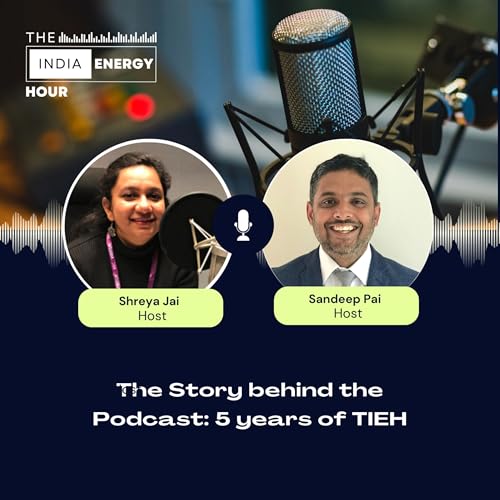
  • The Story behind the Podcast: 5 years of TIEH
    Dec 26 2025

    As The India Energy Hour completes five years, the hosts come together for a special recap episode reflecting on how the podcast began and how it has evolved alongside India’s energy transition. From the early motivation behind starting the show to the moments that shaped its direction, this episode revisits key milestones from the last five years.

    The hosts discuss some of the most impactful episodes and conversations, memorable guests, and how listener engagement has influenced the podcast’s journey. The episode also looks ahead to what listeners can expect in the coming year—from new themes to deeper dives into India’s evolving energy and climate trends.

    A full transcript of the episode is available in English.

    Presented by 101Reporters

    Follow TIEH podcast on Twitter, Linkedin & YouTube

    Our hosts, Shreya Jai on Twitter, Linkedin & Dr. Sandeep Pai on Twitter, Linkedin

    Más Menos
    33 m
  • How Climate Proof are Indian States? | ft. Abinash Mohanty
    Dec 12 2025

    As climate risks intensify across India, state governments are emerging as critical drivers of climate action, adaptation, and energy transition. In this episode of The India Energy Hour, we explore how states can plan, finance, and implement climate action on the ground. While several state-specific models are in the works, New Delhi–based IPE Global recently unveiled a one-stop Climate Readiness Index for states. This index, which relies on tech-based tools and modelling, aims to provide authoritative guidance to states for building their climate action plans.

    In this episode, we speak with Abinash Mohanty, Global Sector Head – Climate Change and Sustainability at IPE Global, to understand why such an index is needed, which states face the most urgent risks, and how sub-national plans shape India’s net-zero pathway. Mohanty has nearly two decades of experience working across government, development finance, and policy research.

    Full transcript of the episode is available in English.

    Presented by 101Reporters

    Abinash Mohanty is on LinkedIn and Twitter.

    Follow TIEH podcast on Twitter, Linkedin & YouTube

    Our hosts, Shreya Jai on Twitter, Linkedin & Dr. Sandeep Pai on Twitter, Linkedin

    Más Menos
    37 m
  • Pathways to Round the Clock RE in India | ft. Irfan Mohamed
    Nov 26 2025

    Having committed to the ambitious target net zero by 2070 and 50 per cent energy from green sources, India would need transition planning across sectors. The most important planning would be in the electricity sector which would need to decarbonise faster than any other sector. This transition would depend on India's ability to produce round-the-clock clean energy, or 24/7 carbon free energy (24/7 CFE), at cost and scale to meet the country’s rapid economic development. But it faces the challenge of grid management and conducive energy planning which would integrate renewable energy across the power systems of the country.

    To understand one such model of 24/7 CFE, we spoke with Irfan Mohamed, South Asia Analyst at climate analytics nonprofit TransitionZero to delve into the concept of 24/7 CFE and why, according to TransitionZero’s modelling, 24/7 CFE planning and procurement is a ‘no regrets’ option for India’s energy planners, grid operators, and corporates. Irfan is an energy modeller and analyst with multiple years of experience in modelling electricity markets. Before joining TransitionZero, Irfan worked at the Department for Energy Security and Net Zero developing decarbonisation policies for the UK.

    Full transcript of the episode is available in English.

    Presented by 101Reporters

    Irfan Mohamed is on LinkedIn.

    Follow TIEH podcast on Twitter, Linkedin & YouTube

    Our hosts, Shreya Jai on Twitter, Linkedin & Dr. Sandeep Pai on Twitter, Linkedin

    Más Menos
    44 m