Episodios

  • Episode 282 - James Hamilton on FBI Close Protection, and Practical Executive Protection Training
    Apr 1 2026

    In this episode, host Mark Ledlow is joined by James Hamilton, a former sheriff’s deputy and FBI special agent who spent 18 years with the Bureau, served on SWAT and the Joint Terrorism Task Force, and was selected in 2004 for the FBI Director’s protective detail under Director Mueller. Hamilton later became a Quantico tactical instructor and created a 10-day protection school used by agencies including NSA and CIA. Influenced by Gavin de Becker’s books The Gift of Fear and Just Two Seconds, he joined de Becker’s firm and now serves as Senior Vice President overseeing quality, licensing, training, and equipment for roughly 650 protectors. He emphasizes fundamentals over firearms-heavy training, focusing on time/distance, evacuation, interpersonal skills, professional presentation, and robust medical training (CPR/AED, first aid, TCCC, quarterly refreshers). The discussion also covers liability insurance, 1099 work concerns, California self-defense standards, confidentiality and social media risks, and how 2020 unrest and police defunding may increase demand for private security.


    Learn about all this and more in this episode of The Fearless Mindset Podcast.


    KEY TAKEAWAYS

    • Medical skills over firearms: EP professionals use medical kits 60 times per quarter vs. rarely drawing weapons - invest in comprehensive medical training (CPR, AED, TCCC, trauma care)
    • Two seconds principle: Research shows ~2 seconds between moment of commitment and moment of recognition in attacks - understanding time and distance is critical
    • Cover and evacuate: Default response should be protecting the principal and evacuation, not engaging threats or "getting drawn out" into crowds
    • Professional presentation matters: CEOs notice quality - invest in interpersonal skills, nice clothes, polished shoes, and personal fitness
    • No preemptive shootings in US EP history: Study of 1400+ attacks shows no documented case where US close protection stopped an attack preemptively with firearms
    • Insurance is non-negotiable: Operating without professional liability insurance in 2020's legal climate is reckless - you're judged by civilian defensive standards, not law enforcement
    • Confidentiality kills careers: Social media selfies and public disclosures destroy the trust-based protector-client relationship
    • Position over firepower: Most attacks fail because protectors are out of position, not under-armed - distance and proximity matter more than weaponry

    QUOTES

    • "There's about two seconds between the moment of commitment when the assailant commits to the act...and the moment of recognition, that's when the protected person or the protectors get their head around what's happening."
    • "We have 650 some odd bodyguards and we routinely go into our medical bags 60 times a quarter...and we're rarely drawing weapons."
    • "If you can only do one, go to the principal. If you go out into the crowd...it's one to three, one to four, one to five, you could get drawn out into something and you lose sight of the principle."
    • "I do not believe that bodyguards or protectors wake up in the morning and say, 'Hey, I wanna fail today.' Maybe they haven't been properly trained. Maybe they're mentally not prepared."
    • "They always say that. They're like, man, I couldn't get there fast enough. I saw it happening."
    • "The protectee protector relationship is based on trust. You can't really buy it. You gotta earn it, and you definitely don't earn it by blabbing your mouth."
    • "These folks that hire us are discerning people. They know quality, they understand professionalism. And they don't suffer fools."
    • "This isn't the government. They will fire you tomorrow. There's no union protection in the EP industry."

    Get to know more about James Hamilton through the link/s below.

    https://www.linkedin.com/in/james-hamilton-752894104/


    To hear more episodes of The Fearless Mindset podcast, you can go to https://the-fearless-mindset.simplecast.com/ or listen on major podcasting platforms such as Apple, Google Podcasts, Spotify, etc. You can also subscribe to the Fearless Mindset YouTube Channel to watch episodes on video.

    Más Menos
    31 m
  • Episode 281 - Hiring, Remote Work, and Leadership Principles with Scott Thomas Ware
    Mar 24 2026

    In this episode, host Mark Ledlow is joined by Scott Ware, a senior recruiter at Amazon and former Microsoft recruiter who supported 11 Xbox organizations, about transitioning to Amazon just before COVID-19 sent employees remote and extended work-from-home into January. Ware explains Amazon’s leadership culture, his role hiring product leaders across about 15 consumer organizations, and notes large-scale hiring during COVID-19 (including tens of thousands of warehouse, delivery, and corporate roles) alongside smaller contractor adjustments such as DDSP layoffs. They discuss remote onboarding, productivity gains, and work-life balance. Ware shares hiring advice and red flags (resume/LinkedIn mismatches, frequent job hopping, overly long resumes), explains degree requirements versus equivalent experience and certifications, outlines the interview process (phone screens plus a five-interviewer loop), and emphasizes preparing with Amazon’s 14 leadership principles, especially customer obsession.


    Learn about all this and more in this episode of The Fearless Mindset Podcast.


    KEY TAKEAWAYS

    • Amazon hired 175,000+ new positions in 2020 (75,000 + 100,000), making them one of the largest employers during COVID-19
    • Remote work has increased productivity - eliminating commute time allows better work-life balance and mental space
    • Certifications matter as much as degrees - Microsoft certifications, Udemy courses, and equivalent experience can substitute for bachelor's degrees
    • Interview prep is critical - Amazon's full loop includes 5 one-hour interviews testing 14 leadership principles
    • Customer obsession drives success - prioritizing customer needs over profits creates long-term sustainability
    • Career consistency beats job hopping - stay 2+ years to prove yourself before moving
    • Keep resumes concise (2-4 pages max) with data points, not paragraphs
    • 2020 is a year of forced change - use disruption to expand interests, develop talents, and eliminate distractions


    QUOTES

    • "If you can do right by who your customer is... you don't make a profit unless you do right by the customer."
    • "Do more for others than they can do for themselves." - Zig Ziglar quote (adopted by Scott)
    • "The best time to start a new business is right after a market crash." - Robert Kiyosaki
    • "2020 is a year of forced change... when you take a step back... you're being forced to change and learn new things - that's good."
    • "High tide raises all ships."
    • "The biggest leaders are the biggest servers of all."
    • "It was never necessarily about making money. It was about doing right by the customer." - Jeff Bezos philosophy


    Get to know more about Scott Thomas Ware through the link/s below.

    https://www.linkedin.com/in/scott%E2%98%81ware/


    To hear more episodes of The Fearless Mindset podcast, you can go to https://the-fearless-mindset.simplecast.com/ or listen on major podcasting platforms such as Apple, Google Podcasts, Spotify, etc. You can also subscribe to the Fearless Mindset YouTube Channel to watch episodes on video.

    Más Menos
    36 m
  • Episode 280 - From Marine Security Platoon to Training Civilians and Executive Protection Teams with Robert Lamm
    Mar 10 2026

    In this episode, host Mark Ledlow is joined by Robert Lamm, a Montana rancher, Marine veteran, and security professional they met on a confidential Northern California disaster project. Robert recounts joining the Marine Corps in 1999, deploying with 2/1 and a special-operations-capable unit, then serving in a security platoon supporting special operations across Southeast Asia, Afghanistan, and Iraq. After leaving the Marines, he guided hunts, then entered State Department contracting with Blackwater and Triple Canopy, later working nearly 10 years in Afghanistan, including base security, threat assessments, and training local nationals; he describes attacks, a VBIED blast injury, and concerns about TBI. He discusses executive protection work, industry backstabbing, and the importance of networking and teamwork. Now lead instructor at Tactic MT and director of training for Veterans Covert Protection Group, he focuses on mindset, firearms safety, soft skills, and raising security standards amid COVID, unrest, and ammo shortages.


    Learn about all this and more in this episode of The Fearless Mindset Podcast.


    KEY TAKEAWAYS

    • Security industry success depends on networking and consistent performance - every detail is an interview
    • Teamwork and supporting colleagues during difficult times is essential in high-stress environments
    • Mindset determines survival - refusing to "go quietly" and maintaining mental resilience is critical
    • The security industry needs to evolve beyond 1980s-90s standards with better training and professionalism
    • Training should cover both hard skills (firearms) and soft skills (communication, medical, client service)
    • Families and clients increasingly want consistency in security personnel rather than constant turnover
    • Americans need to take personal responsibility for their safety and not rely solely on authorities
    • Living each day as if it's your last is both a strength and challenge for veterans transitioning to civilian life
    • Real security training must include mindset preparation, not just technical skills
    • Unity and helping each other matters more than political divisions

    QUOTES

    • "You're only as good as your last detail" - on reputation in executive protection
    • "Your network is your net worth in this industry"
    • "Every firearm made is to kill another person easier than they can kill you" - on honest mindset training
    • "One mind, any weapon" - Marine Corps philosophy on adaptability
    • "If any politician's mouth is moving, he's lying"
    • "It boils down to your team - that's what you're really there for"
    • "We've gone from love to hate" - on social media and division
    • "I'm not gonna go quietly" - on survival mindset
    • "If you don't have the mindset, all you're doing is learning to sport shoot"
    • "We're social creatures - they're playing us from both sides"


    Get to know more about Robert Lamm through the links below.

    https://www.linkedin.com/in/eddiegarciava/


    To hear more episodes of The Fearless Mindset podcast, you can go to https://the-fearless-mindset.simplecast.com/ or listen on major podcasting platforms such as Apple, Google Podcasts, Spotify, etc. You can also subscribe to the Fearless Mindset YouTube Channel to watch episodes on video.

    Más Menos
    43 m
  • Episode 279 - Transitioning into Private Security, Networking, and Leading the Next Generation with Ken Carrasco
    Feb 24 2026
    In this episode, Mark Ledlow joins Ken Carrasco’s podcast, Fortify Your Future, to discuss handling adversity and building a fearless career in corporate and physical security. Mark offers actionable value by inviting listeners to DM him on LinkedIn for guidance on transitioning into the industry and emphasizes that relationships and back-channel networking often open doors more than resumes. He recounts his own military-to-private-sector transition, including moving from Oregon to Southern California, spending 6–12 months obtaining California licensing (guard card, exposed permit, CCW), adjusting professional presentation, and building connections through coffees and lunches. He credits “knowing somebody who knew somebody” for landing his first job with Pinkerton and stresses that in security, each day on the job is an interview and work can be ad hoc. He advises those transitioning to start licensing early, network aggressively, and vet associations carefully due to unscrupulous characters and reputational risk. They discuss the importance of in-person conferences to validate relationships and build trust, with Mark recommending groups and events such as IPSB, the Close Protection Conference (noting it is volunteer-run/nonprofit), Silicon Valley Security Group, ASIS/GSX (including executive protection standardization efforts), and EP Access mixers. Mark encourages young professionals to invest in themselves, present professionally, ask for lunches or dinners (and offer to pay), seek out the smartest people, accept constructive criticism, and remember everyone is replaceable. The conversation shifts to “next gen” workforce challenges: differing communication styles (texting over calls/email), expectations around work-life balance, rapid recognition, and job-hopping. Ken argues leaders should be more participatory in career development rather than expecting conformity. Mark says leaders should ask what motivates each person, understand their family and psychological context, and build trust through genuine care; he describes using profit sharing and small gestures (e.g., upgrading travel) to support his team while noting loyalty cannot be bought. They address social media as unavoidable and platform-specific, with LinkedIn described as most reliable but requiring careful vetting; Mark notes clients research companies online and form opinions from posted content, and both highlight the growing impact of AI and the importance of authenticity and face-to-face connection. Looking ahead to 2026, Mark outlines Ludlow Security’s strategic focus amid elections, geopolitics, and major events (Super Bowl in San Francisco, World Cup, Olympics). He describes increasing international relationships, supporting travel teams, expanding residential security and site security, providing risk/threat assessments, and launching a chauffeur driving course with Texas-based training (including FBO/tarmac simulations). He mentions interest in guard work opportunities in Texas (e.g., construction), growing work with family offices, private equity, and law firms, and expanding licensing to the East Coast. Mark also shares a personal impact story of a former team member crediting a job opportunity with saving his life, reinforcing his motivation to support veterans and law enforcement amid post-COVID mental health struggles. The episode closes with mutual appreciation and a shared emphasis on adding value and lifting the industry through community and digital media.Learn about all this and more in this episode of The Fearless Mindset Podcast.KEY TAKEAWAYSNetworking is essential - Success in the security industry depends heavily on relationships and who you know, not just submitting resumes onlinePlan your transition early - Allow 6-12 months to obtain proper licensing, permits, and certifications when transitioning from military/law enforcement to private sectorAttend industry conferences - Face-to-face interactions at events like IPSB, Close Protection Conference, and ASIS GSX are crucial for vetting relationships and building trustInvest in personal growth - Young professionals must focus on self-improvement, ask questions, and surround themselves with people who challenge themUnderstand next-gen motivations - Leaders need to discover what drives their team members and help them achieve their goals to build loyaltyEach day is an interview - The security industry requires proving yourself daily; no one is irreplaceableSocial media requires strategy - Use platforms purposefully and professionally; LinkedIn is the primary business networking toolBuild authentic relationships - In an age of AI and superficiality, face-to-face authenticity and trust-building are more critical than everQUOTES"You're replaceable. Even Mark Ledlow is replaceable. You're not all that in a bag of chips.""If I can help my teammates get what they want, they'll help me get what I want. It's a symbiotic relationship.""You cannot buy loyalty. ...
    Más Menos
    36 m
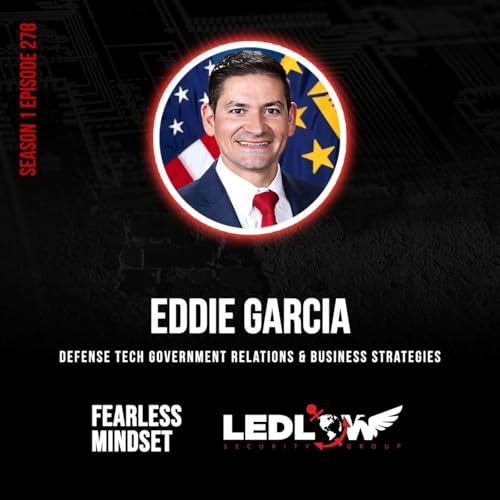
  • Episode 278 - Navigating Geopolitics and Defense Strategies with Eddie Garcia
    Feb 10 2026

    In this episode, host Mark Ledlow and Eddie Garcia, a 22-year Army veteran and former Airborne Ranger, who has extensive experience in special operations and policy work on Capitol Hill, discuss the complexities of the military-industrial complex, recent geopolitical dynamics, the economic strategies behind military spending, and the evolving role of technology in defense. Eddie provides valuable insights into the importance of understanding political environments, the role of lobbyists, and practical advice for veterans transitioning to civilian careers. This episode offers listeners a deep dive into the strategic maneuvers in global politics and the business strategies that support national defense.

    Learn about all this and more in this episode of The Fearless Mindset Podcast.

    KEY TAKEAWAYS

    • It's about money, not war - Countries compete economically, not militarily. The U.S. is winning by making smart business moves
    • Defense spending prevents war - Investing in military now helps avoid World War III later
    • China plays the long game - They've been buying ports and influence worldwide for 20 years. The U.S. is now doing the same
    • Small businesses can win big in defense - Huge opportunities exist, but you need the right connections in Washington DC
    • Relationships beat technology - In DC, who you know matters more than what you're selling
    • Veterans: Start somewhere, anywhere - Get a job first, figure out what you don't want, then build from there

    QUOTES

    • "The real war is the economic war and we're winning."
    • "We can take pieces off the board completely and say, you lost your opportunity in Venezuela."
    • "DC runs on relationships, it runs on politics, it runs on the news cycle. There's so much more than just the right answer."
    • "You might pay somebody like me one year and get nothing out of it except relationships. But then in year three, you come across a $30 million contract - that two years of work is peanuts."
    • "I might not know what I want to do, but I know what I don't want."
    • "Nobody's gonna do it for you. Find out what you're good at, find a need and fill it."
    • "Putin is Europe's problem. They have a bigger stake in what Vladimir Putin does than we do."
    • "We're blessed to live at a time where you can do essentially whatever you want to do, when you want to do it."

    Get to know more about Eddie Garcia through the links below.
    https://www.linkedin.com/in/eddiegarciava/

    To hear more episodes of The Fearless Mindset podcast, you can go to https://the-fearless-mindset.simplecast.com/ or listen on major podcasting platforms such as Apple, Google Podcasts, Spotify, etc. You can also subscribe to the Fearless Mindset YouTube Channel to watch episodes on video.


    Hosted by Simplecast, an AdsWizz company. See pcm.adswizz.com for information about our collection and use of personal data for advertising.

    Más Menos
    43 m
  • Episode 277 - Making Conferences Work for Small Businesses with Phelim Rowe
    Feb 5 2026

    In this episode, host Mark Ledlow is joined by Phelim Rowe, an industry analyst, from the United Kingdom, diving deep into Phelim's journey in the security conference industry. They discuss the challenges small business owners face when investing in conference booths and exhibitions. Through his conversation with a guest, Phelim delves into the common complaint about lack of return on investment (ROI) and explores effective strategies for making such investments worthwhile. They challenge the 'Field of Dreams' mentality and emphasize the importance of momentum and proactive engagement in leveraging conference opportunities. The discussion also covers the differences in business cultures and practices across various regions, and offers practical advice for entrepreneurs to scale their businesses. The episode concludes with event announcements and a reflection on the shifting trends from audio to video podcasting.

    Learn about all this and more in this episode of The Fearless Mindset Podcast.

    KEY TAKEAWAYS

    • Conference ROI requires active engagement, not passive booth sitting
    • Build momentum before scaling your business
    • Conference deals take 6-12 months to close
    • Attend one non-industry conference yearly for fresh perspective
    • Cultural differences significantly impact business expectations

    QUOTES

    • "You need the momentum before you start to scale."
    • "The only reason you really need to tip is because no one is employing this server properly... what you are looking for is an actor or actress to pretend to like you and be your buddy for the evening."
    • "People on the East coast may not be nice, but they are kind. And people on the West Coast may be nice, but may be not kind."
    • "You shouldn't have to bribe somebody to do their job."
    • "There aren't too many events. There's only events that either are or are not attracting people."
    • "Most visions in private industry are, sadly, I want a Ferrari. How can you get me my Ferrari by selling things for me? It's not very attractive."

    Get to know more about Phelim Rowe through the links below.
    https://www.linkedin.com/in/pr33jfhh/

    To hear more episodes of The Fearless Mindset podcast, you can go to https://the-fearless-mindset.simplecast.com/ or listen on major podcasting platforms such as Apple, Google Podcasts, Spotify, etc. You can also subscribe to the Fearless Mindset YouTube Channel to watch episodes on video.


    Hosted by Simplecast, an AdsWizz company. See pcm.adswizz.com for information about our collection and use of personal data for advertising.

    Más Menos
    23 m
  • Episode 276 - Geopolitics, Venezuela, and U.S. Strategy with Eddie Garcia
    Jan 27 2026

    In this episode, host Mark Ledlow is joined by Eddie Garcia, a 22-year Army veteran and former Airborne Ranger, who has extensive experience in special operations and policy work on Capitol Hill. Eddie provides insights on the current geopolitical landscape, particularly focusing on Venezuela and the strategic moves by the Trump administration. They discuss various topics, including the impact of social media on perception, the importance of controlling resources, economic warfare, and the intricate chess game between the U.S., China, and Russia. The episode also touches on the defense industrial base, the significance of securing critical minerals, and the future of economic and defense strategies under the Trump administration. Eddie shares his expertise in navigating the complexities of Washington D.C. for small and medium-sized businesses looking to enter the defense space. The conversation also includes advice for veterans transitioning to civilian life and exploring entrepreneurial opportunities.

    Learn about all this and more in this episode of The Fearless Mindset Podcast.

    KEY TAKEAWAYS

    • Trump's strategy focuses on economic control of the Western Hemisphere, not military occupation
    • Venezuela move erased $19B Chinese debt and secures oil/mineral access for American companies
    • Modern warfare is about controlling resources and supply chains, not traditional combat
    • Defense spending could jump 50% to $1.5 trillion by 2027
    • Huge opportunities in drones, AI, and domestic manufacturing
    • Small businesses need DC connections to navigate Pentagon relationships
    • Get any job first to learn the civilian landscape—you can switch in 6 months
    • List what you DON'T want (location, hours, travel) to narrow your options
    • Use military benefits as a safety net while exploring entrepreneurship

    QUOTES

    • "The bigger war right now is an economic war over resources. If you don't have the critical minerals, you've already lost before anything has ever been fired."
    • "DC doesn't run on the right idea. It runs on relationships, politics, and the news cycle. You can have the right answer, but come from the wrong place and it can lock you out permanently."
    • "$200-$300 drones can inflict tens of billions of dollars in damage on a world superpower. We are gonna spend a ton of money on drone dominance."
    • "Make a list of what you don't want to do. I don't want to shovel snow. I don't want to miss my kids' games. Start there and figure out what you're good at."
    • "You might pay a consultant for two years and get nothing but relationships. Then in year three, you get a $30 million contract. That two years becomes peanuts."

    Get to know more about Eddie Garcia through the links below.
    https://www.linkedin.com/in/eddiegarciava/

    To hear more episodes of The Fearless Mindset podcast, you can go to https://the-fearless-mindset.simplecast.com/ or listen on major podcasting platforms such as Apple, Google Podcasts, Spotify, etc. You can also subscribe to the Fearless Mindset YouTube Channel to watch episodes on video.


    Hosted by Simplecast, an AdsWizz company. See pcm.adswizz.com for information about our collection and use of personal data for advertising.

    Más Menos
    30 m
  • Episode 275 - Building Security Industry Connections Through Global Events with Phelim Rowe
    Jan 20 2026

    In this episode, host Mark Ledlow is joined by Phelim Rowe, an industry analyst, from the United Kingdom, diving deep into Phelim's journey in the security conference industry. The discussion covers various aspects of organizing and running conferences, the impact of COVID-19 on the industry, and the differences in conference culture between the US and Europe. Phelim also shares insights on how to handle adversity, the importance of creating valuable agendas, and his transition from public service to becoming a well-known conference producer. This episode is packed with valuable information for anyone interested in the security, business, and entertainment sectors.

    Learn about all this and more in this episode of The Fearless Mindset Podcast.

    KEY TAKEAWAYS

    • Specialize in one industry rather than jumping between topics - builds credibility and deep understanding

    • Ask layered questions to uncover real pain points, not surface-level answers

    • Post-COVID conferences are thriving - more events, more attendance, but more selective spending

    • US networking is transactional and fast; European networking emphasizes long-term professional relationships

    • The US economy drives most international security work, especially from Silicon Valley clients

    • Good conferences help the entire industry - when one fails, it hurts all events

    QUOTES

    • "I had 42 [job interviews] and I didn't get anything... If they're not asking for it, they don't want to know."
    • "I call myself an analyst... you don't see me jumping between mother and baby Expo and infantry weapons."
    • "What's keeping you up at night? Most people, the initial first thing they say is not correct... We need to peel back the layers."
    • "If I met you for the first time at GSX... and then we continue our dialogue virtually... it's an extension."
    • "People are spending money in ways that are reassuringly expensive. Oh, it cost me a hundred grand, so it must be better. No, you are paying their overheads."

    Get to know more about Phelim Rowe through the links below.
    https://www.linkedin.com/in/pr33jfhh/

    To hear more episodes of The Fearless Mindset podcast, you can go to https://the-fearless-mindset.simplecast.com/ or listen on major podcasting platforms such as Apple, Google Podcasts, Spotify, etc. You can also subscribe to the Fearless Mindset YouTube Channel to watch episodes on video.


    Hosted by Simplecast, an AdsWizz company. See pcm.adswizz.com for information about our collection and use of personal data for advertising.

    Más Menos
    30 m