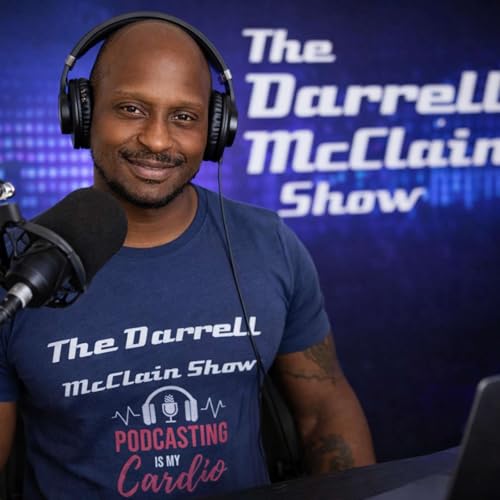
The Darrell McClain show Podcast Por Darrell McClain arte de portada

The Darrell McClain show

The Darrell McClain show

De: Darrell McClain
Escúchala gratis

Independent media that won't reinforce tribalism. We have one Planet; nobody's leaving, so let’s reason together!! Darrell McClain is a Military veteran with an abnormal interest in politics, economics, religion, philosophy, science, and literature. He's the author of Faith and the Ballot: A Christian's Guide to Voting, Unity, and Witness in Divided Times. Darrell is a certified Counselor. He focuses primarily on relationships, grief, addiction, and PTSD. He was born and raised in Jacksonville, FL, and went to Edward H white High School, where he wrestled under Coach Jermy Smith and The Late Brian Gilbert. He was a team wrestling captain, District champion, and an NHSCA All-American in freestyle Wrestling. He received a wrestling scholarship from Waldorf University in Forest City, Iowa. After a short period, he decided he no longer wanted to cut weight, effectively ending his college wrestling journey. Darrell McClain is an Ordained Pastor under the Universal Life Church and remains in good standing, as well as a Minister with American Marriage Ministries. He's a Believer in The Doctrines of Grace, Also Known as Calvinism. He joined the United States Navy in 2008 and was A Master at Arms (military police officer). He was awarded several medals while on active duty, including an Expeditionary Combat Medal, a Global War on Terror Medal, a National Defense Medal, a Korean Defense Medal, and multiple Navy Achievement Medals. While in the Navy, he also served as the assistant wrestling coach at Robert E. Lee High School. He's a Black Belt in Brazilian Jiu-Jitsu under 6th-degree black belt Gustavo Machado. Darrell Trains At Gustavo Machado Norfolk under the 4th-degree black belt and Former Marine Professor Mark Sausser. He studied psychology at American Military University and criminal justice at ECPI University.

© 2026 The Darrell McClain show
Ciencia Política Ciencias Sociales Política y Gobierno
Episodios
  • If Israel Claims A Right To Exist It Must Name Its Borders
    Apr 14 2026

    Send us Fan Mail

    A country can’t claim a “right to exist” while refusing to say where it ends. We start with that blunt standard and follow it to the heart of the Israel Palestine conflict: borders, settlements, and the moral and political tricks that let an occupation stretch on for decades. If words like “security” and “existence” never come with a map, they turn into a license for expansion, and everyone watching is forced to argue about abstractions instead of facts.

    From there, we get concrete about U.S. foreign policy and U.S. military aid to Israel. We talk leverage, why settlement building in the West Bank and East Jerusalem keeps happening even when American leaders condemn it, and what it looked like the last time a U.S. president applied real pressure. We also take on the hardest questions around political violence, rejecting the idea that there’s such a thing as a humane occupation while also refusing to excuse atrocities as “justified resistance.”

    Then the scope widens: how media coverage shapes what the public believes about negotiations, why maps get buried, and how international law and the Geneva Conventions should change the way we talk about responsibility. Finally, we bring the same skepticism to current events, walking through detailed reporting on Netanyahu’s push inside the White House for action against Iran, the hedging responses from Trump’s advisers, and the political incentives that turn war into messaging.

    If you want clearer thinking on the two-state solution, West Bank settlements, U.S. leverage, Netanyahu, Trump, Iran, and the stories we’re not being told, this is the conversation. Subscribe, share this with a friend who argues in slogans, and leave a review with the one question you still can’t shake.

    Support the show

    Más Menos
    53 m
  • Hope Is Not Optimism And That’s The Point
    Apr 10 2026

    Send us Fan Mail

    The hardest truths in public life are usually the ones we’ve trained ourselves not to see. We start by talking with Cornel West about Race Matters and the reality that racial injustice is not only about explosive moments on the news, but also about the “quiet riot” of daily suffering in South Central, Harlem, and any place where poverty and despair are treated as normal. We unpack why hope is not optimism, why small victories of love and care count, and how a renewed public sphere and real political courage matter if America is serious about racial justice.

    From there we widen the lens to foreign policy and ask a question that never stops generating heat: why does the United States support Israel so consistently? We trace the long arc from Christian Zionism and settler colonial history to Cold War strategy, military aid, and intelligence alignment. Along the way, we examine how media framing shapes what the public is allowed to call an invasion, an occupation, or a peace offer, and how “minimal honesty” might change what leaders can get away with.

    The episode closes on a moral note, pairing a humanist warning about greed and despair with scripture on suffering and endurance, not as an escape from politics but as a reminder that language, conscience, and solidarity still matter. If you care about race in America, Cornel West, public policy, U.S. Israel relations, and human rights, this conversation is built to challenge your assumptions without asking you to turn off your compassion. Subscribe, share with a friend, and leave a review, then tell us: what truth do you think our politics is avoiding right now?

    Support the show

    Más Menos
    1 h y 11 m
  • Congrats On Your Big Brain Now Try Making Friends
    Apr 10 2026

    Send us Fan Mail

    Smart people get praised for their “big brain” moments, but no one talks enough about the quiet costs that can come with high intelligence. We go beyond the idea of IQ and dig into intelligence as a multidimensional trait and why it can shape your relationships, your daily choices, and even your sense of self in ways that feel isolating or exhausting.

    We explore why small talk can feel pointless when your mind craves ideas, patterns, and deeper meaning and how that can make social settings feel like a chore instead of a recharge. We also break down why highly intelligent people often become careful, deliberate speakers and how that can be misread as being cold, overly serious, or uninterested. From there we talk about social awkwardness, the research-backed idea that IQ and EQ do not always rise together, and what that means for building real connection.

    Then we get practical about the struggles many listeners will recognize: difficulty making close friends when others feel intimidated, withdrawing into work or academics, and the imbalance that can lead to stress and low self-esteem. We also unpack paralysis by analysis, the constant craving for mental stimulation, and the pressure to succeed that can turn into perfectionism and fear of failure. The core takeaway is a reassurance: you are more than your intelligence, and you don’t need anyone else’s validation to be yourself.

    If any of this hits home, subscribe, share this with a friend who overthinks everything, and leave a review. What’s the hardest part of being “the smart one” in your world?

    Support the show

    Más Menos
    8 m
Todavía no hay opiniones