Episodios

  • Is USMCA at Risk? Colin Bird Breaks Down What Happens Next
    Apr 16 2026
    The USMCA review is fast approaching, uncertainty is building across the automotive industry, and leaders are asking a critical question: Is the agreement that binds North America together at risk?Colin Bird, the Consul General of Canada in Detroit, United States, brings clarity. This is not a collapse or a dramatic reset. It is a built-in review designed to test whether the agreement still works in a world that has fundamentally changed. The environment that shaped USMCA no longer exists. Supply chains are strained, global competition is intensifying, and China has accelerated ahead in the EV space.The real issue is not whether the agreement survives. The issue is whether North America can operate effectively under pressure. July 1 is not a breaking point. It’s part of a process meant to ensure the agreement stays relevant while the industry evolves at speed.Colin makes it clear that the real danger comes when North America starts putting up barriers within its own system. The automotive supply chain has been built over decades to operate seamlessly across borders. When tariffs or policy decisions disrupt that flow, it does not just impact one country. It makes the entire region less competitive at a time when global players are moving fast.This episode is about what matters now: certainty, coordination, and competitiveness. The industry doesn’t need more noise or political posturing. It needs alignment. Because if North America wants to win, it must act as one integrated system, not three separate countries.Themes Discussed in this EpisodeWhat the USMCA “review” really meansWhy July 1 is not a cliff, but a checkpointThe risk of disrupting a deeply integrated supply chainHow tariffs and policy decisions can backfire on North AmericaWhy China’s EV acceleration changes everythingThe critical role of certainty and predictability for investmentWhat leaders must focus on to stay competitive globally🎥 Watch the full episode on YouTube:https://www.youtube.com/@jangriffithsautomotiveleadersThis episode is sponsored by Lockton, click here to learn moreFeatured Guest: Colin BirdColin is the Consul General of Canada in Detroit, United States, brings deep, real-world expertise in international trade at a moment when it matters most to the automotive industry. With a background in government studies from Harvard and a law degree from the University of Ottawa, he has worked across the full spectrum of North American and global trade, from serving as counsel to the NAFTA Secretariat to leading trade law and policy on complex issues like aerospace and softwood lumber. He played a central role in the U.S.-Canada trade relationship while based in Washington, D.C., including during the transformation of NAFTA into USMCA. Colin has also represented Canada at the World Trade Organization and at the highest global forums, including the OECD, G7, and G20. Today, in Detroit, he operates at the heart of the North American automotive ecosystem, where trade policy directly impacts manufacturing, investment, and competitiveness across the region.About Your Host – Jan GriffithsJan Griffiths is the champion for culture change and the host of the Automotive Leaders Podcast. A former automotive executive with a rebellious spirit, Jan is known for challenging outdated norms and inspiring leaders to ditch command and control. She brings honesty, energy, and courage to every conversation, proving that authentic, human-centered leadership is the future of the automotive industry.Episode Highlights[02:43] Inside the Deal: Colin takes us back to the renegotiation of NAFTA into USMCA and why Detroit sits at the center of a deeply integrated, cross-border manufacturing system.[03:37] From Tension to Alignment: What began as a tough negotiation shifted toward shared goals: higher wages, stronger labor standards, and rebuilding North American manufacturing.[06:29] Review, Not Renegotiation: July 1 is not a breaking point. It is a structured review to ensure the agreement keeps pace with change.[08:11] The Need for Certainty: In a volatile environment, the industry is asking for predictability to support investment and long-term planning.[10:49] Reading the Political Noise: Colin explains how to interpret strong political language and separate negotiation tactics from real risk.[13:08] Industry Is Driving the Agenda: Automotive leaders across all three countries are aligned. Protect the agreement. Improve it. Do not disrupt it.[14:00] The Cost of Disruption: Breaking supply chains that took decades to build weakens North America and opens the door for global competitors.[16:30] Competing with China: The real competitive pressure is external. China’s acceleration in EVs raises the stakes for North America to act as one system.[18:45] Avoiding Self-Inflicted Damage: Tariffs and internal barriers do not strengthen local economies. They reduce overall competitiveness across the region.[21:10] A Fragile Global System: Colin ...
    Más Menos
    35 m
  • It's Q2: Are You Ready to Blow Up Your Playbook?
    Apr 2 2026
    Q1 was a wild ride. Tariffs. Geopolitical shocks. Supply chain chaos. And now Q2 is here, and the question no one's asking out loud is: are you walking into your quarterly review meetings with the same playbook you've always used?Are you making decisions the same way? Operating the same way? Thinking the same way?Because if you are, this episode is for you.In this solo episode, Jan Griffiths lays out five things every automotive leader needs to confront as we head into Q2 2026. This is not a pep talk. This is a reality check.The ground is shifting. Trade agreements are uncertain. Chinese competitors are moving faster than ever. And the old playbook, the one built on certainty, hierarchy, and control, is a liability.Jan covers the five forces shaping Q2 2026 and what you need to do about them: from the geopolitical storm still raging, to the reinvention mandate, to why trust is a P&L lever, not a soft skill. She also shares a personal update on her new role as Executive Advisor with Seraph, a global manufacturing and operations consulting firm.If you're heading into Q2 with the same mindset as Q1, this episode will challenge you to change that, now!Themes Discussed in this EpisodeThe geopolitical storm: tariffs, the Iran conflict, global oil crisis, chip shortages, and USMCA renegotiationWhy resilience without reinvention is just enduranceThe reinvention mandate: speed, process destruction, and AI as an accelerator, not a crutchTrust and transparency as competitive weapons, not cultural nice-to-havesWhy command-and-control leadership is a speed killer and authentic leaders are winningOver-customization and why stopping it could be the fastest path to speed and cost reductionThe WRI scorecard: OEMs will be judged on supplier relationships in MayJan's new Executive Advisor role with SeraphThree actions you can take this week to start Q2 differently🎥 Watch the full episode on YouTube:https://www.youtube.com/@jangriffithsautomotiveleadersAbout Your Host – Jan GriffithsJan Griffiths is the champion for culture change and the host of the Automotive Leaders Podcast. A former automotive executive with a rebellious spirit, Jan is known for challenging outdated norms and inspiring leaders to ditch command and control. She brings honesty, energy, and courage to every conversation, proving that authentic, human-centered leadership is the future of the automotive industry.Mentioned in this episodeListen to the Auto Supply Chain Champions Podcast powered by QADThe Automotive Leaders Podcast with Lori Lancaster, Vice Chairwoman at Emotiv MobilityThe North American Automotive Industry's Road to Resilience McKinsey reportGM and Ford should reconsider parts consolidation by John McElroyEpisode Highlights[00:01:26] Q2 Is Here. Now What?: The rules have changed permanently. Stop waiting for certainty. Clarity is not coming[00:02:20] The Geopolitical Storm: Tariffs, the Supreme Court EPA decision fallout, an Iran conflict, a global oil crisis, a looming chip shortage, and USMCA renegotiation in July.Jan also flags Canada allowing 49,000 Chinese OEM vehicles into the country, and what that means when they start crossing into the US.Upcoming guest: Colin Bird, Consul General for Canada, will join the podcast to discuss USMCA. Submit your questions to Jan on LinkedIn.[00:07:05] The Reinvention Mandate: Tear apart your processes and target a 50% reduction in cycle time. Chinese OEMs already launch vehicles in half the time legacy OEMs can. Jan references Terry Woychowski at Caresoft for the data and points to QAD’s framing, systems of record to systems of action, as the right mindset for agentic AI.[00:11:10] Trust and Transparency: Trust is a P&L lever. Approval processes built on decades of mistrust are killing speed. The WRI scorecard drops in May and will show which OEMs are walking the talk with suppliers and which ones aren’t.[00:14:35] Authentic Leaders Are Winning: Command and control is too slow. Jan references Lori Lancaster, Vice Chair at Emotive Mobility, on leaders who wait too long to ask for help. When people hide problems instead of raising them, it's a speed killer. Culture is the operating system.[00:16:50] Stop Customizing What Nobody Cares About: The McKinsey North American Automotive Road to Resilience report and Terry Woychowski at Caresoft make the case: the industry agonizes over components consumers don’t care about. Chinese OEMs don’t. Jan previews an upcoming conversation with the President of Horse North America on shared component strategy.[00:18:30] Personal Update: Jan has taken on an Executive Advisor role with Seraph, a global manufacturing and operations consulting firm focused on supply chain and operational improvement. She also shares an update on the Automotive Leaders YouTube channel.[00:20:15] Closing: Three Things You Can Do This WeekIdentify one decision that can be pushed downstream and push it down todayName one process that slows you down and kill itHave an honest ...
    Más Menos
    24 m
  • Why Reinvention Is Critical for Automotive Suppliers Right Now
    Mar 19 2026
    Reinvention in the automotive industry is no longer optional. It is survival. In this episode, Jan Griffiths sits down with Lori Lancaster, Vice Chair of Emotiv Mobility, to break down what reinvention really looks like when you are living it, not talking about it from a distance. The old playbook is cracking, and incremental improvement will not get us where we need to go. Yet many leaders are still holding on, waiting for direction instead of stepping up to create it.Lori did not wait. She made the decision to step back from the EV hype, resist the pressure to go all in, and focus instead on the real constraint holding the industry back. Infrastructure. That shift required courage. It meant challenging conventional thinking and refusing to follow the herd. Instead of chasing what everyone else was doing, she looked at where the real opportunity was and made a strategic move to meet it.That decision led to a bold reinvention of the business. By taking core automotive manufacturing capabilities such as process discipline, scale, and precision, Lori and her team expanded into energy and transformer production while exploring emerging mobility spaces like eVTOL. This was not diversification for the sake of it. It was a deliberate move to stabilize the business, reduce reliance on automotive cycles, and position the company for what comes next.But reinvention is not just about strategy. It is about leadership. Lori grounds her approach in servant leadership, accountability, and clarity of purpose. She makes it clear that transformation only works when people understand the why, when they are engaged in the journey, and when leaders create an environment of trust. Without that foundation, even the best strategy will fail.The message is simple and direct. If you are waiting for certainty, you are already behind. If you are waiting for direction, you have missed the point. Reinvention belongs to leaders who are willing to see what is coming, make the hard calls, and move forward without a safety net.Themes Discussed in this EpisodeReinvention as a survival strategyWhy incremental improvement is no longer enoughBreaking free from OEM dependency and legacy thinkingThe real barrier to EV adoption: infrastructure, not vehiclesDiversification beyond automotive to stabilize volatilityTranslating automotive manufacturing discipline into new industriesLeadership courage in high-risk, uncertain decisionsServant leadership vs command-and-control in transformationAccountability through clarity of purpose and shared visionCulture as the foundation for successful reinvention🎥 Watch the full episode on YouTube:https://www.youtube.com/@jangriffithsautomotiveleadersThis episode is sponsored by Lockton, click here to learn moreFeatured Guest: Lori LancasterLori is a seasoned automotive and advanced manufacturing executive known for leading organizations through complex industry change. Over the course of her career, she has overseen large-scale operations supporting major OEMs, helping guide companies through supply chain disruption, operational transformation, and the shift toward electrified mobility.She began her career as a critical care nurse at Massachusetts General Hospital, an experience that shaped her leadership style and approach to decision-making in fast-moving, high-pressure environments.About Your Host – Jan GriffithsJan Griffiths is a champion for culture transformation and the host of the Automotive Leaders Podcast. A former automotive executive with a rebellious spirit, Jan is known for challenging outdated norms and inspiring leaders to ditch command and control. She brings honesty, energy, and courage to every conversation, proving that authentic, human-centered leadership is the future of the automotive industry.Mentioned in this episodeDakkotaeVTOL (Electric Vertical Take-Off and Landing)Episode Highlights[01:26] Reinvention is survival, not strategy: Jan opens with a hard truth. The legacy automotive model is breaking, and incremental improvement is no longer enough to compete.[02:36] Defining leadership: servant, not command-and-control: Lori shares her leadership philosophy. Lead by example. Serve the team. Hold people accountable without losing trust.[03:47] Challenging old-school leadership norms: Jan calls out the industry’s past. Command-and-control once ruled. Lori explains how she chose a different path and why it works.[04:18] Engagement and buy-in drive accountability: Lori breaks down the real meaning of accountability. It starts with listening, aligning on vision, and helping people understand the why.[06:00] The industry’s biggest trap: incremental thinking: Jan challenges the status quo. Automotive is great at small improvements, but that mindset is now holding companies back.[07:18] From healthcare to automotive: A powerful personal reinvention. Lori shares how starting in healthcare shaped her ability to lead in high-pressure environments.[09:11] Building Emotiv Mobility: The ...
    Más Menos
    30 m
  • Policy, Power, and the Future of Automotive Manufacturing with Congresswoman Haley Stevens
    Mar 5 2026
    If you had told Jan a year ago she would bring a member of Congress onto this show, she would have said you were crazy.But this isn’t about politics.It’s about survival.It’s about supply chains, tariffs, China, semiconductors, and the reality that policy decisions now move faster than most production lines.In this episode of the Automotive Leaders Podcast, Jan Griffiths sits down with Congresswoman Haley Stevens, often called the “manufacturing geek,” for a direct conversation about industrial policy, public-private partnership, national security, and what automotive leaders should expect from Washington.Whether we like it or not, policy volatility is now a leadership variable.Themes Discussed in this EpisodeWhy Manufacturing Mondays keep policymakers grounded in shop-floor realityLessons from the 2008–2009 auto rescue and bipartisan public-private partnershipThe Chips and Science Act and reshoring semiconductor productionChina’s 95% dominance in rare earth processing and why it mattersCritical minerals, battery recycling, and national competitivenessTariff volatility and the cost of policy uncertaintyUSMCA review, Canada relationships, and North American stabilityThe Chinese OEM threat and rule-based trade enforcementWhat automotive leaders can expect from policymakers moving forward🎥 Watch the full episode on YouTube:https://www.youtube.com/@jangriffithsautomotiveleadersThis episode is sponsored by Lockton, click here to learn moreFeatured Guest: Congresswoman Haley StevensCongresswoman Haley Stevens is a Michigan native who served as Chief of Staff on President Obama’s auto rescue team, helping save 200,000 Michigan jobs. Elected to Congress in 2018, she flipped a Republican-held seat and has since championed Michigan’s manufacturing and auto industries. She has introduced legislation to strengthen domestic supply chains, counter China’s influence in critical minerals and auto production, and push back against tariffs impacting Michigan families. Stevens has been recognized as one of the most effective Democrats in Congress, particularly on science and technology issues, and is currently running to be Michigan’s next U.S. Senator.About Your Host – Jan GriffithsJan Griffiths is a champion for culture transformation and the host of the Automotive Leaders Podcast. A former automotive executive with a rebellious spirit, Jan is known for challenging outdated norms and inspiring leaders to ditch command and control. She brings honesty, energy, and courage to every conversation, proving that authentic, human-centered leadership is the future of the automotive industry.Mentioned in this episodeCirba SolutionsEpisode Highlights[01:26] Why Jan Brought a Policymaker Onto the Show: Policy now shapes daily decisions in automotive. Jan explains why Washington can no longer be ignored.[04:09] Nearly 200 Manufacturing Mondays Visits: Haley Stevens shares how nearly 200 shop floor visits keep her grounded in real manufacturing issues.[07:03] Inside the Auto Task Force During GM’s Bankruptcy: A firsthand look at the bipartisan effort to stabilize GM and protect American jobs during the crisis.[10:03] Chips and Reshoring Strategy: From pandemic shortages to the CHIPS Act, rebuilding semiconductor strength became a national priority.[11:14] China’s 95% Control of Critical Minerals: China dominates processing and refining. Stevens calls it a supply chain and national security risk.[14:17] USMCA and Canada Trade Tensions: Uncertainty around trade agreements creates instability for manufacturers across North America.[15:20] 55 Tariff Announcements in 100 Days: Volatility is the real problem. Constant tariff changes leave suppliers scrambling.[16:57] The Chinese OEM Threat: Chinese automakers are expanding globally. The competitive pressure is real, even if we do not see it yet.[18:26] What Leaders Should Expect from Policymakers: Leaders need steady voices who understand the supply chain and fight for fair competition.Top Quotes[07:53] Haley Stevens: “We were caught holding the bag and we needed to act.”[10:03] Haley Stevens: “They're doing 95% of that processing and refining, we've seeded an industry to them.”[00:15:20] Haley Stevens: “When you mention the White House tab that's open, 55 tariffs announcements in the first a hundred days, and then many more from that. I mean, manufacturers didn't know which way is up.”[00:18:37] Haley Stevens: “Well, look, I think we need reasonable policy makers who actually have an understanding of the industries and the jobs that they are lawmaking around.”[00:19:20] Jan Griffiths: “I would agree. It's the volatility that kills us. Tariffs are here. They're a reality, whether we like it or not, it's part of the administration moving forward. They're here, but it's the way that they're administered that we have a problem with.”The automotive industry does not operate in a vacuum.Trade policy, tariffs, semiconductor access, critical ...
    Más Menos
    20 m
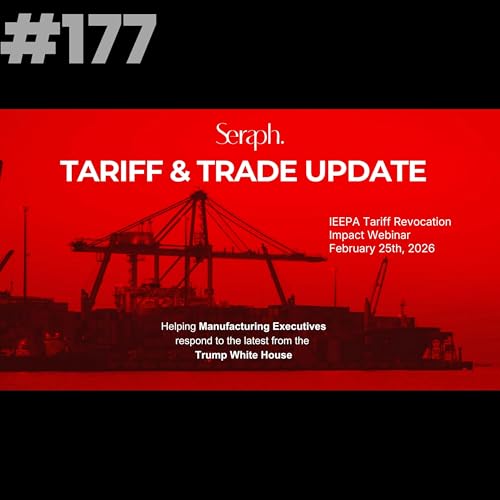
  • IEEPA Struck Down — Why the Tariff Pressure Remains
    Feb 26 2026
    Download the full webinar slides hereSpecial Audio from the February 20th Seraph WebinarTariffs were struck down.So why does the pressure still feel the same?If the Supreme Court ruled against IEEPA, why aren’t costs meaningfully lower?This special episode is different.It is the full audio recording from the February 20th Seraph IEEPA Tariff Revocation Impact Webinar, led by Ambrose Conroy, CEO of Seraph.In this episode of the Automotive Leaders Podcast, Jan Griffiths joins Ambrose and Harrison Catlin as they break down what the Supreme Court decision actually changed and what it didn’t.Headlines suggested relief. But Section 122 tariffs were implemented almost immediately. Effective rates dropped briefly, then climbed back up — not fully to prior IEEPA levels, but still materially impactful.This conversation goes beyond policy.It is about enterprise risk, supply chain resilience, and what leaders must do next.Themes Discussed in this EpisodeWhat the Supreme Court ruling actually changedHow Section 122 partially restored tariff levelsThe three critical dates: entry date, liquidation date, protest windowHow Post Summary Corrections (PSC) impact refund strategyOEM debit risk and cascading supply chain pressureWhy geopolitics — not just tariffs — is the real long-term riskThe July 2026 convergence: Section 122 expiration and USMCA negotiationsUsing AI and prediction markets to anticipate legal outcomesWhy reshoring must continue regardless of short-term tariff shiftsFeatured Guest:Ambrose Conroy is the Founder and CEO of Seraph, a global operational excellence and manufacturing strategy firm. He advises CEOs, boards, and private equity leaders on supply chain restructuring, footprint acceleration, and industrial resilience in volatile geopolitical environments.Ambrose is known for his reality-first perspective on manufacturing strategy and for translating global uncertainty into decisive operational action.About Your Host – Jan GriffithsJan Griffiths is a champion for culture transformation and the host of the Automotive Leaders Podcast. A former automotive executive with a rebellious spirit, Jan is known for challenging outdated norms and inspiring leaders to ditch command and control. She brings honesty, energy, and courage to every conversation, proving that authentic, human-centered leadership is the future of the automotive industry.Episode Highlights[01:05] Supreme Court strikes down IEEPA tariffs[02:00] Section 122 implemented and effective rates climb back[06:07] What tools remain available to the administration[11:55] Refund mechanics: entry date, liquidation date, PSC filings[14:46] OEM debit risk and supply chain tension[18:08] China, Taiwan, and geopolitical escalation[25:47] July 2026 - Section 122 expiration meets USMCA negotiations[30:00] AI and prediction markets used to model the ruling[32:00] Why tariffs are likely here to stayTop Quotes[11:38] Ambrose: “ Tariffs are a core tenet.”[17:23] Ambrose: “ Pre-COVID supply chain was, was a function that was seen as supportive. Now it's so core, and it's so critical, and it's so impactful so many times because everything is so fragile since we've sought the lowest cost and lowest price and not necessarily taken into account true resiliency. “[27:43] Jan: “Get your arms around the data, get visibility all the way through the supply chain. And make sure that you know those dates, the entry date and the liquidation date, and that you've got the right team of people around you with the right set of expertise.”[26:34] Ambrose: “ The only thing that it is clear to me if you if you want to sell a product in the United States, make it in the United States, source it in the United States.”If this episode resonated, share it with a fellow automotive leader and subscribe to The Automotive Leaders Podcast, where we’re shaping the future of authentic leadership in the automotive industry.This podcast episode is also available on YouTube. Check out our YouTube channel at JangriffithsautomotiveleadersSend us your feedback or questions — email Jan at Jan@Gravitasdetroit.com.
    Más Menos
    34 m
  • Building a $67B Auto Business Within Constraints: The Leadership Behind 230% Growth
    Feb 19 2026
    This conversation goes straight at the tension every legacy leader feels but rarely names.How do you build something new inside a company designed for stability?How do you move fast inside a system built to control risk?How do you create urgency without burning out your team?In this episode of the Automotive Leaders Podcast, Jan Griffiths sits down with Ted Cannis, former CEO of Ford Pro and longtime executive at Ford Motor Company.Ted didn’t just grow revenue. He helped build an integrated ecosystem of vehicles, software, charging, service, and financing. But this conversation isn’t about the numbers. It’s about the leadership and culture required to produce them.Ted shares what it really takes to drive change inside a legacy organization. Why data is your most powerful ally. Why shared metrics matter more than motivation. Why speed is a discipline. And why every bold initiative faces what he calls “status quo snapback.”He also makes a surprising admission. He’s a self-confessed micromanager. And that opens up one of the most honest leadership moments we’ve had on the show.This episode is about disciplined change.Not hype. Not slogans. Not transformation theater.Real leadership inside real constraints.Themes Discussed in this EpisodeWhy building inside constraints sharpens leadershipThe power of going to the gemba instead of managing from the conference roomUsing data to win enterprise-level changeHow shared metrics break down silosWhy speed requires preparation, not chaosThe danger of “sketchy scoping” in big strategic betsWhat “status quo snapback” looks like inside legacy organizationsCan micromanagement and authentic leadership coexist?Watch the full episode on YouTube - click hereThis episode is sponsored by Lockton, click here to learn moreFeatured GuestTed Cannis is the former CEO of Ford Pro, where he scaled the business to $67B in revenue and $9B EBIT by integrating commercial vehicles, SaaS, charging, service, and financing into one global ecosystem.Across a 30+ year career at Ford Motor Company, Ted led global electrification strategy, investor relations, and international operations. He is known for combining operational discipline with enterprise-level vision and has been featured in CNBC, The Wall Street Journal, and Forbes.Today, he serves as a strategic advisor and board-level collaborator across mobility, energy, and technology ventures.About Your Host – Jan GriffithsJan Griffiths is a champion for culture transformation and the host of the Automotive Leaders Podcast. A former automotive executive with a rebellious spirit, Jan is known for challenging outdated norms and inspiring leaders to ditch command and control. She brings honesty, energy, and courage to every conversation, proving that authentic, human-centered leadership is the future of the automotive industry.Episode Highlights[02:47] “Build within constraints” — Ted’s leadership mindset[06:17] Why going to the gemba is a strategic investment, not a luxury[12:16] Using hard data to sell change across the enterprise[15:43] Speed, impatience, and seizing decision windows[19:04] The Culture Change Hub — leaders, teams, rituals, rules, metrics, stories[22:18] Why C-suite sponsorship is non-negotiable[26:23] Pivoting fast when the plan breaks[28:24] “Status quo snapback” and how initiatives quietly die[30:39] Vision and ownership as the core of authentic leadership[32:46] The micromanagement confessionTop Quotes[02:48] Ted: “I build within constraints. Set a vision of where you want to go and be pragmatic about how you get there.”[07:25] Ted: “You can’t be blind. You have to go and see.”[14:14] Jan: “Speed is everything. The way we make decisions, how we make decisions, and the speed of those decisions.”[22:49] Ted: “If you really want change in a large company or a small one, it needs to come from the top.”[28:44] Ted: “The most exciting days for the project are the day it's announced. That is the high. It never gets any better.”[31:59] Ted: “You have to own the pivot. No matter what.”If this episode resonated, share it with a fellow automotive leader and subscribe to The Automotive Leaders Podcast, where we’re shaping the future of authentic leadership in the automotive industry.This podcast episode is also available on YouTube. Check out our YouTube channel at JangriffithsautomotiveleadersSend us your feedback or questions — email Jan at Jan@Gravitasdetroit.com.
    Más Menos
    36 m
  • Reality Check 2026: Speed, China, AI, and the Hard Truths Automotive Leaders Can’t Ignore
    Feb 5 2026
    This conversation doesn’t sugarcoat anything. The auto industry is under real pressure, and leaders can’t afford denial or delay.In this episode of the Automotive Leaders Podcast, Jan Griffiths sits down with Jamie Butters, now an independent journalist, speaker, emcee, and content creator who has spent decades reporting from every corner of the automotive ecosystem.Jamie brings a clear, grounded view of where the industry stands at the start of 2026. China’s competitive advantage is no longer theoretical. Affordability is becoming an existential issue. Tariffs and geopolitics are injecting uncertainty that freezes investment. AI is everywhere, but leaders still struggle to separate real value from noise.They unpack why legacy automotive culture slows decision-making, how bespoke thinking drives unnecessary cost, and why speed is now a leadership requirement, not a nice-to-have. The conversation also digs into Tesla’s influence on manufacturing thinking, the future of dealer AI tools, and what’s at stake as the UAW heads into a pivotal leadership year.This episode is about reality. Not hype. Not fear. Just the hard truths automotive leaders need to face if they want to compete, adapt, and lead with courage.Themes Discussed in this EpisodeWhy China’s scale and speed threaten global incumbentsHow affordability became automotive’s silent crisisWhere AI delivers value and where it quietly creates wasteThe cultural cost of bespoke thinking in legacy organizationsTariffs, uncertainty, and their chilling effect on investmentWhat UAW leadership changes could mean for competitivenessWhy speed of decision-making is now a core leadership skillWatch the full video on YouTube - click hereThis episode is sponsored by Lockton, click here to learn moreFeatured GuestJamie Butters is an independent automotive journalist, speaker, emcee, and content creator. He previously served as Executive Editor and Chief Content Officer at Automotive News, Detroit bureau chief for The Wall Street Journal, and automotive editor at Bloomberg. Jamie is known for connecting the dots early, telling the truth plainly, and translating complex industry dynamics into language leaders can actually use.About Your Host – Jan GriffithsJan Griffiths is a champion for culture transformation and the host of the Automotive Leaders Podcast. A former automotive executive with a rebellious spirit, Jan is known for challenging outdated norms and inspiring leaders to ditch command and control. She brings honesty, energy, and courage to every conversation, proving that authentic, human-centered leadership is the future of the automotive industry.Mentioned in this EpisodeAutomotive NewsBloombergThe Wall Street JournalUSMCAUHY RFQ white paperEpisode Highlights[02:08] Jamie’s move to independence and why now is the right moment[04:51] Why China’s competitive threat feels distant in Detroit but isn’t[07:47] Affordability, regulation, and how the industry boxed itself in[13:29] The hidden cost of bespoke thinking in the supply base[17:20] Tesla’s influence on China’s manufacturing mindset[18:30] Using AI where customers don’t see it but value it[25:03] Tariffs, uncertainty, and frozen investment[31:03] What’s at stake in the next UAW leadership cycle[36:18] Why speed of decision-making defines modern leadershipTop Quotes[05:24] Jamie: “It's a real challenge when you're competing with players in an economy that is not a capitalist market economy. They have different motivators; they have different factors that determine who survives. And so, it's a really asymmetric competition. ”[08:24] Jamie: “ They really never made money on small cars. Being able to focus on the bigger ones, it's more profitable, it's less good for the environment, and it does make it harder for low to middle-income people to buy a new vehicle. ”[14:54] Jan: “If you change the process but you’re still feeding it with legacy thinking, what have you really achieved?”[18:50] Jamie: “You should focus where you have the most cost and where the consumer doesn’t really know or care how you get it done.”[25:17] Jamie: “Just having those threats continue to come really paralyzes investment.”[36:14] Jan: “Speed is everything. The way we make decisions, how we make decisions, the speed of those decisions.”If this episode resonated, share it with a fellow automotive leader and subscribe to The Automotive Leaders Podcast, where we’re shaping the future of authentic leadership in the automotive industry.This podcast episode is also available on YouTube. Check out our YouTube channel at JangriffithsautomotiveleadersSend us your feedback or questions — email Jan at Jan@Gravitasdetroit.com.
    Más Menos
    40 m
  • Why Automation Fails in Manufacturing and the Leadership Shift Required to Fix It
    Jan 22 2026
    Re-industrializing America sounds bold. Necessary. Inevitable.But on factory floors across the country, automation keeps stalling before it ever delivers real value.Robots sit unused. Projects drag on for years. Leaders know automation is essential, yet decisions stall, risks get avoided, and the same problems repeat. This episode goes straight to the heart of why.Jan Griffiths is joined by Søren Peters, CEO of HowToRobot, a global marketplace helping manufacturers source and implement robotics more effectively. Søren has spent decades leading digital transformation and operational change, giving him a front-row seat to why automation struggles inside real plants, not PowerPoint decks.This conversation moves past hype. It tackles the real blockers: fear-based leadership, siloed decision-making, short-term contracts, poor education, and a complete lack of ownership once robots hit the shop floor. Automation doesn’t fail because the technology isn’t ready. It fails because organizations aren’t.Søren challenges leaders to rethink how they assess risk, train their workforce, and take responsibility for change. Buying a robot isn’t a technology decision. It’s a leadership decision. And without courage, clarity, and accountability, even the smartest automation strategy will collapse.If the automotive industry is serious about rebuilding manufacturing capacity, closing labor gaps, and preparing for an AI-enabled future, leaders must stop waiting for certainty and start owning the change.Themes DiscussedWhy automation failures are leadership failures, not technology failuresThe risk-avoidance mindset is slowing manufacturing transformationHow siloed decision-making kills automation on the shop floorWhy education matters beyond engineers and integratorsThe hidden impact of short-term supplier contracts on ROIWhat successful automation leaders do differentlyWhy ownership and courage matter more than toolWatch the full video on YouTube - click hereThis episode is sponsored by Lockton, click here to learn moreFeatured GuestSøren Peters is the CEO of HowToRobot, a global industrial robot marketplace that helps manufacturers find, evaluate, and implement automation solutions more effectively. He has spent over two decades leading companies through digital transformation, outsourcing, and large-scale operational change across Europe and the United States. Søren brings a pragmatic, leadership-first perspective to automation, grounded in what actually works inside manufacturing plants.About Your Host – Jan GriffithsJan Griffiths is a champion for culture change and the host of the Automotive Leaders Podcast. A former automotive executive with a rebellious spirit, Jan is known for challenging outdated norms and inspiring leaders to ditch command and control. She is the author of AutoCulture 2.0 and the co-host of the Auto Supply Chain Prophets podcast. Jan brings honesty, energy, and courage to every conversation, proving that authentic, human-centered leadership is the future of the automotive industry.Mentioned in this EpisodeHowToRobotUHY RFQ white paperEpisode Highlights[02:55] Re-industrialization sounds great until automation decisions stall for years[04:12] Why factories don’t need humanoids, they need basics that work[06:35] The real reason companies delay buying robots for a decade[09:10] Fear, risk, and leadership paralysis inside manufacturing[12:58] Why training only engineers guarantees automation failure[14:41] Robots are workers, and leaders must manage them as such[18:04] Short-term contracts destroy long-term automation ROI[19:52] Financing, trust, and the reality of buying unfamiliar technology[21:21] What the DNA of a successful automation leader really looks likeTop Quotes[11:20] Soren Peters: “I think it’s leadership. And I think those who want to be the one who takes the torch and says, I will take the risk. I will bear the burden.”[14:52] Soren Peters: “A robot is a worker in a sense, and it comes with different ROIs, it comes with different behaviors.”[15:15] Soren Peters: “And a robot also has a sick day. But we are also saying to everybody, a robot never gets sick — and it’s not, well, but it does.”[25:48] Jan Griffiths: “The tech mindset is let’s get this technology and play with it. Let’s break it. Let’s break it. Let’s iterate it.”If this episode resonated, share it with a fellow automotive leader and subscribe to The Automotive Leaders Podcast, where we’re shaping the future of authentic leadership in the automotive industry.This podcast episode is also available on YouTube. Check out our YouTube channel at JangriffithsautomotiveleadersSend us your feedback or questions — email Jan at Jan@Gravitasdetroit.com.
    Más Menos
    34 m