Episodios

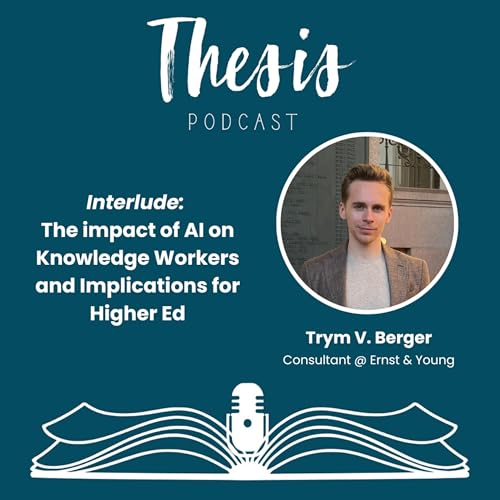
  • Interlude: The impact of AI on Knowledge Workers and Implications for Higher Ed
    Dec 18 2024

    Today we are discussing the impact of artificial intelligence, or AIm on knowledge workers, the topic of Trym Berger’s master’s thesis which he completed from the University of Oslo in June, 2024. At the time he was writing his thesis, Trym was also working at UiO’s Faculty of Educational Sciences on innovation initiatives - which is how the THESIS team met him and learned about his work. This gave Trym some perspective on the implications of his thesis findings for higher education. Trym is now a consultant at Ernst and Young in Oslo.


    Trym's masters thesis (Norwegian): “Den Generative Kunnskapsarbeideren" - En case-studie av hvordan Generativ AI påvirker læring hos kunnskapsarbeidere i Posten Bring

    https://www.duo.uio.no/handle/10852/113005

    Más Menos
    23 m
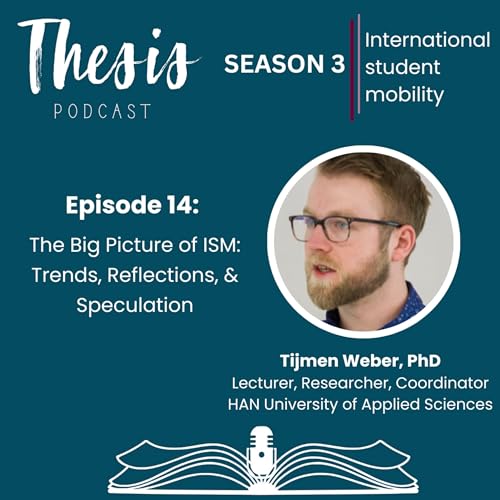
  • The Big Picture of ISM: Trends, Reflections, & Speculation
    Nov 20 2024

    We are wrapping up our third season on international student mobility today with our guest, Tijmen Weber. Tijmen recently obtained his PhD focused on the movement of international students and how immigration, institutional characteristics, programs, and funding policy influence their migration trajectories. He works at the international business program of HAN University of Applied Sciences in the Netherlands, where he mostly teaches courses in quantitative research and data science and does (applied) research on sustainability for the Research Center International Business at the HAN.


    You can view Tijmen's website for his research here: Global Campuses? Mapping the Influence of Location on International Student Mobility


    Check out the related sources below:

    de Haas, Hein. (2021). A theory of migration: the apsirations-capabilities framework. (open access)


    Charles, Maria & Bradley, Karen. (2009). Indulging Our Gendered Selves? Sex Segregation by Field of Study in 44 Countries.

    Más Menos
    38 m
  • Remote but Mighty: From Iceland’s ISM Strategy to Advocacy at the Supranational Level
    Oct 23 2024

    Today we’re talking about Iceland, a small country of almost 400,000 people considered a “remote” location for students studying abroad. We speak with Rúna Gudmarsdottir, Erasmus+ National Agency Director at RANNIS (The Icelandic Centre for Research), about how Iceland both attracts incoming students and works to support students going abroad.

    In her role as the Director of the National Agency, Rúna oversees the implementation of the Erasmus+ programme in Iceland, which covers all sectors on education, youth and sport. Rúna also manages projects that support implementation of the Bologna process in Iceland. She is a co-leader of a working group on social inequalities in international student mobility in a COST action and a member of the administrative board of ACA - the Academic Cooperation Association.

    Más Menos
    27 m
  • Understanding international student flows between sub-regions in the MENA
    Sep 4 2024

    Today we’ll be discussing the flows of international students withIN the Middle East and North Africa in the context of security policies with our guests, Dr. Sevgi Kaya-Kasikci and Dr. Chris Glass. Sevgi is a scholar of higher education studies and most recently conducted research as a Hans de Wit Fellow at Boston College’s Center for International Higher Education, where Chris is the Program Director for the Doctorate of Education in Higher Education.


    Outline of Episode:

    1:30 - General regionalization trends in internationalization

    5:40 - Context of MENA: unique aspects, power dynamics

    8:00 - Regional security complex theory description

    9:30 - Contextual ISM patterns

    12:00 - 2011 and 2020 data comparisons

    19:45 - Policy implications


    Resources:

    Kaya-Kasikci, S. & Glass, C. (2024). Analyzing the influence of regional security on international student flows in the MENA region: a social network approach. Higher Education.

    Glass, C. & Cruz, N. I. (2023). Metatrends in Mobility: Education Hubs and the New Multipolar Structure of International Student Mobility.
    Glass, C. & Cruz, N. I. (2023). Moving towards multipolarity: shifts in the core-periphery structure of international student mobility and world rankings (2000–2019). Higher Education.

    Más Menos
    31 m
  • Disrupting a Success Story: International Student Enrollment Caps in Australia
    Aug 7 2024

    Today we are discussing international student enrollment caps in Australia which will be issued through the Education Services for Overseas Students Amendment (Quality and Integrity) Bill 2024. The bill will be moving through the parliament in mid-August, 2024, and is expected to pass. We will speak with Andrew Norton, a Researcher and Professor in the Practice of Higher Education Policy at The Australian National University.


    Additional Resources:

    • ANU Migration Hub Insights: "International students: A government changes its mind"
    • Andrew Norton's Blog
    • "Do not introduce caps says Norton" - The Koala News, Tracy Harris, 5th August, 2024
    • "Labor’s international student cap an ‘unprecedented’ overreach and ‘recipe for chaos’, experts warn" - The Guardian, Betsy Reed, 22nd May, 2024
    Más Menos
    22 m
  • Virtual student mobility post-COVID in Japan: Furthering national and global goals
    May 1 2024

    Today we speak with Dr. Ariunaa Enkhtur and Dr. Xixi Zhang about virtual student mobility, and other online programming, at Osaka University in Japan. Both Dr. Ariunaa and Dr. Sissi are assistant professors at the Center for Global Initiatives at Osaka University where they design and implement virtual programs. Dr. Ariunaa’s research interests include academic mobility including virtual mobility and its post-study impacts, and Dr. Sissi’s interests focus on Japanese linguistics, transnational higher education partnerships, and distance education.

    Dr. Ariunaa additionally serves as a Digital Media and Communications Co-Chair for the CIES Study Abroad and International Students Special Interest Group, and Dr. Zhang is a lecturer for one of the online courses collaborating with Osaka University alumni in US and Japan).


    Virtual Student Mobility from Students' Perspectives: Case Study From Japan.

    Enkhtur, A., Zhang, X., & Chen, L. Exploring an Effective International Higher Education Partnership Model Through Virtual Student Mobility Programs: A Case Study.

    Más Menos
    31 m
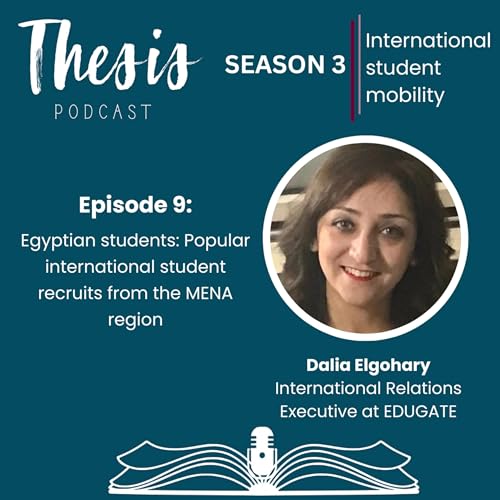
  • Egyptian students: Popular international student recruits from the MENA region
    Apr 10 2024

    Today we speak with Dalia Elgohary, International Relations Executive at EDUGATE, a company based in Egypt hosting Egypt’s largest University fair. We discuss destinations of interest for Egyptian students and reasons why higher education students from Egypt choose to study in different countries, from her perspective.

    EDUGATE Youtube Channel

    EDUGATE on LinkedIn

    EDUGATE Facebook Page

    Arab Ranking for Universities

    Más Menos
    19 m
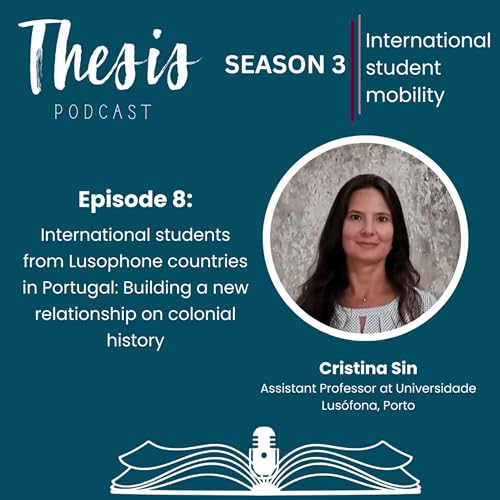
  • International students from Lusophone countries in Portugal: Building a new relationship on colonial history
    Mar 20 2024

    Today the conversation focuses on international student flows between Portugal and what is known as the Lusophone sphere, or countries which share a historical past with Portugal and where Portuguese is still an official language. We speak with Dr. Cristina Sin, Assistant Professor at Universidade Lusófona in Porto, whose research focuses on internationalization in Portugal, and discuss international student flows to Portugal from countries which were former colonies.


    Sin, C., Tavares, O., Aguiar, J. & Amaral, A. (2022). More students and more diverse: new trends in international mobility to Portugal. Tertiary Education and Management. https://doi.org/10.1007/s11233-022-09090-y


    Sin, C., Tavares, O., Aguiar, J., Biscaia, R., & Amaral, A. (2022). International students in Portuguese higher education: who are they and what are their choices?. Studies in Higher Education, 47(7), 1488-1501. https://doi.org/10.1080/03075079.2021.1916907

    Más Menos
    43 m