Episodios

  • Amsterdam Dawn
    Apr 2 2026
    This is a free preview of a paid episode. To hear more, visit chadcrouch.substack.com

    On many a post I’ve told a story about how I found a spot somewhere, that despite being within an urban area, sounded as if it might be in the deep woods. As a practical matter this tends to rely on geologic and erosive forces creating canyons and acoustic gullies of one sort or the other. While I find this sort of thing interesting, I’m mindful it doesn’t spark other peoples imaginations quite like my own. So, it is with some reluctance that I advance this line of thinking yet again, but with a twist. Bear with me.

    One thing that is not abundant along the Netherlands coastline are hills, canyons, and gullies. It’s for this reason, the bicycle is embraced as a primary form of transportation for many (maybe most) people. Amsterdam is alive with cyclists in part because the flat landscape is so conducive to cycling. And, because more trips are made via bicycle, the inner city does not pulse with automobile traffic sounds in the same way that a hilly, post-industrial city might. San Fransisco, for example. Or wherever.

    All of this is background to presenting to you today the first of many soundscape and soundwalk recordings that embrace anthropogenic sounds (alongside the wildlife sounds) in these urban environments. Consider this an easing-in.

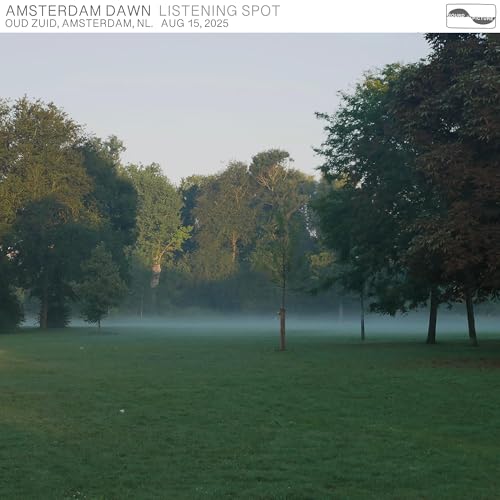
    We are getting our feet wet, so to speak, in the Oud Zuid district of Amsterdam, alongside the Noorder Amstelkanaal, as the city wakes up, on a summer day. Sirens mix with songbirds in a strangely musical way. Overall, though, it’s astonishingly quiet. The buildings and canals form an engineered canyon, of sorts.

    It’s well known that travel can spark a person to reconsider assumptions; to make new associations. I guess that can be said of my travels in Europe last summer, leading me to re-evaluate my approach to making environmental recordings. In some ways the cities sounded familiar to the one I call home. In others, quite distinct. On the whole, I was able to find new appreciation for these city sounds in general, hearing them with fresh ears.

    There is a futility in attempting to record soundscapes free of any anthropogenic sound. Our noisy machines routinely puncture the soundscapes of even the most remote locations. It comes as a relief to me, therefore, to chart a new course that embraces the totality of sound, with less rigidity.

    Amsterdam Dawn is available under the artist name Listening Spot on all streaming platforms tomorrow, Friday, April 3rd, 2026. Thank you for meeting me here; for listening and reading. There’s a lot to read and hear in this modern world. I’m grateful for your interest in my little corner.

    Más Menos
    4 m
  • Spring Shower
    Mar 20 2026

    Traveling around, I’ve become aware of how Pacific Northwest rain is different from rain patterns in other regions of the US. Take Texas, for example. Texas rain pours. Houses don’t have gutters there, presumably because they can’t engineer them large enough to accommodate the deluges reliably. Storm water infrastructure is three times the size of what I see around here. In contrast, Oregon rain is persistent. Drizzle can last for days. It’s kind of like the tortoise and the hare, I guess.

    This soundscape was recorded in Forest Park last year around this time, on a dead-end, unnamed trail that doesn’t see a lot of use, but nonetheless features a sturdy old bench. It is a pretty sweet listening spot for this reason, and this particular time slice offers a pretty accurate sound portrait of our soft rain. Our soft power.

    Did you know that the Pacific Temperate Rainforest—a bioregion extending from the northern California redwoods to the coastal forests along the gulf of Alaska—can pack more carbon per acre than a tropical rainforest like the Amazon?

    The Pacific Temperate Rainforest is the second-most dense biomass repository and carbon sink in the world (bested only by the Eucalyptus regnans forests of Victoria and Tasmania, Australia) and it’s what gives our Pacific Northwest rain its unique character (and sound). The Pacific Temperate Rainforest operates like a giant lung. Just as a lung draws in air, extracts what's vital, and releases what the body needs to stay alive, the Pacific Temperate Rainforest breathes on a continental scale, pulling carbon dioxide out of the atmosphere and locking it away in massive old-growth trunks, roots, and the deep organic soils beneath them, while exhaling oxygen and releasing moisture that cycles inland as rain. The forest doesn't just store carbon passively; it actively pumps water vapor into the atmosphere, seeding clouds and feeding rivers that sustain salmon, which in turn fertilize the forest floor when they die. It’s a closed loop where nothing is wasted.

    Spring Shower is available under the artist name Listening Spot on all streaming platforms Friday, March 20th, 2026. I’ve made it available here in its entirety with the idea it might be useful.

    Thanks for reading and listening!


    This is a public episode. If you'd like to discuss this with other subscribers or get access to bonus episodes, visit chadcrouch.substack.com/subscribe
    Más Menos
    8 m
  • Nature Trail
    Mar 13 2026
    This is a story about a trail called Nature Trail. At the heart of the story is a simple question: What is nature for? Feel free to click play above to listen to the soundscape of Nature Trail as we ponder this question. Nature Trail was built in the 1960’s in the interior of the roughly 5,000-acre nature park that had been dedicated 20 years prior, but received little attention in the way of development. Indeed, the most newsworthy question in those early years seemed to be what should we call it? In 1957, a call for suggestions—perhaps favoring something more showy than the functional, socially adopted name, The Forest Park—yielded many (Skyline, Tualatin, Wildwood, Tualatin Mountain…) but the de-facto name won the day. Officially, “Portland’s Forest Park” was favored by one vote over “Skyline Forest Park”. The “Portland’s” part never seemed to really catch on.Actually, the biggest changes to the park, to this day, came in response to a 1951 fire that burned over 1200 acres in the center of it. Fifteen emergency access fire lanes were constructed in the early 1950’s, broadly perpendicular to the slope of the Tualatin Mountains, like rungs on a ladder. What was nature for in the 1950’s? Accessible nature was becoming scarce. The public wanted protections from both development and the threat posed by wildfire. These fire lanes likely became informal points of entry for the park users in the early years. A network of hiking trails was modest: around 10 miles in total, on the southern end in 1960. Today there are over 80 miles of trails.What was nature for in 1960? A refuge to visit and admire via trails and lanes. Today, Nature Trail still harbors subtle clues to its origins There’s an old steel pole gate and concrete bollards covered by so much moss they could pass for stumps at the end of Fire Lane 1. It all appears quite out of place in the quiet interior of Forest Park. Nearby there is a meadow-like ridge with a couple weathered picnic tables. Starting in the late 60’s and running for about two decades or so, this was the drop zone for thousands of children in a campaign to foster a connection with nature, formalized in 1968. A rare 1968 publication in the Library Use Only stacks of Multnomah County Library holds the key to understanding Nature Trail: Portland’s Forest Park Nature Trail was a 32-page interpretive guide authored by Oregon Outdoor Education Councils as informal curriculum for a generation of school children. Fifty-two markers on Nature Trail were keyed to entries in the guide. Midway through the trail was a shelter, bathroom and campfire area. Bus drop off and pickup areas were located on each end. What was nature for in 1968? Nature was a common good. It was a living lab for learning about the interconnectedness of plants, animals and humans, as stated in the booklet introduction:If you are quiet and observant, you may see some of the animals that live here.The forest community is a living area of plants and animals. It has many parts. Some tall plants shade everything on the ground. Under these grow the medium size and the small ground plants. Part of the forest community is the soil and the many organisms that live in the ground. It is the animals that live in the forest. It is the water that comes from the forest. The forest community is many more things. (Portland’s Forest Park Nature Trail, 1968)Mind you, this was all designed and implemented a couple years before Earth Day made its debut. A 1970 Oregonian article about Nature Trail noted the large coalition involved— the Park Bureau, Multnomah County schools, U.S. Forest Service, Oregon State Game Commission, Industrial Forestry Association, and others. Much of the trail building for Nature Trail was done by the Neighborhood Youth Corps, employing low-income urban teenagers in public works projects. It all took coordination and vision. Precisely who the masterminded Nature Trail isn’t easily discerned, but there is little doubt Thornton T. Munger was a galvanizing force from the late 40’s into the 60’s, inspiring people to work together, while advancing principles of conservation and education in the nascent Forest Park.Munger’s own connection to nature can be traced back to growing up next to an eighteen-acre natural area called Hillhouse Woods in North Adams, Massachusetts, which fostered his lifelong interest in forests. In 1908 he was hired by the US Forest Service, and trained under Gifford Pinchot, who between 1905 and 1910 oversaw a rapid expansion, roughly tripling the number of National Forests and acreage. In his retirement, Munger chaired the Committee of Fifty, convincing city leaders to designate the lands as a nature park. The committee eventually became the Forest Park Conservancy, that to this day provide a Nature Education Program with free public events, organize volunteers, raise money, and conduct community outreach.In 1960, Munger—in collaboration with C. Paul...
    Más Menos
    27 m
  • Dosewallips Soundwalk
    Feb 13 2026
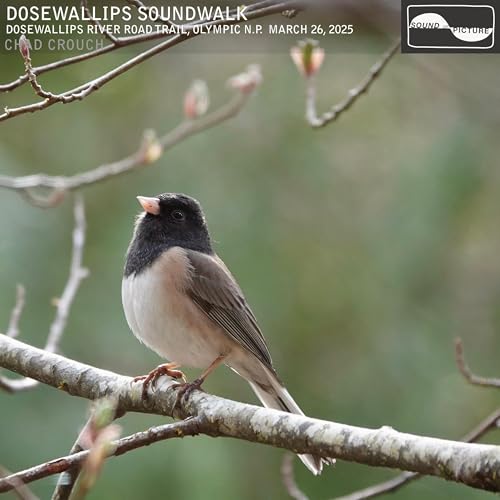
    Olympic National Park is the 8th most visited National Park in the US. About 95% of the park is roadless and designated wilderness, making it one of the most wild and undeveloped parks in the entire National Park system. Many of these most-visited parks have a significant road footprint, which makes much of their interior accessible. In contrast, Olympic National Park is largely one big wilderness, absent of roads. There are highways encircling it, and a few spur roads reaching in a few miles, but none passing through the interior. Dosewallips River Trail is the remains of one such spur road that washed out in 2002. The road reroute/repair proved too costly, and so has added to the relative inaccessibility of the canyon. When paired with the East Fork Quinault River Trail, this makes an enticing 35-mile multi-day backpack traverse through Enchanted Valley in the southern interior of the park. The Enchanted Valley offers lush old-growth rainforests, towering mountains with countless waterfalls, and an iconic chalet, nestled in an absolutely stunning valley.This soundwalk barely scratches the surface of the wilderness soundscape that awaits the visitor here, but it’s an appealing teaser. In these lower reaches, small wetlands thrive, fed by creeks coming down the mountain, making for ideal frog habitat. Trilliums burst through the resplendent mosses found here. A Great Blue Heron perches above a creek channel. The name Dosewallips derives from a Twana Indian myth about a man named Dos-wail-opsh who was turned into a mountain at the river's source. Twana is the umbrella term for nine bands of Coast Salish groups that lived around Hood Canal, the largest being the Skokomish. As with so many tribes of the Pacific Northwest, a defining conflict the Skokomish faced over the last century was the salmon fishery collapse.The ironically-named 1855 Treaty of Point No Point established a roughly 5000-acre reservation at the Skokomish River delta for the Twana bands, roughly 30 miles south of where the Dosewallips meets the Hood Canal, part of the Salish Sea. The 1920’s-era Cushman Dam projects on the North Fork of the Skokomish not only blocked fish passage to the upper river, they also removed the water from the river, tunneled it through a mountain, and dumped it directly into Hood Canal. From 1930 to 2008 the North Fork of the Skokomish ran nearly dry. Because lower river flows no longer flushed sediment and debris in the lower river, it caused a devastating pattern of flooding in the Skokomish valley where two-thirds of the Skokomish Reservation is within the floodplain. After decades of legal struggle, the tribe reached a settlement in 2009 with Tacoma Power that resulted in a 2010 amendment to the dam’s federal license. This restored about 40% of natural river flows and gave the tribe joint management authority. The river now has considerably more water, a salmon restoration effort is in place on the North Fork, and the delta benefits from increased flows. Still, it’s just the first step toward restoration. The Skokomish valley is still flood-prone after 80 years of sediment aggradation, and the fish passage solutions are as yet underperforming. So, what does this have to do with listening to the sounds of the Dosewallips River? For me, listening to a place just naturally arouses my curiosity. Who is making the sound? Why is it called Dosewallips? Who named it? Where are they now? What will I find upriver, downriver? How will the sound change? How has it changed over time?That the mountain, river, and tribe were named after a mythical chief who was transformed into a mountain tells us something about a worldview tied to the language, where the landscape itself is imbued with not only personhood, but ancestry. Twana people viewed the river not as a resource, the land not as property, but as a living entity, as family. Coast Salish people spoke of animals with a similar non-hierarchical framing. Salmon were seen as gift-bearing relatives.This was such a departure from the Euro-American worldview it was, and is, both hard to grasp and easy to dismiss. With the benefit of hindsight, though, it’s worth questioning how the English language encodes a worldview that can lead to short-sighted outcomes.My score for the Dosewallips soundwalk is very relaxed and minimal; just four instrument voices in all. I drew inspiration from the frog choruses. It’s unusual for me to rest on an undulating single chord arpeggio for several minutes, but that’s what felt right for “Part 7, Frog Chorus”. Now that I know a little more about the area, I’m eager to make a return. Thanks for reading and listening. Dosewallips Soundwalk is available on all music streaming services today, February 13th, 2026. This is a public episode. If you'd like to discuss this with other subscribers or get access to bonus episodes, visit chadcrouch.substack.com/subscribe
    Más Menos
    32 m
  • Mt. Tabor Rain Soundwalk
    Jan 15 2026
    This is a free preview of a paid episode. To hear more, visit chadcrouch.substack.com When I first heard a radio piece about Mt. Tabor Park being awarded America’s first Urban Quiet Park I have to admit I was incredulous. Don’t get me wrong, I’m all for it, but of all the parks I visit to make field recordings in the Portland area, this one might be the most frustrating. That is, if you’re hoping to get away from anthropogenic sounds—people and their machines.It was just last October that I introduced you to Mt. Tabor (if you weren’t already acquainted.) I described it as a “island of green in a patchwork of grey.” And so it is: all 176 acres of it. The deal with mountains, though, is they only give the listener more acoustic vantage as you venture further up and in. There are few folds in the park’s contours, so getting out of earshot of boulevards pulsing with machine energy and airplanes raining down sound waves on approach to PDX, just 5 miles to the north, is nearly impossible. It’s also a well-loved, well-used park. Runners and cyclists breathe heavy scaling its slopes. People talk. On phones. It is not packed on a weekday, but it sure isn’t lonely either. All this sound energy is not a bad thing, don’t get me wrong, but why the first urban quiet park in the US? This is an exemplar?It’s all about framing isn’t it? I mean yeah, you walk up the mountain and there’s downtown looking like a diorama set against the green West Hills. It looks quiet. It seems quiet. Quiet is so slippery, so subjective. Maybe it’s the signal-to-noise ratio of the near field soundscape—of being able to key in on small sounds because the background noise is just a wash—that lends itself to the perception of quiet. When you can hear little birds, with their little bird-whisper sounds. Or rain. Yes, rain with its crowd-suppressing effect; it makes the park seem quieter. Rain and wind in the trees masks the city din. Like passing through a veil, moving through the rain can feel transportive. It sounds a sizzle on the reservoirs, a diffused and hushed drum circle played on millions of leaves. But still, the first quiet urban park in the whole of the USA? I love the sentiment, but the logic seemed imprecise. Unearned, even.And then a few weeks ago, on a Wednesday, I went up there for a walk. Something was different. The gate to one of several lanes leading to one of several parking areas was locked shut. “Park Closed to Vehicles on Wednesday” a sign read. I don’t remember this. Is this new? Then a thought occurred to me: maybe this is why it’s the first urban quiet park. Maybe it is earned. After all, cordoning off whole interior parking lots, even one day a week is sure to rankle some folks. This is what intention looks like, I thought. This is a place that, at least on Wednesdays, sounds different. Measurably quieter. It came with a cost. People can’t vroom in and out. They have to enter from the perimeter and use good old-fashioned human power to move through it. Mt. Tabor Park, I’m sorry I ever doubted you. But how long has this been going on? A while, it seems. According to a 2013 article, which references the closure policy, it’s been well over a decade; so long even the internet doesn’t know. I love it when the internet—and AI, when it’s not hallucinating— doesn’t know something. That’s when I let my fingers do the walking through the maze of research tools the Multnomah County Library provides: not quite microfiche, but as close to it as digital gets. Could the policy go back to the 1980’s? Conceivably. In a bulletin of Matters to be Considered by City Council, the Apr. 6, 1981 Oregonian references “an ordinance authorizing Parks to install 5 traffic control gates in Mt. Tabor Park” up for consideration. I found no events programmed for the park on a Wednesday thereafter, save for Audubon bird walks embarking from a perimeter entrance in 2006.If it goes back that far, what really motivated no-vehicle-Wednesdays? Was a day of peace and quiet? Wilderness-in-the-city-Wednesdays? I’d like to think so.On several spring and summer Wednesday nights, however the quiet park is jolted to life. Established in 2020, Mount Tabor Dance Community (aka MTDC or Tabor Dance) saw another role that the closure policy could lend itself to in summertime: Insulating their outdoor music-fueled events from the dense neighborhoods of SE Portland, while also minimizing potential conflicts of park users. Tracing its roots to the pandemic and dancing in chalk circles drawn for distancing, the event grew over the years to draw crowds in the hundreds. Last spring and summer MTDC started again at Mt. Tabor, then hopped around to at least five other Portland parks, making good on the motto “Portland is our dance floor.”My score for Mt. Tabor Rain Soundwalk is very gauzy: mostly languorous synth pads and drones. Electric piano only enters the instrumentation in the final third of ...
    Más Menos
    5 m
  • Coastal Forest
    Jan 1 2026

    And so we start again. Happy New Year everyone!

    I picked this album to coincide with the new year because the field recording it is built on is, to me, a kind of tonic. It pulses with the sound of distant surf, wildlife, and a spring rain shower.

    Recorded on April 10th last year at Agnes Creek Open Space, a 57 acre woodland in the heart of Lincoln City, Oregon, this soundscape features the low din of the ocean, the ebullient Pacific Wren, and a very nice ensemble of Varied Thrush adding their ethereal single-note song. In the distance we hear cheerful American Robins and Song Sparrows. In time, a Purple Finch and a Douglas’ squirrel take positions in the soundstage. Mixed flocks—bushtits and Chestnut-backed Chickadees primarily—pass through. It sounds like a thriving habitat, but it was not always this way.

    The area was clear-cut in the 1960s. After that, it regenerated naturally, resulting in a very dense thicket of young conifers that became draped with invasive species. By 2000, when the city purchased the property with funds from an open space acquisition bond, it was overgrown and trash-strewn.

    In 2013 the city conducted a selective forest thinning project, which improved forest health, and provided wood chips for a new loop trail. In 2016 a ribbon cutting ceremony celebrated carved benches and a footbridge created by local groups.

    This environmental recording serves as a testament to the forces of both neglect and attention to create renewal. Yes, neglect. Don’t we all have issues we don’t tend to? We make resolutions and then fail to act on them. Sometimes that’s just a necessary step in natural rejuvenation, creating the necessary conditions for real transformation.

    My composition takes cues from the low moan of the surf, with a variety of sampled and synthesized instrument voices selected to preserve space in the higher frequencies for the wildlife.

    Coastal Forest is available under the artist name Listening Spot on all streaming platforms Friday, January 2nd, 2026. I’ve made it available here in its entirety with the idea it might be somehow useful. Thanks for reading and listening. And, again, may the promise of a fresh new year be a boon to us all!

    Thanks for reading Soundwalk! This post is public so feel free to share it.

    ps. For a deeper dive from, see also Field Report Vol 26: Nelscott by Chad Crouch available on all-but-one streaming services.


    This is a public episode. If you'd like to discuss this with other subscribers or get access to bonus episodes, visit chadcrouch.substack.com/subscribe
    Más Menos
    38 m
  • Interrorem Soundwalk
    Dec 11 2025
    This is a free preview of a paid episode. To hear more, visit chadcrouch.substack.com

    Hi Everyone. How are we? Are you OK? I’m OK. I’m just really grateful to be able to do this: to walk, listen, make music. To share it here. It’s a dream gig, really.

    So for starters today, I think we should discuss the weird name of this week’s soundwalk. It comes from a log cabin built in 1907, as the first administrative site in the Olympic National Forest. Ranger Emery J. Finch constructed it for his bride Mabel, and they moved in on April 22, 1908. Word has it he chose the spot for a nearby fishing hole, which came to be known as Ranger Hole. But the name, recorded in early years as “No. 27 Interrorem Administrative Site,” remains something of a mystery. This rustic cabin is still standing proud, near the SE border of the park, and you can even book a stay for $58/night in the near future.

    “Interrorem” is latin. It’s law jargon for a legal threat, meant to compel compliance without resorting to a lawsuit or prosecution. It’s basically what a cease and desist letter attempts to accomplish, and it is undoubtedly a primary objective of any ranger: to convey authority over a domain. It is not however, a term that would often enter the lexicon of an early 20th century ranger. It’s difficult to imagine Emery saying to Mabel, after putting his whipsaw and adze to rest, “This will be our home, dear. We’ll call it Interrorem.”

    Some say it was a scrambling of the less fussy word “interim.” Seems like we’ll never know. The important thing for this story is that the trail I walked for this soundwalk is basically the same path Ranger Emery J. Finch wore into the once-primeval forest to go down to the Duckabush River fishing hole he prized.

    The cabin itself is surrounded by Big Leaf Maple trees in a clearing, giving way along the trail to western hemlock, Douglas-fir, and western red cedar. The Olympic National Forest is famous for its temperate rain forests, and while this watershed may not see the 130” of annual rainfall the famous Hoh Valley does, it too is a mossy wonderland.

    On this rainy day soundwalk we are greeted in the beginning by Varied Thrush, before the woodland seems to envelop the visitor in quiet. As the rain lets up a little, we hear Golden-crowned Kinglets and trailside rivulets before the surging Duckabush River comes into the fore. Clocking in at 19 minutes, it’s on the shorter side, but long enough to relax me into slumberland.

    This is just a taste of what’s to come. We’ll hear more soundscapes from Olympic National Park in 2026! Thank you, as always, for joining me here, and for listening.

    Interrorem Soundwalk is available on all music streaming services on December 12th, 2025.

    Más Menos
    5 m
  • Morgan Lake
    Dec 5 2025
    This is a free preview of a paid episode. To hear more, visit chadcrouch.substack.com

    The view from Morgan Lake looks more like Montana than Oregon to me. It’s big sky country.

    Just 10 minutes up a gravel road from the eastern Oregon city of La Grande, Morgan Lake is mysteriously a world apart. From its shores you see only rolling prairie giving way to distant mountains. Situated on a ridge, Morgan and its sibling Twin Lake have an implacable mirage-like quality. The surrounding topography—the absence of enfolding contours—doesn’t readily explain their presence. There is no incoming stream to feed them. Subterranean springs pump water from an active aquifer hidden below.

    I found myself on the lake shore on a breezy March Saturday. People were fishing nearby. The wind billowed through the Ponderosa Pine canopy. An osprey occasionally called out. Nuthatches passed through. Later on, White-throated Sparrows sing in the quiet, followed by a wayfaring Winter Wren.

    As I’ve shared in the past, I like to program my releases in batches. This is the last in a trilogy located in the Pacific Northwest, east of the Cascade Range. It’s lodgepole and ponderosa pine country. Once again, the main character in this soundscape is the mesmerizing whisper of the wind in the pines. This particular day was dynamic; the breeze ebbed and flowed. Occasionally it howled.

    The arrangement is super sparse. Honestly it would likely fail as a piece of music without the wind. The ratio of solos to duets is about 50/50. Most of my arrangements are comprised of at least duets, most of the time. I think I was responding to the sense of loneliness I felt in the physical space. The chord progression is progressive. Each part adds another chord and more harmonic complexity. There is a touch of minor color, which sounds a little unsettling. Though it was recorded in early spring, it strikes me as a wintry listen. I hope you enjoy it.

    Morgan Lake is available under the artist name Listening Spot on all streaming platforms today Friday, December 5th, 2025.

    Más Menos
    6 m