Soundwalk Podcast Por Chad Crouch arte de portada

Soundwalk

Soundwalk

De: Chad Crouch
Escúchala gratis

Soundwalk combines roving field recordings with an original musical score. Each episode introduces you to a sound-rich environment, and embarks on an immersive listening journey.

chadcrouch.substack.comChad Crouch
Desarrollo Personal Música Éxito Personal
Episodios
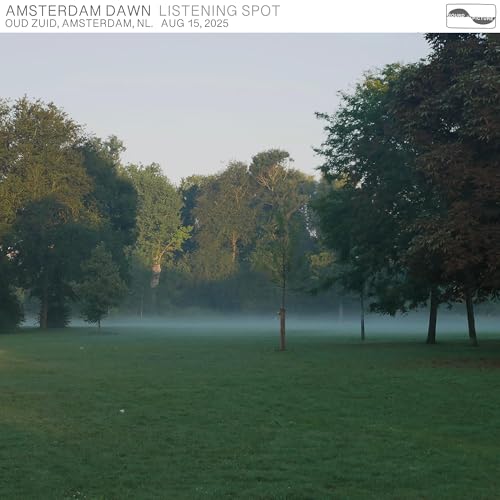
  • Amsterdam Dawn
    Apr 2 2026
    This is a free preview of a paid episode. To hear more, visit chadcrouch.substack.com

    On many a post I’ve told a story about how I found a spot somewhere, that despite being within an urban area, sounded as if it might be in the deep woods. As a practical matter this tends to rely on geologic and erosive forces creating canyons and acoustic gullies of one sort or the other. While I find this sort of thing interesting, I’m mindful it doesn’t spark other peoples imaginations quite like my own. So, it is with some reluctance that I advance this line of thinking yet again, but with a twist. Bear with me.

    One thing that is not abundant along the Netherlands coastline are hills, canyons, and gullies. It’s for this reason, the bicycle is embraced as a primary form of transportation for many (maybe most) people. Amsterdam is alive with cyclists in part because the flat landscape is so conducive to cycling. And, because more trips are made via bicycle, the inner city does not pulse with automobile traffic sounds in the same way that a hilly, post-industrial city might. San Fransisco, for example. Or wherever.

    All of this is background to presenting to you today the first of many soundscape and soundwalk recordings that embrace anthropogenic sounds (alongside the wildlife sounds) in these urban environments. Consider this an easing-in.

    We are getting our feet wet, so to speak, in the Oud Zuid district of Amsterdam, alongside the Noorder Amstelkanaal, as the city wakes up, on a summer day. Sirens mix with songbirds in a strangely musical way. Overall, though, it’s astonishingly quiet. The buildings and canals form an engineered canyon, of sorts.

    It’s well known that travel can spark a person to reconsider assumptions; to make new associations. I guess that can be said of my travels in Europe last summer, leading me to re-evaluate my approach to making environmental recordings. In some ways the cities sounded familiar to the one I call home. In others, quite distinct. On the whole, I was able to find new appreciation for these city sounds in general, hearing them with fresh ears.

    There is a futility in attempting to record soundscapes free of any anthropogenic sound. Our noisy machines routinely puncture the soundscapes of even the most remote locations. It comes as a relief to me, therefore, to chart a new course that embraces the totality of sound, with less rigidity.

    Amsterdam Dawn is available under the artist name Listening Spot on all streaming platforms tomorrow, Friday, April 3rd, 2026. Thank you for meeting me here; for listening and reading. There’s a lot to read and hear in this modern world. I’m grateful for your interest in my little corner.

    Más Menos
    4 m
  • Spring Shower
    Mar 20 2026

    Traveling around, I’ve become aware of how Pacific Northwest rain is different from rain patterns in other regions of the US. Take Texas, for example. Texas rain pours. Houses don’t have gutters there, presumably because they can’t engineer them large enough to accommodate the deluges reliably. Storm water infrastructure is three times the size of what I see around here. In contrast, Oregon rain is persistent. Drizzle can last for days. It’s kind of like the tortoise and the hare, I guess.

    This soundscape was recorded in Forest Park last year around this time, on a dead-end, unnamed trail that doesn’t see a lot of use, but nonetheless features a sturdy old bench. It is a pretty sweet listening spot for this reason, and this particular time slice offers a pretty accurate sound portrait of our soft rain. Our soft power.

    Did you know that the Pacific Temperate Rainforest—a bioregion extending from the northern California redwoods to the coastal forests along the gulf of Alaska—can pack more carbon per acre than a tropical rainforest like the Amazon?

    The Pacific Temperate Rainforest is the second-most dense biomass repository and carbon sink in the world (bested only by the Eucalyptus regnans forests of Victoria and Tasmania, Australia) and it’s what gives our Pacific Northwest rain its unique character (and sound). The Pacific Temperate Rainforest operates like a giant lung. Just as a lung draws in air, extracts what's vital, and releases what the body needs to stay alive, the Pacific Temperate Rainforest breathes on a continental scale, pulling carbon dioxide out of the atmosphere and locking it away in massive old-growth trunks, roots, and the deep organic soils beneath them, while exhaling oxygen and releasing moisture that cycles inland as rain. The forest doesn't just store carbon passively; it actively pumps water vapor into the atmosphere, seeding clouds and feeding rivers that sustain salmon, which in turn fertilize the forest floor when they die. It’s a closed loop where nothing is wasted.

    Spring Shower is available under the artist name Listening Spot on all streaming platforms Friday, March 20th, 2026. I’ve made it available here in its entirety with the idea it might be useful.

    Thanks for reading and listening!


    This is a public episode. If you'd like to discuss this with other subscribers or get access to bonus episodes, visit chadcrouch.substack.com/subscribe
    Más Menos
    8 m
  • Nature Trail
    Mar 13 2026
    This is a story about a trail called Nature Trail. At the heart of the story is a simple question: What is nature for? Feel free to click play above to listen to the soundscape of Nature Trail as we ponder this question. Nature Trail was built in the 1960’s in the interior of the roughly 5,000-acre nature park that had been dedicated 20 years prior, but received little attention in the way of development. Indeed, the most newsworthy question in those early years seemed to be what should we call it? In 1957, a call for suggestions—perhaps favoring something more showy than the functional, socially adopted name, The Forest Park—yielded many (Skyline, Tualatin, Wildwood, Tualatin Mountain…) but the de-facto name won the day. Officially, “Portland’s Forest Park” was favored by one vote over “Skyline Forest Park”. The “Portland’s” part never seemed to really catch on.Actually, the biggest changes to the park, to this day, came in response to a 1951 fire that burned over 1200 acres in the center of it. Fifteen emergency access fire lanes were constructed in the early 1950’s, broadly perpendicular to the slope of the Tualatin Mountains, like rungs on a ladder. What was nature for in the 1950’s? Accessible nature was becoming scarce. The public wanted protections from both development and the threat posed by wildfire. These fire lanes likely became informal points of entry for the park users in the early years. A network of hiking trails was modest: around 10 miles in total, on the southern end in 1960. Today there are over 80 miles of trails.What was nature for in 1960? A refuge to visit and admire via trails and lanes. Today, Nature Trail still harbors subtle clues to its origins There’s an old steel pole gate and concrete bollards covered by so much moss they could pass for stumps at the end of Fire Lane 1. It all appears quite out of place in the quiet interior of Forest Park. Nearby there is a meadow-like ridge with a couple weathered picnic tables. Starting in the late 60’s and running for about two decades or so, this was the drop zone for thousands of children in a campaign to foster a connection with nature, formalized in 1968. A rare 1968 publication in the Library Use Only stacks of Multnomah County Library holds the key to understanding Nature Trail: Portland’s Forest Park Nature Trail was a 32-page interpretive guide authored by Oregon Outdoor Education Councils as informal curriculum for a generation of school children. Fifty-two markers on Nature Trail were keyed to entries in the guide. Midway through the trail was a shelter, bathroom and campfire area. Bus drop off and pickup areas were located on each end. What was nature for in 1968? Nature was a common good. It was a living lab for learning about the interconnectedness of plants, animals and humans, as stated in the booklet introduction:If you are quiet and observant, you may see some of the animals that live here.The forest community is a living area of plants and animals. It has many parts. Some tall plants shade everything on the ground. Under these grow the medium size and the small ground plants. Part of the forest community is the soil and the many organisms that live in the ground. It is the animals that live in the forest. It is the water that comes from the forest. The forest community is many more things. (Portland’s Forest Park Nature Trail, 1968)Mind you, this was all designed and implemented a couple years before Earth Day made its debut. A 1970 Oregonian article about Nature Trail noted the large coalition involved— the Park Bureau, Multnomah County schools, U.S. Forest Service, Oregon State Game Commission, Industrial Forestry Association, and others. Much of the trail building for Nature Trail was done by the Neighborhood Youth Corps, employing low-income urban teenagers in public works projects. It all took coordination and vision. Precisely who the masterminded Nature Trail isn’t easily discerned, but there is little doubt Thornton T. Munger was a galvanizing force from the late 40’s into the 60’s, inspiring people to work together, while advancing principles of conservation and education in the nascent Forest Park.Munger’s own connection to nature can be traced back to growing up next to an eighteen-acre natural area called Hillhouse Woods in North Adams, Massachusetts, which fostered his lifelong interest in forests. In 1908 he was hired by the US Forest Service, and trained under Gifford Pinchot, who between 1905 and 1910 oversaw a rapid expansion, roughly tripling the number of National Forests and acreage. In his retirement, Munger chaired the Committee of Fifty, convincing city leaders to designate the lands as a nature park. The committee eventually became the Forest Park Conservancy, that to this day provide a Nature Education Program with free public events, organize volunteers, raise money, and conduct community outreach.In 1960, Munger—in collaboration with C. Paul...
    Más Menos
    27 m
Todavía no hay opiniones