Episodios

  • “Never too old to Serve”: The Life and Career of Captain Joe Wubbold, Part I
    Mar 27 2026

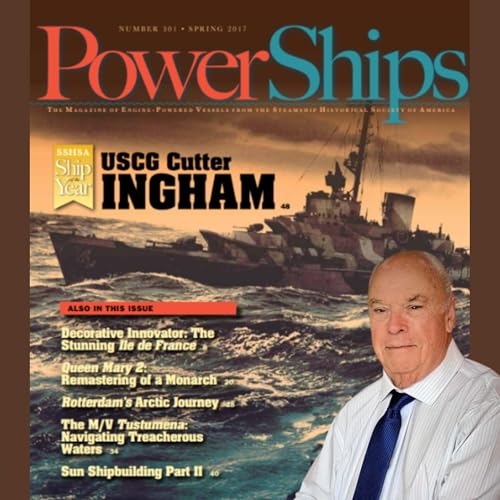
    Captain Joe served in the US Coast Guard on active duty for 34 years, commanding a series of six ships, the last one being an icebreaker. He was Chief of Operations for the 13th Coast Guard District in the Pacific Northwest, which included oversight of all aids to navigation. His last assignment was Chief of Ice Operations in the Arctic, Antarctic, and the American Great Lakes.

    After he retired, Captain Joe went on to obtain a master's degree in Polar Studies from the University of Cambridge and managed the construction of the Shackleton Memorial Library. He currently serves as the president of the board of the Keepers of Point Robinson Light House on Vashon Island in Washington State. He is also the Director of the Washington Poison Center. Captain Joe has a weekly radio show on the Voice of Vashon called "From the Captain's Chair."

    The first part of this two-part episode will focus on why he's been a member for well over 40 years and why he continues to support the Steamship Historical Society to this day. We will also discuss his career up through serving as the captain of the Coast Guard Cutter Ingham during the Vietnam War.

    Más Menos
    32 m
  • The Elmo N. Pickerill Collection with SSHSA Curator Jordan Berson
    Feb 4 2026

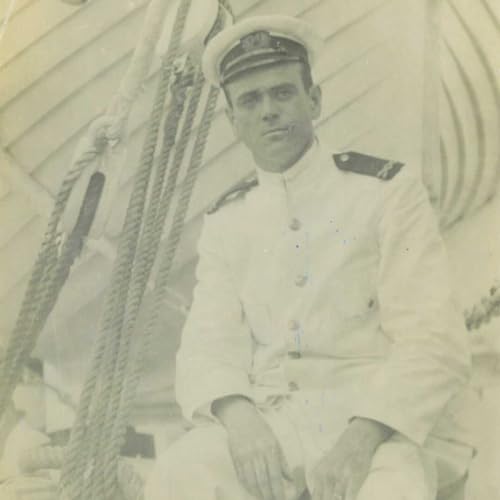
    Join Education Director Aimee Bachari for a chat with Curator Jordan Berson about the fascinating Elmo N. Pickerill Collection at the Steamship Historical Society of America. Elmo Neale Pickerill served as Chief Radio Operator aboard the world’s biggest ocean liner SS LEVIATHAN for most of the ship’s career. Pickerill had already made a name for himself in the fields of aviation and wireless radiotelegraphy, and he had been to sea. He was known to be an accomplished and daring innovator with nearly 20 years of experience under his belt. The Wright brothers taught Elmo Pickerill to fly and he had also studied radio with Guglielmo Marconi.

    Among his accomplishments, Elmo Pickerill was credited with making the first ever airplane-to-ground radio communication, while solo-piloting a biplane in August 1910. During the flight Pickerill was said to have tapped out Morse code that was received by two stations on the beach, three different steamships, and a radio station on a New York City rooftop. This type of historic feat should have made front page headlines worldwide. But the event didn’t get any such publicity, and today due to this absence of period news reports, some historians have suggested that Pickerill fabricated the story for the purpose of self-promotion.

    A large volume of the papers and mementos he saved from this time period were donated to Steamship Historical Society in 1968 when he passed away. These include but are not limited to: signage from LEVIATHAN’s radio room, Pickerill’s badge, epaulettes, certification cards, 137 crew passes, 168 log abstract cards, photographs, souvenir-type objects, silver, correspondence, clippings, memoranda, books, and a very large 48-star American flag that purportedly was flown aboard LEVIATHAN.

    Two groupings of materials within that donation stand out as exceptional records of what it was like to work in the radio department of an early 20th century ocean liner. The first grouping is Pickerill’s photographs, that he kept in a large bound album. The second grouping are documents stored inside of two file-boxes stamped “SS LEVIATHAN” on their spines. These boxes were apparently saved from the radio room by Pickerill when the ship went out of service for the last time in 1934. Work has been going on at SSHSA to more thoroughly document and understand the contents of these boxes.

    Learn more about this and other collections at the Steamship Historical Society at sshsa.org/collections.

    Más Menos
    27 m
  • The Sinking of the RMS Laconia with History Daily
    Nov 25 2025

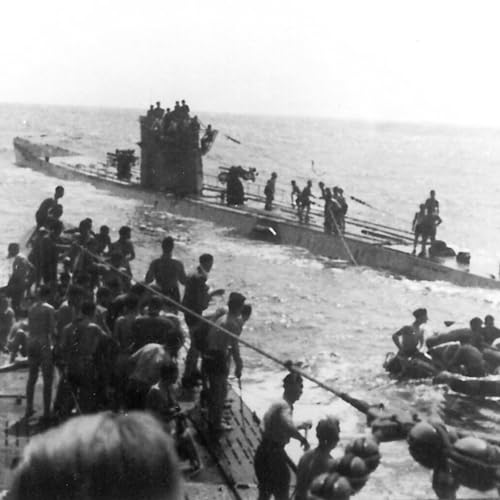
    On September 12, 1942, U-156 commander Werner Hartenstein torpedoed the RMS Laconia, a former Cunard White Star liner that was converted into a troopship during the war. On board that day, traveling from South Africa to England, were 1,500 Italian prisoners of war, military personnel, and women and children.

    After the attack, and realizing there were German allies and women and children on board, Hartenstein called other U-boats to aid in the rescue. What happens next when he decides to request assistance from the Allies would change the course of the war, leading to even more casualties.

    Today you'll hear an episode on the Laconia Incident by History Daily with Host Lindsay Graham. With new episodes every weekday, you'll hear the fascinating stories of what happened "on this day" in history. Like our podcast, each episode is 20 minutes or under, so you can stand and finish a show whenever you want a quick dose of history. You can find them by searching History Daily wherever you get your podcasts.

    Más Menos
    19 m
  • The 50th Anniversary of the Edmund Fitzgerald with Mark Sprang
    Nov 10 2025

    Join SSHSA Education Director Aimee Bachari and the Historical Collections of the Great Lakes Archivist Mark Sprang to reflect on the 50th anniversary of the sinking of the EDMUND FITZGERALD. The two discuss what makes this shipwreck so popular, the changes that came about after, and the material related to "Big Fitz" that you can find in Mark's archive and collections at Bowling Green State University. Most importantly, the Steamship Historical Society remembers the 29 men that were lost that fateful day when the EDMUND FITZGERALD went down on November 10, 1975, just 17 miles north-northwest of Whitefish Point, Michigan. To see the film version of this interview with historic images, video, and documents from both Mark's archive and the SSHSA archive along with materials in the public domain, visit https://youtu.be/_Jk-prcwotU?si=o2fRH81OqsbfTmKw.

    The main purpose of the Historical Collections of the Great Lakes (HCGL) is to collect, preserve, and make available historical materials documenting the Great Lakes region and connecting waterways. The HCGL consists of manuscript and archival materials (more than 2,000 cubic feet and over 600 collections); books, pamphlets, and periodicals; naval architectural drawings, maps, and charts; and photographs. Finding aids are available for processed manuscript collections and are searchable. Learn more at https://www.bgsu.edu/library/cac/collections/hcgl.html.

    To learn more about SHIPS visit shiphistory.org/ships.

    Subscribe to our channel @ShipHistory

    Learn more about SSHSA at www.sshsa.org.

    Check out our education program at www.shiphistory.org/education.

    Más Menos
    29 m
  • 125 Years after the 1900 Storm: America's Deadliest Hurricane and the Vessels Impacted
    Sep 30 2025

    "It would be impossible for any cyclone to create a storm wave which could materially injure the city." Meteorologist Dr. Isaac Cline, 1891.

    Founded in 1839 on Galveston Island, the City of Galveston was a thriving seaport community. In 1899, Galveston was the biggest cotton port in the country, and the third busiest overall. Forty-five steamship lines served the city, among them the White Star Line connecting Europe to Galveston. By 1900 it was the 4th largest city in Texas and one of the wealthiest in the country.

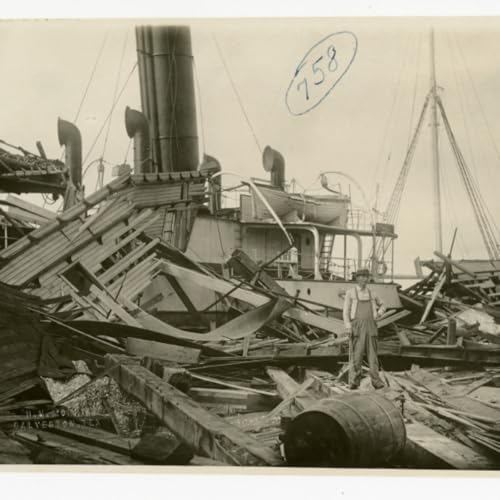
    On September 8, 1900, the deadliest natural disaster in American history occurred, when one of the worst Atlantic hurricanes hit Galveston. The Category 4 storm surge was between 8 and 15 feet. Wind speeds were estimated at up to 135 miles per hour. Residents had very little warning and the destruction of bridges and telegraph lines made evacuation to and communication with the mainland impossible.

    The following day, messengers took a surviving ship to Houston to report on the disaster and request aid. While at first their estimate of 500 dead was considered an exaggeration, soon the magnitude of the tragedy became clear. Though the total number of casualties is unknown, estimates range from 6,000 – 12,000.

    Join Education Director Aimee Bachari for a chat with PowerShips author Eric Pearson who details the undertold story of the vessels that encountered the storm not just in Galveston, but from its beginnings to the Caribbean and the aftermath in the Great Lakes and Canada. You'll also hear clips from an oral history with Katherine Vedders Paul, a storm survivor from Galveston, courtesy of the Rosenberg Library.

    Learn more at https://shiphistory.org/radio/.

    Join SSHSA and get PowerShips as a member benefit at https://shiphistory.org/join/.

    Purchase single issues of the magazine in our shop at https://shiphistory.org/product-category/powerships/.

    Más Menos
    36 m
  • Howard Middleton and Integration at the Port of Houston
    Aug 19 2025

    Howard Middleton served as the first Black Port Commissioner in Houston from 1978 to 1996. He was a former Manpower programs director and labor executive when he was appointed to the Port of Houston Authority’s Port Commission. Middleton played a crucial role in the development of the Houston Foreign Trade Zone and was instrumental in the appointment of the Port’s first Black ship pilot, Paul Brown. He passed away in 2023.

    In this episode, we will continue the theme of race and labor at the Port of Houston, and you'll hear excerpts from Jason Theriot's 2006 interview with Howard for the University of Houston's Center for Public History. This is our third episode on this topic. If you haven't heard our previous episodes, I would suggest going back to episode 19 to hear about the original project, the history of the port and ship channel, and more about Jason's work.

    Learn about the Steamship Historical Society of America.

    Learn more about Jason’s work on his website and find more information on his Oral History of the Port of Houston.

    Read the Houston History Magazine’s issue on the 100 year anniversary of the Houston Ship Channel: Dredged to Excellence.

    Check out the Center for Public History at the University of Houston.

    Más Menos
    25 m
  • WWII, Race, and Labor at the Port of Houston with Jason Theriot and William Robb
    May 29 2025

    Continuing on from Episode 19, today, you will hear from Captain William Robb who was born in Edinburgh, Scotland, and went to sea at 16. He served in the Merchant Navy for the United Kingdom during World War II. After the war, he married and came to the US to live and work in 1949. He had heard that the Port of Houston was seeking stevedoring superintendents, and he and his wife relocated to Texas that same year. He spent over 50 years working in the stevedoring business. Captain Bill passed away in 2013.

    He spoke with Jason Theriot in 2006 as part of a series of oral histories on the Port of Houston for the Center for Public History's Houston History Project at the University of Houston. They talked about WWII, union troubles, and race and labor in the Port during the peak days of breakbulk cargo.

    Jason interviewed individuals with a long history of working at the Port of Houston and on the Ship Channel. They worked as port captains, ship pilots, commissioners, and longshoremen. If you missed our last episode, go back and listen to episode 19 to learn about the interviews and the history of the Port of Houston and the Houston Ship Channel.

    Learn more about Jason’s work at https://jasontheriot.com/ and find more information on his Oral History of the Port of Houston at https://jasontheriot.com/oral-history-of-the-port-of-houston/.

    Find the Houston History Magazine’s issue on the 100 year anniversary of the Houston Ship Channel at https://houstonhistorymagazine.org/wp-content/uploads/2015/03/vol-12-no-1-port-final.pdf.

    Check out the Center for Public History at the University of Houston at https://uh.edu/class/ctr-public-history/.

    Más Menos
    36 m
  • The Merchant Marine, WWII, Integration, & Labor on the Houston Ship Channel with Jason Theriot and Charles Mills
    Feb 18 2025

    In honor of Black History Month, Education Director Aimee Bachari will be discussing race and labor on the Houston Ship Channel with Jason Theriot. Jason is an independent professional historian and consultant based in Houston, TX who specializes in historical research and writing services, focusing on energy, environment, business, and culture along the Gulf Coast.

    Jason and Aimee both received their graduate degrees at the University of Houston and worked for with the Center for Public History's Houston History Project, which has an oral history program, publishes the Houston History magazine, and maintains an archive in the university's library where the oral histories are preserved.

    Jason conducted a series of oral histories on the Port of Houston back in 2006 for the Houston History Project and interviewed individuals with a long history of working at the Port of Houston and on the Ship Channel. They worked as port captains, ship pilots, commissioners, and longshoremen.

    After hearing from Jason, you'll hear segments of his oral history with Charles Mills, who spent fifty years in the maritime industry. Originally from Galveston, Texas, he joined the U.S. Merchant Marine in the late 1930s, served in an integrated unit, and sailed for Lykes Brothers Shipping. The Merchant Marines primarily transport cargo and passengers during peacetime, but in times of war, they serve as auxiliary to the U.S. Navy. At this time, all branches of the U.S. military were segregated. On July 26, 1948, when President Truman signed Executive Order 9981 mandating the desegregation of the U.S. military.

    Learn more about Jason's work at https://jasontheriot.com/ and find more information on his Oral History of the Port of Houston at https://jasontheriot.com/oral-history-of-the-port-of-houston/.

    Find the Houston History Magazine's issue on the 100 year anniversary of the Houston Ship Channel at https://houstonhistorymagazine.org/wp-content/uploads/2015/03/vol-12-no-1-port-final.pdf.

    Check out the Center for Public History at the University of Houston at https://uh.edu/class/ctr-public-history/.

    Learn more about the Steamship Historical Society at https://shiphistory.org/.

    Más Menos
    45 m