Episodios

  • Efficient Market Hypothesis (Series 65 and Series 66)
    Mar 19 2026

    Send us Fan Mail

    Support the show

    📚 About the Podcast

    Real-world finance explained the way exams and real life actually test it.
    Ideal for the SIE, Series 7, Series 65/66, and anyone who wants to actually understand money—not just memorize buzzwords.

    ⚠️ Disclosure

    This podcast is for educational purposes only and is not a recommendation to buy or sell any security. Opinions expressed are solely those of the host.

    🚀 Go Deeper

    Live classes, tutoring, practice questions, and bonus content:

    👉 Website / Classes: https://capitaladvantagetutoring.com

    👉 YouTube: https://youtube.com/@Series7exam

    👉 Substack:https://substack.com/@series7whisperer?

    New episodes weekly — subscribe so you don’t miss one.

    Más Menos
    15 m
  • SIE Exam Prep ( Market mechanics) Options,Mutual Funds,Economics,Order types
    Mar 14 2026

    Send a text

    Support the show

    📚 About the Podcast

    Real-world finance explained the way exams and real life actually test it.
    Ideal for the SIE, Series 7, Series 65/66, and anyone who wants to actually understand money—not just memorize buzzwords.

    ⚠️ Disclosure

    This podcast is for educational purposes only and is not a recommendation to buy or sell any security. Opinions expressed are solely those of the host.

    🚀 Go Deeper

    Live classes, tutoring, practice questions, and bonus content:

    👉 Website / Classes: https://capitaladvantagetutoring.com

    👉 YouTube: https://youtube.com/@Series7exam

    👉 Substack:https://substack.com/@series7whisperer?

    New episodes weekly — subscribe so you don’t miss one.

    Más Menos
    55 m
  • Series 7 Exam: Customer Accounts ( SIE Exam also )
    Mar 7 2026

    Send us Fan Mail

    Support the show

    📚 About the Podcast

    Real-world finance explained the way exams and real life actually test it.
    Ideal for the SIE, Series 7, Series 65/66, and anyone who wants to actually understand money—not just memorize buzzwords.

    ⚠️ Disclosure

    This podcast is for educational purposes only and is not a recommendation to buy or sell any security. Opinions expressed are solely those of the host.

    🚀 Go Deeper

    Live classes, tutoring, practice questions, and bonus content:

    👉 Website / Classes: https://capitaladvantagetutoring.com

    👉 YouTube: https://youtube.com/@Series7exam

    👉 Substack:https://substack.com/@series7whisperer?

    New episodes weekly — subscribe so you don’t miss one.

    Más Menos
    51 m
  • A Guide to Equity Securities
    Feb 15 2026

    Send us Fan Mail

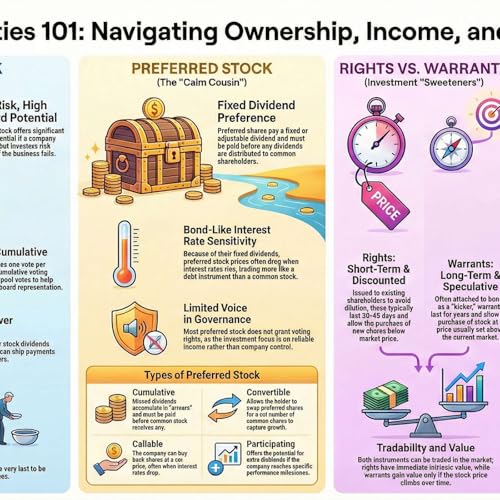
    Equity securities represent ownership interests in a corporation, offering a range of risk and reward profiles suited to different investment objectives. Common stock serves as the primary vehicle for capital appreciation and corporate governance, though it carries the highest risk and the lowest priority in liquidation. Preferred stock functions as a hybrid instrument, providing consistent dividend income and higher claim priority, similar to debt instruments.

    Short-term and long-term opportunities are facilitated through rights and warrants, which allow for the purchase of shares under specific conditions—rights protecting existing ownership from dilution and warrants acting as long-term speculative "sweeteners." Finally, American Depositary Receipts (ADRs) provide a streamlined mechanism for domestic investors to access foreign markets while mitigating the logistical complexities of international trading, despite persistent currency and tax considerations.

    --------------------------------------------------------------------------------

    Common Stock: Growth and Governance

    Common stock represents the most basic form of corporate equity, providing shareholders with a residual claim on company assets and a voice in corporate oversight.

    Preferred Stock: Income and Priority

    Preferred stock is characterized as a more stable, income-oriented security that shares traits with both common stock and bonds. It is primarily utilized by investors seeking reliable dividend streams


    Rights and Warrants

    Rights and warrants are instruments that grant the holder the opportunity to purchase stock at a specific price, but they differ significantly in duration and intent.


    American Depositary Receipts (ADRs)

    ADRs facilitate the trading of foreign stocks on U.S. exchanges. They are issued by U.S. banks that purchase bundles of shares in foreign corporations and re-issue them as ADRs.

    Support the show

    📚 About the Podcast

    Real-world finance explained the way exams and real life actually test it.
    Ideal for the SIE, Series 7, Series 65/66, and anyone who wants to actually understand money—not just memorize buzzwords.

    ⚠️ Disclosure

    This podcast is for educational purposes only and is not a recommendation to buy or sell any security. Opinions expressed are solely those of the host.

    🚀 Go Deeper

    Live classes, tutoring, practice questions, and bonus content:

    👉 Website / Classes: https://capitaladvantagetutoring.com

    👉 YouTube: https://youtube.com/@Series7exam

    👉 Substack:https://substack.com/@series7whisperer?

    New episodes weekly — subscribe so you don’t miss one.

    Más Menos
    32 m
  • What AI Really Means for Finance Careers (No Hype)
    Jan 26 2026

    Send a text

    Artificial intelligence isn’t “ending finance jobs.”
    That headline is lazy — and wrong.

    What AI is actually doing is stripping out the parts of finance roles that were never worth a human salary, while putting more pressure (and upside) on judgment, client work, risk decisions, and real thinking.

    In this episode, we break down — without hype or fear-mongering — what AI is actually changing across finance careers, including:

    • Wealth management and financial advisors
    • Client-facing associates and sales assistants
    • Sales & trading desks
    • Investment banking analysts and associates
    • Entry-level roles and career switchers

    We separate jobs vs tasks, explain why some AI-exposed roles are seeing higher wage growth, and walk through where AI helps, where it replaces, and where humans still get paid.

    If you work in finance, are studying for a finance license, or are considering a career change into banking, trading, or advising, this episode is a reality check — not a pep talk and not a doom spiral.

    No hype.
    No panic.
    Just how this actually plays out in the real world.

    • AI and finance jobs
    • AI impact on finance careers
    • artificial intelligence in finance
    • finance jobs automation
    • AI vs finance jobs
    • wealth management careers
    • financial advisor career path
    • investment banking analyst jobs
    • sales and trading careers
    • client associate finance role
    • entry level finance jobs
    • career change into finance
    • AI in banking
    • AI in trading
    • will AI replace finance jobs
    • how AI affects financial advisors
    • future of investment banking jobs
    • AI and trading desks
    • finance career outlook with AI
    • jobs vs tasks AI finance

    Support the show

    📚 About the Podcast

    Real-world finance explained the way exams and real life actually test it.
    Ideal for the SIE, Series 7, Series 65/66, and anyone who wants to actually understand money—not just memorize buzzwords.

    ⚠️ Disclosure

    This podcast is for educational purposes only and is not a recommendation to buy or sell any security. Opinions expressed are solely those of the host.

    🚀 Go Deeper

    Live classes, tutoring, practice questions, and bonus content:

    👉 Website / Classes: https://capitaladvantagetutoring.com

    👉 YouTube: https://youtube.com/@Series7exam

    👉 Substack:https://substack.com/@series7whisperer?

    New episodes weekly — subscribe so you don’t miss one.

    Más Menos
    12 m
  • Series 7 Exam Prep: All About Bonds
    Jan 26 2026

    Send us Fan Mail

    a comprehensive study guide for the Series 7 exam, focusing on the technical and regulatory nuances of debt securities. They contrast the structures of corporate, municipal, and government bonds, detailing how interest is calculated and how secondary market transactions are settled. Specific attention is given to accrued interest methodologies, such as the 30/360 and actual/365 systems, which determine the payments owed between buyers and sellers. The documents also outline the legal protections and tax implications unique to general obligation and revenue bonds, including the role of trust indentures and bond covenants. Additionally, the sources clarify the characteristics of Treasury bills, notes, and bonds, emphasizing their varying maturities and safety profiles for investors. By providing mnemonics and formulas, these resources serve to equip candidates with the essential knowledge required to manage fixed-income portfolios and navigate federal securities laws.

    Support the show

    📚 About the Podcast

    Real-world finance explained the way exams and real life actually test it.
    Ideal for the SIE, Series 7, Series 65/66, and anyone who wants to actually understand money—not just memorize buzzwords.

    ⚠️ Disclosure

    This podcast is for educational purposes only and is not a recommendation to buy or sell any security. Opinions expressed are solely those of the host.

    🚀 Go Deeper

    Live classes, tutoring, practice questions, and bonus content:

    👉 Website / Classes: https://capitaladvantagetutoring.com

    👉 YouTube: https://youtube.com/@Series7exam

    👉 Substack:https://substack.com/@series7whisperer?

    New episodes weekly — subscribe so you don’t miss one.

    Más Menos
    42 m
  • Securities Acts Explained for SIE Exam
    Dec 22 2025

    Send us Fan Mail

    he provided text outlines the fundamental legal frameworks governing the American financial industry, specifically focusing on the Securities Act of 1933 and the Securities Exchange Act of 1934. The 1933 Act establishes protocols for new investment offerings, requiring companies to provide full transparency through registration statements and prospectuses to protect the public from fraud. In contrast, the 1934 Act regulates the secondary market, overseeing the ongoing trading of existing stocks and the conduct of broker-dealers and self-regulatory organizations. Additional sections clarify specific exemptions and rules, such as Regulation D for private placements and Rule 147 for local state-level offerings. These rules collectively ensure that investors receive essential disclosures while defining the boundaries for accredited individuals and institutional buyers. Ultimately, the material serves as a comprehensive guide for candidates preparing for the Securities Industry Essentials (SIE) exam.

    Support the show

    📚 About the Podcast

    Real-world finance explained the way exams and real life actually test it.
    Ideal for the SIE, Series 7, Series 65/66, and anyone who wants to actually understand money—not just memorize buzzwords.

    ⚠️ Disclosure

    This podcast is for educational purposes only and is not a recommendation to buy or sell any security. Opinions expressed are solely those of the host.

    🚀 Go Deeper

    Live classes, tutoring, practice questions, and bonus content:

    👉 Website / Classes: https://capitaladvantagetutoring.com

    👉 YouTube: https://youtube.com/@Series7exam

    👉 Substack:https://substack.com/@series7whisperer?

    New episodes weekly — subscribe so you don’t miss one.

    Más Menos
    16 m
  • Intro to the SIE Exam 2024 ( AUDIO ONLY )
    Oct 12 2024

    SIE exam overview part 1 Podcast episode

    major securities regulations (Securities Acts of 1933, 1934, etc.) and their key provisions - Detailed explanations were provided on different types of securities including stocks, bonds, options, and their characteristics - Math concepts related to securities pricing, yields, and options were demonstrated - Practice questions were reviewed to show how concepts may be tested on the SIE exam

    Topics

    Securities Regulations

    - Securities Act of 1933 covers primary market and new securities issuance - Securities Act of 1934 created the SEC and regulates the secondary market - Other key acts include Investment Company Act of 1940 and Investment Advisers Act of 1940

    Equity Securities

    - Common stock provides ownership, voting rights, potential dividends - Preferred stock provides fixed dividends, no voting rights - ADRs allow trading foreign stocks on US exchanges - Rights offerings allow existing shareholders to maintain ownership percentage

    Debt Securities

    - Corporate bonds, municipal bonds, and US Treasuries discussed - Key concepts: par value, coupon rate, yield, call provisions - Risks include interest rate risk, credit risk, reinvestment risk

    Options

    - Calls provide right to buy, puts provide right to sell - Key terms: strike price, premium, expiration, intrinsic value - Buying options limits risk to premium paid - Selling options has potentially unlimited risk

    Calculations

    - Stock splits, dividends, and rights offerings - Bond yields - current yield, yield to maturity, yield to call - Options pricing and breakeven points

    Next Steps

    - Review practice questions, especially on topics like options and bond yields - Focus on memorizing key regulatory acts and their provisions - Practice calculations for stock splits, dividends, bond yields, etc. - Review risks associated with different security types

    #sieexam #sieexam #finra

    Más Menos
    1 h y 1 m