Episodios

  • From the Factory Floor to System Design: Why Women in STEM Matter with Kristen Eckart - Episode 189
    Mar 24 2026
    When we talk about reliability, we usually focus on materials, processes, test methods, and standards.
    But what if one of the most overlooked reliability risks is who is not at the table when engineering decisions are made?

    Today’s episode focuses on women in STEM, Science technology engineering and mathematics, and why this conversation extends far beyond mere representation. It impacts how problems are defined, how risks are identified, and how resilient our technologies ultimately become.

    My guest is Kristen Eckart, an accomplished engineer whose career includes working in high-reliability environments at Lockheed Martin.

    While Kristen’s background includes complex systems where failure is not an option, this conversation is not about any specific product or program. Instead, it is about the broader experience of women in engineering, the barriers that still exist, and why attracting and retaining women in STEM is essential to the future of technology and manufacturing.

    For those of you working in electronics manufacturing, quality, reliability, or engineering leadership, this discussion connects directly to how teams make better decisions, reduce risk, and design systems that perform reliably in the real world.

    This is a conversation about engineering excellence, opportunity, and why who we include ultimately matters.
    Más Menos
    41 m
  • An Academic Look at Al in Electronics Manufacturing: Where It Works, Fails, & Why It Matters - # 187
    Mar 10 2026
    Artificial intelligence is being promoted as the next revolution in electronics manufacturing, but what happens when the people evaluating it aren’t traditional AI experts, aren’t software vendors, and aren’t selling anything?

    Today’s conversation brings together engineers and professors who live at the intersection of education, reliability, and real-world manufacturing to separate meaningful progress from speculation.
    Each episode brings together engineers, researchers, and industry leaders to examine best practices, emerging technologies, and real-world lessons, always with a focus on data, physics, Best practices, and long-term performance.

    Today’s episode is a little different—and the setting couldn’t be better. I’m recording live from the Big Island of Hawaii, in Kona, at the SMTA Pan Pacific Strategic Electronics Symposium, better known as PanPac.

    At PanPac, academia meets industry in a way that’s truly unique. Leading international universities join forces with CEOs, inventors, senior engineers, and decision-makers from around the world.
    This is where the brightest research collides with the most pressing industry challenges — and sparks solutions that drive the future of electronics. I’m honored to be the conference chair, especially on this 30th anniversary of PanPac.

    This episode is all about “AI in Action: Progress, Pitfalls, and the Future of Electronics.”
    Artificial intelligence is becoming a frequent topic in electronics manufacturing—from inspection and process optimization to predictive maintenance and reliability modeling.

    But rather than approaching this conversation from the standpoint of AI evangelists or software developers, we’re taking a different path.

    My panelists are: Eva Hymes, Hayden Lee, Dr. Ron Lasky, Dr. John Evans, and Dr. Pradeep Lall.

    None of today’s panelists claim to be AI experts. Instead, they are engineers and professors who sit at the intersection of education, engineering, and real-world manufacturing challenges. Their perspective is grounded in physics, data, reliability science, and decades of experience teaching the next generation of engineers—many of whom will be working alongside AI-driven tools whether they choose to or not.

    Because all of our panelists come from academia, this conversation intentionally steps back from hype and buzzwords. We’ll focus on how AI is actually being used, where it shows promise, where it introduces risk, and where critical gaps still exist—especially in high-reliability electronics manufacturing. And because PanPac serves the electronics manufacturing community, we’ll keep this discussion connected to the factory floor, workforce readiness, education, and long-term product reliability.

    We’ll also touch on broader societal questions, including how AI is shaping engineering education and professional intuition.

    So if you’re looking for a grounded, thoughtful discussion on AI—one rooted in engineering reality rather than marketing claims—this episode is for you.
    Más Menos
    54 m
  • Readiness Through Repair: How the U.S Military is Strengthening Capabilities with Right to Repair - Episode 187
    Feb 24 2026
    If a $26,000 drone repair can be done in the field—but policy says it has to be shipped back to the manufacturer, do you really have a reliability problem… or a repair access problem?

    Today on the show, I’m joined by William Santos, International Sales Manager at ABI Electronics and a global advocate for the Right to Repair movement.

    William recently wrote a compelling article titled “Readiness Through Repair: How the U.S. Military is Strengthening Capabilities with Right to Repair,” where he explores how repair access—or the lack of it—directly impacts mission readiness, lifecycle cost, and operational resilience within the U.S. military.
    For decades, highly trained military technicians have been prevented from repairing mission-critical equipment due to restricted access to diagnostic tools, software, and spare parts. That model is now being challenged.

    In April 2024, the U.S. Army announced plans to embed Right-to-Repair provisions into both new and existing contracts—a major shift with enormous implications for reliability, sustainment, and cost control.

    Today, we’ll unpack what this policy change really means, why repair capability is inseparable from readiness, and what lessons commercial industry can learn from the military’s pivot toward repair empowerment.

    Willian's Posts:
    Exposing the Myths and Truths of the Repair Industry!
    https://tinyurl.com/mr47r33p

    Readiness Through Repair: How the US Military is Strengthening Capabilities with Right to Repair
    https://tinyurl.com/4pytbvcs

    ABI Electronics
    https://www.abielectronics.co.uk

    Repair Don't Waste Podcast
    https://tinyurl.com/du8skcxk
    Más Menos
    59 m
  • Electronics Manufacturing Today: Pressures, Priorities, and the Path Forward With Trevor Galbraith - Episode 186
    Feb 10 2026
    When you talk to one manufacturer, you hear a story. When you talk to hundreds, patterns emerge. Today, we step back and examine what those patterns tell us about the real state of electronics manufacturing.

    Today’s episode takes a step back from individual processes and technologies to look at the electronics manufacturing industry through a broader, editorial lens.

    My guest is Trevor Galbraith, publisher of Global SMT & Packaging—one of the industry’s valuable trade publications.

    As a publisher, Trevor speaks with manufacturers, suppliers, technologists, and industry leaders from around the world. That gives him a unique vantage point—not just on where the industry is investing, but where it’s struggling, where expectations and reality diverge, and how issues like reliability, workforce challenges, supply chain pressure, automation, and standards are truly playing out on the factory floor.

    In this Meet-the-Press–style conversation, we’ll explore the current state of electronics manufacturing, how reliability is being prioritized—or deprioritized—amid cost and speed pressures, whether manufacturing processes are keeping pace with design complexity, and what Trevor sees ahead for the industry over the next five to ten years.

    This episode isn’t about promoting solutions. It’s about understanding the landscape, asking hard questions, and gaining perspective from someone who hears unfiltered voices across the entire electronics manufacturing ecosystem.

    Global SMT & Packaging Magazine
    https://www.globalsmt.net
    Más Menos
    56 m
  • How Accuracy & Force Compliance Contribute to Better Quality & Reliability with Michael Sivigny
    Jan 28 2026
    In electronics manufacturing, defects don’t usually announce themselves. They happen in milliseconds, far faster than human perception, and often long before anyone realizes a process has drifted out of control. By the time failures show up in test, inspection, or worse, in the field, the root cause may be buried deep inside machine behavior that no one thought to question.

    When machines are assumed to be accurate instead of proven to be accurate, and when force is set but not verified, hidden variation creeps in. That variation can translate directly into cracked components, misalignment, latent damage, and long-term reliability risk.

    My guest today is Michael Sivigny, SMT Productivity & Profit Strategist and owner and General Manager CeTaQ Americas, a company that has spent decades doing what most factories don’t, objectively measuring machine performance under real production conditions.

    Michael’s work has repeatedly shown that even well-maintained, recently serviced equipment can operate outside of specification, quietly generating defects at high speed.

    In this conversation, we’ll dig into how accuracy validation and force measurement expose problems traditional troubleshooting misses, why OEM calibration alone is no longer enough for today’s miniaturized electronics, and how statistically sound measurement practices improve not only yield and uptime, but long-term product reliability.

    If you believe reliability starts long before functional test, this is a conversation you won’t want to miss.

    CeTaQ Americas
    https://cetaq-americas.com
    msivigny@cetaq-americas.com
    Más Menos
    48 m
  • Advances in Dispensing Automation and Thermal Management with PVA’s Jon Urquhart - Episode 184
    Jan 13 2026
    Today, I’m joined by someone who has spent more than three decades at the intersection of materials science, automation, and high-reliability manufacturing.

    Jon Urquhart is the Director of Global Applications Engineering at Precision Valve and Automation — one of the world’s leading developers of dispensing, coating, and industrial motion-automation systems. Since joining PVA in 1993, Jon has become widely recognized for his expertise in fluid material processing, precision dispensing, and the engineering-to-manufacturing handoff that so often makes or breaks product reliability.

    Jon holds multiple patents and has helped shape advanced processes used in industries where the stakes couldn’t be higher — from aerospace and EV battery systems to semiconductor packaging, medical devices, and high-density electronics assembly. His work spans everything from protective coatings that safeguard electronics in extreme environments, to next-generation thermal interface material (TIM) deposition, to automation strategies that reduce human error, improve consistency, and dramatically scale production.

    We’ll discuss the real-world challenges of protecting critical electronics and batteries, the latest advances in TIM materials and deposition, sustainable precision-coating techniques, and the power of a strong collaboration model between vendors, manufacturers, and lab technicians.

    PVA Website:
    https://www.pva.net

    Jon Urquhart:
    jurquhart@pva.net
    Más Menos
    50 m
  • Preserving Knowledge,Advancing Reliability: A Reliability Matters Podcast Year-End Reflection - #183
    Dec 23 2025
    Since 2018, Reliability Matters has been building a knowledge vault, capturing the wisdom of industry experts for engineers everywhere.

    In this special year-end episode, we celebrate the journey, the growth, and the community that made it possible.
    Más Menos
    10 m
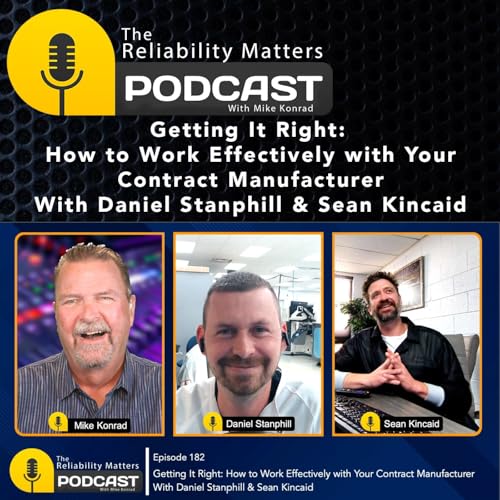
  • Getting it Right: How to Work Effectively with your CM - With Daniel Stanphill & Sean Kincaid
    Dec 9 2025
    Today, we’re continuing our dive into the world of contract manufacturing—a vital piece of the electronics ecosystem.

    Joining me are two industry leaders who know this space inside and out. First, we have Daniel Stanphill, SMT Process Engineer at Aurora Boardworks, and alongside him, Sean Kincaid, President of K & F Electronics.

    Both Daniel and Sean represent companies that provide contract manufacturing services to a wide range of customers, helping turn design concepts into dependable, production-ready circuit assemblies.

    In this conversation, we’ll explore what makes for a successful relationship between contract manufacturers and their customers. We’ll talk about the types of customers they look for, the challenges they face in today’s manufacturing environment, and the common mistakes that can derail a project if not addressed early on.

    Most importantly, we’ll dig into best practices that can help customers and manufacturers work together more effectively.

    You may recognize Daniel and Sean. In addition to their day jobs, Daniel and Sean, along with Elias Malfavon Jr. are also co-hosts of the d-code podcast, where they share candid conversations and insights from across the electronics industry.

    We’ll hear what inspired them to launch the show and how it ties into their mission of building stronger connections in this field.

    So whether you’re an engineer, a buyer, or anyone working with contract manufacturers, this episode is packed with advice to help you navigate the process with confidence.

    Daniel is an SMT Process Engineer at:
    Aurora Boardworks
    https://auroraboardworks.com

    Sean is President of:
    K & F Electronics
    https://www.circuitboards.com
    Más Menos
    1 h y 6 m