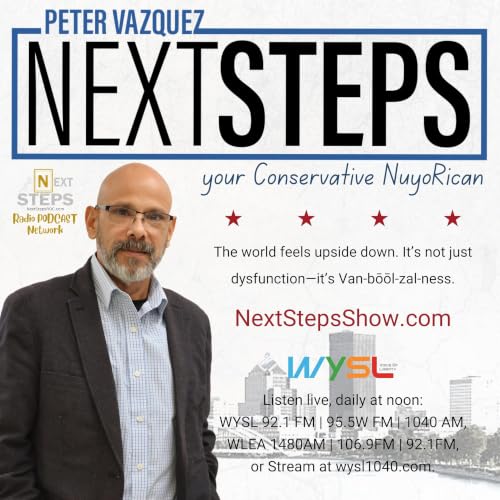
Next Steps Show Podcast Por Peter Vazquez arte de portada

Next Steps Show

Next Steps Show

De: Peter Vazquez
Escúchala gratis

This is a gathering forged to awaken conviction and stir resolve, where Faith, Politics, and Entrepreneurship converge as pillars shaping the destiny of We the People. We educate with purpose, challenge with clarity, and equip individuals to reclaim stewardship over their lives and communities. Through fearless truth and real solutions, we restore balance in belief, governance, and enterprise. This is more than conversation. It is a summons. Juntos, podemos restaurar el equilibrio y trazar el camino hacia un futuro próspero.

Copyright 2022 The Next Steps Radio POSCAST Network. All rights reserved.
Ciencia Política Ciencias Sociales Política y Gobierno
Episodios
  • The Ballot, the Ledger, and the Fight for Trust
    Jun 22 2026
    A republic is not defended first in marble buildings. It is defended behind a curtain. It is defended in the small, private space where a citizen stands alone with conscience, ballot, and God. That space is supposed to be sacred because the vote is supposed to belong to the voter, not to a party, not to an elected official, not to a campaign worker, not to a political machine that has grown too comfortable walking where it does not belong. This conversation began there, at the line between assistance and influence. The allegation was serious: Monroe County Legislator Rose Bonnick, while appearing on the primary ballot and while connected professionally to Senator Jeremy Cooney’s office, was accused of bringing voters into the polling place at Staybridge Suites and accompanying them behind the curtain under the banner of voter assistance. The issue was not treated as rumor for sport. It was treated as a civic alarm. Mercedes Vazquez called in and sharpened the matter into a demand for accountability, calling on Senator Cooney’s office and Monroe County Democrats to denounce the conduct and urging investigation into what she described as possible abuse of power. The law matters here because the curtain matters. New York Election Law allows voter assistance under narrow circumstances, including blindness, disability, or inability to read or write. The assister is not free to persuade, steer, induce, or reveal what happens inside the booth. New York law also bars electioneering inside polling places and within the protected distance outside them. In plain language, helping a voter is one thing. Turning assistance into influence is another. When the person allegedly assisting is also on the ballot, the public has every right to demand answers. That was the first wound of the hour: election integrity is not merely about machines, rolls, mail ballots, citizenship checks, or lawsuits. It is about whether the voter remains sovereign at the precise moment power wants access to the hand holding the pen. Mark Johns entered the discussion from the Assembly District 130 race and widened the lens. His focus on term limits and election trust pointed to a deeper disease: systems that protect incumbency, discourage competition, and reward political machinery over citizen energy. He warned that voters cannot trust elections if they believe influence is happening before, during, or after the vote. His argument was blunt: election integrity starts before the ballot is cast and does not end until the people believe the process was clean. Then the conversation moved from the booth to the books. Joseph Hernandez, candidate for New York State Comptroller, brought a different but connected warning. Born in Cuba, the son of a political prisoner, he left communist rule at seven years old and arrived in America through the hard mercy of exile. His story carried the weight of a man who does not romanticize government power. He understands that when power is not watched, it grows. When money is not guarded, it is used. When institutions lose moral discipline, they begin speaking the language of public good while quietly serving political control. That is why the Comptroller’s race belongs in the same hour as election integrity. One protects the ballot. The other protects the ledger. Both ask the same question: who is watching the people who claim to be watching out for us? The New York State Comptroller is not merely a bookkeeper with a title. The office audits government, reviews contracts, monitors public spending, and serves as sole trustee of one of the largest public pension funds in America. The New York State Common Retirement Fund closed the 2025–26 fiscal year at an estimated $295.4 billion after an 11.94% annual return. That fund represents promises made to public workers, retirees, and beneficiaries. It also represents obligations backed by taxpayers. If politics corrupts investment discipline, retirees and taxpayers both stand in the blast radius. Hernandez framed the office through fiduciary duty, not ideology. Pension money, in his view, should chase performance, not political fashion. Audits should not be polite paperwork after the damage is done. They should be alarms. Contracts should not be rubber-stamped through a maze of friendly insiders and bureaucratic fog. Public money should never be treated as government property. It was earned first by citizens. That is where the moral thread tightened. A polling booth can be abused by influence. A pension fund can be abused by ideology. A campaign-finance system can be abused by insiders who understand how to turn small-dollar rules into public money. A state can talk about compassion while creating dependency. A party can talk about democracy while resisting scrutiny. A government can say “trust us” while citizens keep finding reasons not to. New York’s public campaign-finance system became part of the same ...
    Más Menos
    49 m
  • When the Bill Comes Due
    Jun 16 2026
    There is a moment when a country stops arguing about policy and starts asking a deeper question: who is this system really serving? That question moved through today’s conversation like a warning bell. It began in the shadows of intelligence power, where Peter Vazquez spoke with author, investigator, and Discussions of Truth host Ian Trottier about High Stakes Treason and the allegations surrounding John Brennan, counterterror authority, secrecy, and the machinery built after 9/11. The issue was never merely one man or one agency. It was the old and dangerous temptation of power: build something in the name of protection, hide it behind classified language, fund it with billions, and then ask ordinary citizens to trust what they are not allowed to see. That is where public trust begins to rot. When Americans hear that trust in the federal government has not risen above 30% since 2007, and that the CIA’s positive job rating fell to 30% in 2025, they are not reacting to one headline. They are reacting to years of being told that institutions are above question while those same institutions grow larger, richer, and less accountable. The intelligence budget alone tells the story in numbers too large to ignore: $73.3 billion appropriated for the FY2025 National Intelligence Program, with the FY2026 request rising to $81.9 billion, while military intelligence requested another $33.6 billion. That is more than money. That is power with a locked door. Then the conversation came home, because the same disease has local symptoms. It shows up in the grocery aisle, where families stare at meat prices and wonder why every trip to the store feels like a quiet punishment. Washington says monopoly. Farmers say regulation. Callers say family farms are being squeezed out, swallowed by scale, compliance, foreign ownership, processing bottlenecks, and a food system that makes the people closest to the land feel farthest from control. When four companies dominate much of the meatpacking market and families are told the answer is another federal fix, the question becomes unavoidable: how many government solutions have already been folded into the price of dinner? The issue is not whether consolidation matters. It does. The issue is whether politicians are brave enough to name the full cost stack: taxes, fuel, insurance, labor rules, imports, energy, compliance, litigation, and the slow death of local control. A small farm is not just an economic unit. It is inheritance. It is memory. It is a father teaching a son before sunrise, a mother keeping books at the kitchen table, a family holding land against the pressure to sell. Lose enough of that, and America does not just lose farms. It loses rootedness. That same hidden cost appears in New York’s Scaffold Law, where the price of building becomes another invisible tax on every homeowner, business owner, renter, and taxpayer. When construction insurance costs are estimated to run hundreds of percent higher than nearby states, the bill does not vanish. It moves. It lands in rent. It lands in housing. It lands in maintenance. It lands in the family trying to fix a roof, the business trying to expand, the tower crew that will not even take the job because the risk is too high. New York does not merely tax earnings. It taxes effort. It taxes repair. It taxes the courage to build. And then came Kyra’s Law, the part of the conversation that should stop every argument cold. A two-year-old child killed during court-ordered unsupervised visitation. A mother who warned. A system that did not listen. A decade-long fight to force family courts to treat child safety not as a footnote, but as the floor beneath the entire decision. There are policies that affect wallets, and there are policies that touch the grave. This one does both, because when government fails to protect children, every claim of compassion becomes suspect. The show moved from there into culture, where Robert De Niro’s words became more than celebrity outrage. They became a portrait of conditional patriotism: love of country suspended until the correct people are in charge. That is not dissent. Dissent argues because it loves what can still be saved. Conditional patriotism withdraws love as punishment. It mistakes political disappointment for moral superiority. America is not lovable because Washington behaves. America is lovable because mothers still pack lunches, fathers still go to work, veterans still carry scars, farmers still fight the soil, churches still open their doors, and citizens still have the right to speak even when their words are foolish enough to need a helmet. And finally, the ballot box. Monroe County’s early voting numbers became the mirror no one gets to dodge. Three days, 3,223 early votes. Democrats at 3,098. Republicans at 124. Women outpacing men. Older voters carrying the civic weight. Younger voters barely visible. Whatever the reason, ...
    Más Menos
    49 m
  • Framing the Fight, Feeding the Neighbor
    Jun 15 2026
    There are days when the country feels less like a republic and more like a courtroom with bad lighting, where every headline arrives already framed, every cultural event becomes evidence, and every citizen is asked to pick a side before anyone is allowed to ask what actually happened. The conversation began with a fight on the White House lawn, but the real fight was never inside the Octagon. It was in the frame around it. A UFC event at the White House became a national Rorschach test: strength to some, spectacle to others, scandal to the people who have apparently never noticed that politics has been theater with worse costumes for decades. Peter Vazquez and Bob Savage pressed into the deeper question with Nick Kangadis, Senior Content Creator at MRC Video: not merely whether the event was good or bad, but what the media’s reaction revealed about its instincts. Nick brought the lens where it belonged. The outrage was not just about combat sports. It was about Trump, cultural power, masculinity, and the press recoiling at a crowd it does not understand and often despises. The same media class that treats celebrity resistance as civic virtue suddenly discovered the dignity of public space when the spectacle belonged to the wrong political tribe. That is the Vanbōōlzalness Crisis in miniature: one spectacle is democracy, another is danger; one crowd is brave, another is crude; one stage is noble, another is a threat. The conversation moved from UFC to “No Kings,” from Jane Fonda and Robert De Niro to the old machinery of elite activism, where Hollywood veterans gather under First Amendment banners and pretend that dissent is endangered while they broadcast their contempt into every open microphone they can find. The irony is not subtle. In a country with an actual king, these events would not happen. In America, they get lighting, amplification, donor networks, celebrity branding, and press coverage. Nick cut through that contradiction with the blunt force of lived observation: these protest movements often look less like spontaneous uprisings and more like staged productions, complete with color-coded shirts, professional signage, shifting slogans, and donor-facing theater. Then came The View, which may be daytime television, but it is also a political mood factory. The reported Media Research Center findings cited in the conversation were sharp: in 2025, The View had 341 total guests, 128 liberal guests, and only two conservatives. That does not sound like balance. That sounds like one ideological neighborhood pretending to host a town hall. Nick’s point was not that J.D. Vance could not handle it. It was that the setup itself tells the story. Five voices, one worldview, one conservative guest, and a studio built for ambush disguised as conversation. But the hour did not stay in Washington. It came home. Diane Miller of Advantage Federal Credit Union joined Peter to talk about something quieter, smaller, and arguably more important than the noise of national politics: a food drive. Not a theory. Not a slogan. Not a press conference. Food. Bags of groceries. Local branches. Members donating. Staff competing in good faith to collect more. A Saturday distribution at 1625 Mount Hope Avenue where families in need could pull up and receive help without proving their pain to a clipboard. That was the emotional turn of the hour. After the spectacle, a branch lobby. After the national argument, a local pantry. After the accusations, a bag of food passed through a car window. Diane explained that the effort began with branch managers who wanted to do something real for the community. The drive ran for more than eight weeks across seven locations, with internal and external promotion, friendly competition, and a back area at Mount Hope packed with donations. No bureaucracy. No humiliation. No interrogation. Just help. That matters because hunger is not theoretical. Foodlink says it serves the Greater Rochester and Finger Lakes region by addressing both hunger and poverty, and its mission is to “leverage the power of food to end hunger and build healthier communities.” It distributes millions of pounds of food annually and prepares more than 2 million healthy meals for students. Nationally, Feeding America’s Map the Meal Gap data has placed food insecurity around 14.3 percent, with roughly 47 million Americans affected. Those numbers are not abstractions. They are cupboards, paychecks, gas tanks, grocery aisles, and parents doing math with dread in their throat. Diane’s segment carried the old credit union spirit: community is not just where business happens; it is where responsibility happens. A branch can be more than a place to cash a check. It can become a civic altar of practical mercy. A food drive can become a rebuttal to cynicism. One person can make a difference, not because one person can fix everything, but because one person can join the ...
    Más Menos
    50 m
adbl_web_anon_alc_button_suppression_t1
Todavía no hay opiniones