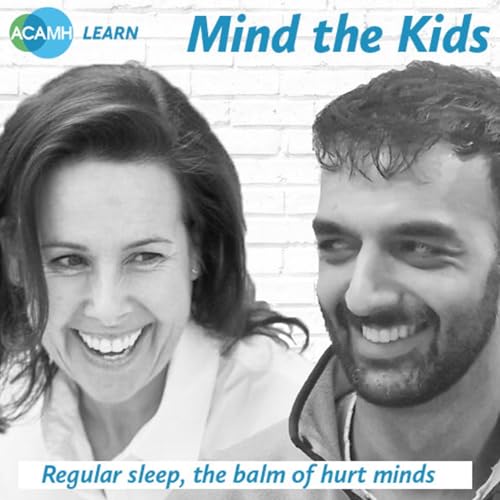
'Mind the Kids': an ACAMH podcast Podcast Por The Association for Child and Adolescent Mental Health arte de portada

'Mind the Kids': an ACAMH podcast

'Mind the Kids': an ACAMH podcast

De: The Association for Child and Adolescent Mental Health
Escúchala gratis

These podcasts are an invaluable resource for anyone interested in child and adolescent mental health. They bridge the gap between rigorous research and practical application, featuring expert discussions on mental health. Each episode highlights cutting-edge studies offering insights into findings, and implications for practice.

The series caters to clinicians, researchers, and those interested in mental health. Available on major platforms like Spotify and Apple Podcasts, it’s an accessible way to stay informed about advancements in the field.

Visit our website for a host of free evidence-based mental health resources.


© 2025 Association for Child and Adolescent Mental Health. All Rights Reserved.
Ciencia Ciencias Sociales Higiene y Vida Saludable Psicología Psicología y Salud Mental
Episodios
  • S7 Ep7: Mind the Kids ‘Regular sleep, the balm of hurt minds'
    Apr 15 2026

    Why do some teenagers seem permanently jet lagged, wide awake at midnight and exhausted at 8am? And what does that actually do to their mood, their learning, and their long term mental health?

    In this episode of Mind the Kids, titled ‘Regular sleep, the balm of hurt minds’, Dr. Konstantin Drexl joins hosts Dr. Jane Gilmour and Professor Umar Toseeb, to unpack the science of adolescent sleep: from what terms like chronotype, circadian rhythm and REM sleep really mean, to how sleep loss and anxiety feed into each other in everyday life.

    Together, they explore why regular sleep can act as a protective factor for some young people, why others seem especially sensitive to even small disruptions, and what this might mean for school start times, smartphones at bedtime, and whole family sleep hygiene. Whether you are a parent, teacher, clinician or researcher, this conversation offers clear, practical insights into how supporting teenage sleep could be one of the simplest ways to support teenage minds.

    You can read the main JCPP Advances paper discussed in this episode, “Toward an idiographic understanding of the role of sleep-mood dynamics in adolescents' internalizing symptoms” https://doi.org/10.1002/jcv2.70082

    Get a free CPD/CME certificate for listening to this podcast by registering for a FREE ACAMH Learn account at https://www.acamhlearn.org

    Visit https://www.acamh.org
    Facebook and LinkedIn search / ACAMH
    Instagram https://www.instagram.com/assoc.camh
    Bluesky https://bsky.app/profile/acamh.bsky.social
    X https://x.com/acamh

    Más Menos
    45 m
  • S7 Ep5: Children with MID, a multi-factored intervention offers best protection
    Apr 8 2026

    Children with mild intellectual difficulties are often overlooked, but the evidence suggests they may face real challenges in emotional wellbeing, behaviour and education, especially when support is patchy or late.

    In this Mind the Kids episode, Dr. Foteini Tseliou joins hosts Dr. Jane Gilmour and Prof Umar Toseeb to discuss the paper 'Factors Associated with Better Emotional, Behavioural and Educational Outcomes in Children with Mild Intellectual Disabilities'.

    They highlight three big messages: many children with mild intellectual difficulties are in mainstream schools and may not be formally identified; peer relationships emerge as one of the strongest protective factors across outcomes; and it is the accumulation of support across home, school and friendships that seems to matter most, rather than any single intervention on its own.

    At the same time, the conversation makes clear that outcomes are not fixed by IQ. With the right support, many children with mild intellectual difficulties can do well, and the protective factors that help them often help other children too – which makes a strong case for universal, inclusive provision rather than waiting until problems become severe.

    You can read the main JCPPA Advances journal paper discussed in this episode, “Factors associated with better emotional, behavioural and educational outcomes in children with mild intellectual difficulties” https://doi.org/10.1002/jcv2.70072

    Get a free CPD/CME certificate for listening to this podcast by registering for a FREE ACAMH Learn account at https://www.acamhlearn.org

    Visit https://www.acamh.org
    Facebook and LinkedIn search / ACAMH
    Instagram https://www.instagram.com/assoc.camh
    Bluesky https://bsky.app/profile/acamh.bsky.social
    X https://x.com/acamh

    Más Menos
    45 m
  • S7 Ep4: Mind the Kids 'Adolescence and Appearance. AI eat your words'
    Apr 1 2026

    AI chatbots can feel warm, human and tailored, but this brings real risks when the advice is wrong or incomplete, especially for vulnerable young people with eating or body-image concerns.

    In this Mind the Kids episode “Adolescence and Appearance. AI eat your words”, Dr. Florence Sheen talks to hosts Dr. Jane Gilmour and Prof Umar Toseeb.

    They highlight three big issues: we rarely know what sources the chatbot is drawing on; there is no built‑in safeguarding link back to parents, schools or services; and its list‑style “here’s what to do” responses may particularly appeal to perfectionistic or rigid thinkers, potentially fuelling disordered behaviours rather than challenging them.

    At the same time, young people are using AI alongside social media and official sites in quite a savvy way – they might go to the NHS for physical symptoms, but to chatbots for lived experience and emotional validation – so opinion and evidence are constantly blended. The Florence, Jane, and Umar argue this makes digital literacy crucial: talk openly with young people about what they see, encourage them to check information against other sources, and model responsible use rather than banning AI outright.

    They also call for independent, transparent evaluation of any AI tools aimed at youth mental health, and for developers to work with researchers, clinicians and people with lived experience so that future systems are both safer and better able to support real-world wellbeing.

    You can read the main CAMH journal paper discussed in this episode, “How do Artificial Intelligence chatbots respond to questions from adolescent personas about their eating, body weight or appearance?” https://doi.org/10.1111/camh.70047

    Get a free CPD/CME certificate for listening to this podcast by registering for a FREE ACAMH Learn account at https://www.acamhlearn.org

    Visit https://www.acamh.org
    Facebook and LinkedIn search / ACAMH
    Instagram https://www.instagram.com/assoc.camh
    Bluesky https://bsky.app/profile/acamh.bsky.social
    X https://x.com/acamh


    Más Menos
    53 m
Todavía no hay opiniones