Episodios

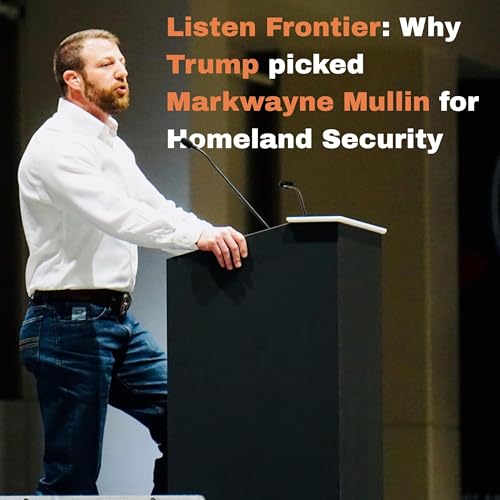
  • Why Trump picked Markwayne Mullin for Homeland Security
    Mar 6 2026

    Today on the Listen Frontier podcast, we’re talking about one of the more surprising political shakeups in Washington — the firing of Kristi Noem and the appointment of Oklahoma Sen. Markwayne Mullin to replace her.

    Noem was abruptly pushed out of her role leading the Department of Homeland Security by President Donald Trump, setting off a scramble over who would take over one of the federal government’s most powerful agencies — responsible for border security, immigration enforcement, disaster response and counterterrorism.

    Trump’s pick of Oklahoma Senator Markwayne Mullin stunned many. If confirmed, Mullin would leave what is often considered one of the most secure jobs in American politics — a U.S. Senate seat — to take on a Cabinet position in an administration known for frequent turnover.

    To help us break down what happened, why Mullin might take the job, and what it could mean for Oklahoma politics, I’m joined by Reese Gorman.

    Reese is a national political reporter for NOTUS covering Congress and the Trump administration. Before that, he worked here in Oklahoma as a reporter for The Frontier.

    Más Menos
    21 m
  • Salty, oily drinking water left sores in their mouths. Oklahoma refused to find out why.
    Feb 11 2026
    In our latest investigation, reporter Nick Bowlin digs into a troubling question: What happens when families report salty, oily drinking water that leaves sores in their mouths — and the state declines to determine the cause? In “Salty, oily drinking water left sores in their mouths. Oklahoma refused to find out why,” Nick traces complaints of oilfield contamination, examines how regulators responded and explains why key questions remain unanswered. In this conversation, he takes us behind the scenes of the reporting, the documents that shaped the story and what it reveals about oversight of oil and gas pollution in Oklahoma.Dylan Goforth: When you first heard about the Boarmans’ situation, what made you think this wasn’t just a private well problem but a story about the state’s oil and gas regulator? What was the moment where the story “clicked” for you?Nick Bowlin: After my initial conversations with Tammy and Chris, I sent in an open records request with the state. Once I got the files and began to read, the click happened pretty fast. I saw that officials at the OCC had found strong signs of oil and gas pollution using a number of different metrics and tests. And this was for a house that sits in the middle of a legacy oilfield, drilled in the 1940s. Old wells plugged with mud – a common practice at the time – surround their house. But all this evidence didn’t seem to lead to urgent action. The agency slow-walked testing nearby oil and gas operations and water sampling for heavy metals. And when they finally ran those tests, they found problems. People all over the state are dealing with pollution threats from historic and current oil and gas. Tammy and Chris were unusually proactive in pushing the state to help them and trying to learn all they could about their situation. If this is how the state handled the Boarmans’ case, it didn’t bode well for other Oklahomans coming to the OCC for help.Dylan: A huge part of this story relies on internal emails, test results and agency reports. How did you go about getting those records, and what was the most surprising or revealing document you found?Nick: I relied primarily on open records requests to the OCC. My first one took a while, since my request covered over a year of agency work on the Boarmans’. But after that, I could submit requests covering only a few months at a time and the agency tended to return these promptly. To my mind, the most revealing set of emails come from September 2024, after the Boarmans’ state senator got involved. His arrival seemed to spur the state to finally order long-delayed tests. I was also struck by the electromagnetic survey images: For the most part, oil and gas reporters don’t get to see the pollution we report on. Leaks happen deep below our feet, while CO2 emissions are invisible. But those images taken by the agency offered a rare and disturbing picture of the pollution plume contaminating the Boarmans’ drinking water.Dylan: There are several points in the story where agency staff appear to know more than the Boarmans do about what’s happening to their water. How did you piece together that timeline of who knew what, and when?Nick: I built out a detailed chronology, based on the records I received and interviews with the Boarmans’. It wasn’t hard to do that with the agency emails. But I also built a timeline of the evidence. There isn’t a single test that definitively proves oil and gas contamination. Instead, the state relied on an accumulation of data, evaluating things like salts, the presence of certain metals, chemical ratios and the belowground electromagnetic maps. That was a useful exercise: to see the growing pile of evidence pointing to oil and gas, compared to the agency’s handling of the Boarmans’ pollution case.Dylan: The McCoon injection well becomes central to the story. How did you figure out it might be a key suspect, and what did you have to learn about injection wells and groundwater science to understand what was going on?Nick: I looked into the McCoon simply because the state flagged it as a problem well. Internal emails noted its checkered operational history and proximity to the Boarman house. And a report commissioned by the state about the Boarman case offered a number of recommendations; the McCoon was the only nearby well singled out for further testing. But near the McCoon are a number of poorly plugged wells, all of them potential pollution threats. It’s not hard to envision these wells working together, with wastewater rising up the poorly plugged wellbores. The report I mentioned just now talks about the pollution possibly spreading through“complex pathways.” That’s the thing about these oil and gas pollution cases: they’re incredibly complex and definitively proving a culprit is an enormous challenge. The state ultimately told Tammy and Chris that it could not find where the pollution originated and closed their case.Dylan: ...
    Más Menos
    22 m
  • ‘The risk is moving too slow’: How Oklahoma's government wants AI to reshape the state's economy
    Jan 21 2026

    Frontier: Hey everyone. Welcome to another episode of listen frontier today. I am joined by Hart Brown, the president of artificial intelligence and transformation at Saxum. He also helped author Governor Stitt's Artificial Intelligence strategy for the state. Thanks for joining us today. I wondered if you would tell us a little bit first about yourself, your background and how you got involved in this project and in this area.

    Hart Brown: You bet. Coming out of school, I was doing a lot of work in what we now refer to as predictive analysis, so algorithmic based decision making, using math to help understand what's likely to happen and then make the best decisions you possibly can.

    I had a number of people come to me and say Hart, can you build an artificial intelligence system that can do what you do on paper in real time? I answered. I said let's find out. It sounds really interesting. At that time, there was really only one system that anybody could really use, and that was IBM Watson. And so I built an artificial intelligence system on top of IBM Watson to be able to leverage this algorithm in real time. And got very good success.

    Frontier: So let's talk about the governor's report a little bit. The document calls itself a forward thinking approach, which is right means, in a lot of ways, that some of it is aspirational in a sense that we're at a point where we don't exactly know where we're going to end up with AI. What are some of the concrete things that Oklahoma could do in the next six months, 12 months that are realistic to embrace AI better or better understand how it’s shaping Oklahoma?

    Hart Brown: It’s really important to understand that we're really talking about a longer timeline. So some elements of that are going to happen closer to a two year time frame. Some may be a little bit further out now. We're transitioning from a period of time where artificial intelligence really kind of felt like a toy. It was interesting, it was fun. We all started to use it. We downloaded the apps. We were making pictures and lots of different things. Oklahoma is in a relatively low unemployment environment, meaning it's hard for Oklahoma employers to find good people to hire, and so with that, let's use the technology. Let's grow the businesses as quickly as we can by leveraging that in a responsible and reasonable way.

    Frontier: Is it even possible at this point to have guardrails, or to know what the guardrails would even be? At some point, it will start to affect people's jobs. You mentioned low unemployment, people having difficulty filling some of these positions that maybe AI could replace, but at some point people's jobs will be what's being replaced. And so are there guardrails to protect workers? Or how should people approach that part of the discussion?

    Hart Brown: From an economic productivity perspective, I need everybody working and I need everybody using the technology. If the technology replaces people in this ecosystem, I don't get the economic value out of the system at the end of the day. And really what we're seeing in the next two to three years, whichever country maximizes its potential related to artificial intelligence, is likely to be the dominant economic country for the next 75 to 100 years. So first and foremost, I need everybody in the ecosystem being productive.

    It doesn't make sense for us to have a broad based disruption of the employment environment, because we don't win at the end of the day. We won't be the dominant economic country. So I'm very optimistic that if we do see that turbulence, that we have enough opportunities to resolve that before it really becomes a problem.

    Frontier: Looking at the strategy and at this report, if we revisit it in five or 10 years, what would success look like in Oklahoma, and what would count as a failure that Oklahoma should be willing to try to avoid?

    Hart Brown: Five years is a great horizon. What I would love to be able to say is that Oklahoma is at the forefront of artificial intelligence and advanced technology for the country and the world, which absolutely we have that that opportunity, I would say, from an economic perspective, that we've grown our economy by 40% here in the state overall by being able to do This, and that is a benefit to every single individual here in the state. So those two things, I think, are incredibly important for us moving forward, and we can accomplish that in a five year window.

    Más Menos
    28 m
  • Inside the legal fight over immigration detention in Oklahoma
    Dec 19 2025

    Immigration detention usually happens out of public view — inside private prisons, through sealed court filings, and far from scrutiny. But in Oklahoma, those cases are starting to surface.

    In recent months, immigrants who’ve lived in the U.S. for years — some for decades — have been jailed for months without bond hearings, even when they have no criminal convictions and deep ties to their communities. Their only path to release has been through habeas corpus petitions filed in federal court.

    At the same time, Oklahoma is becoming a growing hub for immigration detention as private prison companies expand their footprint.

    Our reporter, Ari Fie, has been digging into these cases to understand who’s being detained, why this is happening now, and what it means for due process. I spoke with her about what she found.

    Más Menos
    8 m
  • Listen Frontier: Clifton Adcock on the Real Impact of Oklahoma’s Data-Center Explosion
    Dec 12 2025

    For the past several months, Frontier reporter Clifton Adcock has been digging into one of the fastest-moving — and least transparent — developments in Oklahoma: the rapid rise of data centers. These facilities promise big investment, but they also bring enormous demands for power and water, and much of the planning has happened out of public view.

    In this week’s Q&A, Clifton walks us through how he pieced this story together: from tracking down hard-to-find utility filings to decoding dense regulatory documents and uncovering data center projects that weren’t publicly disclosed. He also talks about the challenges of explaining highly technical issues in a way readers can understand, and what surprised him most as he followed the money, energy, and incentives behind Oklahoma’s data-center boom.

    Read the story: Oklahoma’s data center boom is about to hit the grid — and your power bill

    Más Menos
    16 m
  • Listen Frontier: Are Oklahoma classrooms too wired for learning?
    Oct 17 2025
    Frontier: We spoke back in the spring about the cellphone bill you ran that would remove cell phones from classrooms. Catch our listeners up on where that stands today. Seifried: It’s been in effect for almost two months in Oklahoma, and the results and the feedback have just been amazing. I heard from schools and administrators early on, talking about the lunchrooms being louder and the hallways being more crowded. My favorite recent anecdote is library books are being checked out at a higher frequency than at this point last year, so a lot of really positive feedback.Frontier: That kind of leads us into what we're talking about today, which is you have an interim study about technology in schools. So tell us a little bit about that study and what you hope to learn from it.Seifried: Yeah, this study sort of really dovetails off of my work on removing cell phones, because as I went around the state and talked about it over the last two years, I would meet with parents who were concerned about the use of screens and laptops in their child's classrooms. And they would question if learning was happening, or how much students are using screens. And at first, I sort of didn't want to become the anti-screens girl. But I think it's a good conversation to have. This study got to be a little bit more academic. We got into the neuroscience of how we learn and or how we don't learn. I also serve as chair of the technology committee, so I sort of get to wear these two really fascinating hats. As we're trying so desperately to increase our academic achievement, I want us to make sure that we're doing the right things. And maybe the right thing isn't the new and shiny technology or the new and shiny software, or this platform that promises the moon.Frontier: That’s not only a conversation that's taking place as it relates to schools. Right now, what's the main conversation we’re having in the state? It's AI, it's about data centers, the impact of this technology and this industry. And there is that discussion among adults, too, about the use of AI as a tool. Is it productive to give your creative juices to a computer as opposed to just doing this yourself? How much of our brain power are we giving over to computers? And does that, in a sense, make us less human? You have mentioned technology and how it should be used, with caution, as a teaching tool. And I just kind of wondered at this point in this process, what evidence would you want to see before deciding if a specific type of technological platform or in-class technology is truly improving learning outcomes?Seifried: One of the main things that we really took away was there are a lot of things that can improve educational outcomes. Like the air conditioning, or just a little bit of extra tutoring that kind of moves the needle. But what we should be asking, really, is not, does this move the needle, but does this move the needle better than something else. So for example, if we spend $10 million on this software across the state of Oklahoma, is that going to move the needle for our students more than taking that $10 million and investing it into our teachers or our reading specialists or giving stipends to teachers who are just crushing it in the classroom?AI is an amazing tool. But you have to master those foundational educational blocks, right? You have to be able to do the hard thing first. One of our speakers likened it to learning how to drive. If you learn to drive a stick shift, and then you go to automatic, no problem. But if you start with an automatic and you go stick, you have so much more difficulty going backwards and mastering those topics. And so I just wondered, do these softwares and platforms and AI chat bots really help us learn more than a quality teacher sitting down and working with your student?Frontier: You're essentially talking about opportunity cost here. If you’ve got $10 million to add some technology to classrooms, could that $10 million get you better results in another way? You’ve mentioned investing in some proven supports, like reading specialists,or upping teacher pay, instead of this theoretical technology that might possibly make something in the classroom better. Do you think that maybe there's too much focus or too much spending on tech for classrooms, and not enough focus and not enough spending on more traditional support systems for students?Seifried: That's a really hard question. But that was my point – I want to start talking about it, because I want to start framing these discussions and investments. I've been on the Appropriations Committee, and everyone has the best shiny thing, that this will be the silver bullet, and this will be the unicorn. And I think sometimes just the old fashioned way (is best.) And so I started to take that same principle into spending. Sometimes just hard work, or doing it the old fashioned way, is actually the right way. Frontier: I think that's probably a good lesson ...
    Más Menos
    21 m
  • Numbers Game: Drummond, McCall, and the road to the 2026 Oklahoma Governor election
    Oct 8 2025

    klahoma voters won’t choose their next governor for another year, but the Republican primary is already heating up. Recent polling from former Oklahoma House Speaker Charles McCall’s campaign suggests the race between McCall and Attorney General Gentner Drummond is closer than you might think. But as other candidates begin to join the fray, the Drummond camp says that’s not true.

    The survey, conducted September 23–25, found Attorney General Gentner Drummond leading with 35% support, closely followed by House Speaker Charles McCall at 33%, while 32% of respondents remained undecided.

    The Frontier spoke with pollster Chris Wilson about his recent survey for the McCall campaign and Matthew Parker, Drummond’s campaign chairman, about how the candidates are positioning themselves to voters. The following is a condensed transcript of the conversation. For the full interview, listen to our podcast. The margin of error is 3.5%.

    Más Menos
    40 m
  • Stitt defends Tulsa homeless crackdown as local shelter calls for empathy
    Sep 15 2025

    This week on Listen Frontier, we’re looking at Operation SAFE, Governor Kevin Stitt’s effort to clear homeless encampments in Tulsa with the help of the Oklahoma Highway Patrol.

    The Frontier sat down with Gov. Stitt, who told me the operation isn’t about solving homelessness, but about enforcing the law. He said Oklahomans are experiencing “compassion fatigue,” and that many of the people removed from encampments “didn’t want help.”

    We also spoke with Steven Whitaker, CEO of Tulsa’s John 3:16 Mission, who offered a different view. Whitaker acknowledged the risks of being too compassionate, but stressed that the people living on Tulsa’s streets are our neighbors, and most of them are in desperate need of empathy, shelter, and support.

    Together, their perspectives paint a complicated picture of homelessness in Tulsa, and the deep divide over how the state and city should respond.

    Más Menos
    38 m