Episodios

  • Podcasts That Are Different: How The Law Enforcement Talk Podcast Reaches Millions for Free.
    Dec 27 2025
    Podcasts That Are Different: How The Law Enforcement Talk Podcast Reaches Millions for Free. Podcasting has officially entered the mainstream. What was once a niche medium for early adopters is now a dominant force across news, entertainment, and social media, reaching audiences on Apple Podcasts, Spotify, YouTube, Facebook, Instagram, LinkedIn, and beyond. Look for The Law Enforcement Talk Radio Show and Podcast on social media like their Facebook , Instagram , LinkedIn , Medium and other social media platforms. Today, 85% of people in the United States are familiar with the term “podcast,” a figure that represents a 10% increase since 2020. Familiarity does not necessarily mean regular listening, but it does signal cultural awareness. As podcasts are referenced more frequently on radio, television, and online platforms, they continue to move out of the “podcaster bubble” and into everyday conversation. This special episode is streaming for free on the Law Enforcement Talk Radio Show and Podcast website, on Apple Podcasts, Spotify, YouTube, and most every major Podcast platform. By 2025, well over four in five Americans recognize the term podcast, a clear indicator that the medium has become part of the national media landscape. Supporting articles about this and much more from Law Enforcement Talk Radio Show and Podcast in platforms like Medium , Blogspot and Linkedin . Awareness Is One Thing, Listening Is Another Listening habits reveal just how powerful podcasting has become. In mid-2023, Edison Research reported a major shift in media consumption: on-demand audio, including podcasts and streaming music, surpassed traditional AM/FM radio in total listening time across the United States. Podcasts That Are Different: How The Law Enforcement Talk Podcast Reaches Millions for Free. Available for free on their website and streaming on Apple Podcasts, Spotify, Youtube and other podcast platforms. That trend has only accelerated. According to Infinite Dial data released in early 2025, 70% of Americans have listened to a podcast at least once, up from 55% in 2020. While listening dipped briefly in 2022 as pandemic routines normalized, both monthly and weekly consumption rebounded strongly in 2023 and has continued to grow. Podcasting, it is now clear, is no longer an experiment. It is a mainstream medium. A Podcast That Breaks the Mold Among the thousands of shows competing for attention, some podcasts stand out by doing things differently. One of those is the Law Enforcement Talk Radio Show and Podcast, a program built around police, crime, trauma, and real-life stories, delivered without cost and without filters. The Law Enforcement Talk Radio Show and Podcast episode is available for free on their website , Apple Podcasts , Spotify and most major podcast platforms. “It’s 100 percent free,” the show’s creator often emphasizes. “No subscriptions, no credit cards, and no paywalls. It never has been paid content, and it never will be.” That commitment to free access has helped the show grow into a nationally syndicated weekly talk radio program, now airing on 148 AM and FM commercial radio stations. Each week, the show is broadcast to an estimated 48 million people across the United States, in addition to its global podcast audience. Podcasts That Are Different: How The Law Enforcement Talk Podcast Reaches Millions for Free. Equally important is the show’s tone. “This isn’t a lecture, and it’s never a sales pitch,” the host explains. “It’s about personal experience. People telling their own stories, in their own words.” There are no scripted questions, no product promotions, and no partisan politics... ever, by design. The special episode can be found on The Law Enforcement Talk Radio Show and Podcast website, on Apple podcasts, Spotify, Youtube and on LinkedIn, Facebook, Instagram, and across most podcast platforms where listeners will find authentic law enforcement stories. More Than a Police Podcast Despite its title, the Law Enforcement Talk Radio Show and Podcast is not created solely for police officers. In fact, the audience is far broader. With more than 780 free episodes available, and new episodes released every Wednesday and Sunday, the show offers an expansive library of stories that resonate well beyond one profession. Each episode is a conversation, not an interview. Guests are encouraged to speak openly, allowing their experiences to unfold naturally. Podcasts That Are Different: How The Law Enforcement Talk Podcast Reaches Millions for Free. Approximately 75% of the episodes focus on trauma-related stories, often connected to crime. Guests include law enforcement officers, firefighters, paramedics, military members, victims of violent crime, survivors, and family members. These conversations explore the impact of trauma, not only on the individual, but on families, relationships, and long-term purpose. The full podcast episode is streaming now ...
    Más Menos
    12 m
  • Police Addicted to Drugs And His Amazing Recovery
    Dec 26 2025
    Police Addicted to Drugs And His Amazing Recovery, Special Episode. Police Officer Attacked, Multiple Surgeries, Forced Retirement, Addiction, and an Inspiring Recovery. This special episode is streaming for free on the Law Enforcement Talk Radio Show and Podcast website, on Apple Podcasts, Spotify, YouTube, and most every major Podcast platform Brock Bevell never imagined that a single violent moment would change the entire trajectory of his life. A retired Mesa, Arizona police officer, Brock dedicated his career to public service, until a targeted act of violence ended his time on the job and set him on a painful, unexpected journey through addiction and recovery. Look for The Law Enforcement Talk Radio Show and Podcast on social media like their Facebook , Instagram , LinkedIn , Medium and other social media platforms. “She threw the truck into reverse and hit me,” Brock recalls. “In an instant, everything changed.” Supporting articles about this and much more from Law Enforcement Talk Radio Show and Podcast in platforms like Medium , Blogspot and Linkedin . A Career Cut Short by Violence While serving with the Mesa Police Department, Brock was seriously injured during a violent incident involving a vehicle. The attack caused devastating, career-ending injuries and required multiple surgeries. What followed was a long and grueling rehabilitation process, one familiar to many injured officers across the country. Police Addicted to Drugs And His Amazing Recovery, Special Episode. Available for free on their website and streaming on Apple Podcasts, Spotify, Youtube and other podcast platforms. To manage the intense pain, Brock was prescribed opioid pain medication. Like countless patients recovering from serious injuries, he trusted the prescriptions meant to help him heal. Instead, they quietly became the beginning of a much deeper struggle. From Recovery to Addiction During months of surgeries and physical therapy, Brock developed a severe dependence on opioid painkillers. What started as medically prescribed relief slowly evolved into addiction. “I didn’t recognize myself anymore,” Brock says. “My world became smaller and darker. I was surviving, not living.” Brock openly shares how addiction affected every part of his life, his relationships, his identity, and his sense of purpose after forced retirement from policing. His story reflects a reality many first responders face but few openly discuss. Police Addicted to Drugs And His Amazing Recovery, Special Episode. The Law Enforcement Talk Radio Show and Podcast episode is available for free on their website , Apple Podcasts , Spotify and most major podcast platforms. The Science Behind the Crisis Research underscores just how common Brock’s experience is. A major study published in JAMA Internal Medicine by researchers at the Stanford University School of Medicine found that patients undergoing 11 common surgeries faced an increased risk of becoming chronic opioid users. Lead author Eric Sun, MD, PhD, explained: “For a lot of surgeries, there is a higher chance of getting hooked on painkillers.” The study defined chronic opioid use as filling 10 or more prescriptions or receiving more than a 120-day supply within a year after surgery. Patients undergoing knee surgery faced the highest risk, nearly five times that of nonsurgical patients, followed by gallbladder surgery. Importantly, the study did not suggest avoiding surgery, but emphasized the need for careful monitoring and alternative pain management strategies. Police Addicted to Drugs And His Amazing Recovery, Special Episode. The interview can be found on The Law Enforcement Talk Radio Show and Podcast website, on Apple podcasts, Spotify, Youtube and on LinkedIn, Facebook, Instagram, and across most podcast platforms where listeners will find authentic law enforcement stories. Trauma, Policing, and Substance Use Law enforcement officers face unique occupational hazards, including repeated exposure to trauma. Studies show that substance use disorders, including alcohol and drug dependence, occur at higher rates among officers, particularly those experiencing psychological distress. In nationally representative data, more than half of men with lifetime PTSD also had a history of alcohol abuse or dependence. For police officers, these risks are compounded by work stress, injuries, and the cultural stigma surrounding mental health and asking for help. “We wear the uniform, but we’re human,” Brock says. “And sometimes the damage doesn’t show until it’s almost too late.” The full podcast episode is streaming now on their website, on Apple Podcasts, Spotify, Youtube and across Facebook, Instagram, and LinkedIn. Hitting Bottom and Choosing Recovery Brock’s turning point came when he realized addiction had taken everything it could from him. With professional help, support, and unwavering determination, he entered recovery and committed to sobriety. ...
    Más Menos
    39 m
  • Working Undercover for the ATF
    Dec 24 2025
    Working Undercover for the ATF: His Journey, Special Episode. Working undercover for the ATF is not just a job, it is a life lived in shadows, deception, and constant danger. For Lou Valoze, a retired federal agent with the Bureau of Alcohol, Tobacco, Firearms and Explosives, that life became his reality for nearly a decade as he infiltrated some of the most violent criminal organizations in the United States. Look for The Law Enforcement Talk Radio Show and Podcast on social media like their Facebook , Instagram , LinkedIn , Medium and other social media platforms. His journey through police work at the federal level reveals the true cost of confronting violent crime head-on, while quietly removing thousands of illegal guns from the streets. This special episode is streaming for free on the Law Enforcement Talk Radio Show and Podcast website, on Apple Podcasts, Spotify, YouTube, and most every major Podcast platform A Life Lived Undercover Lou Valoze’s career stands apart even within federal law enforcement circles. As a long-term undercover ATF agent, he specialized in “storefront stings”, covert operations where agents create fake businesses to attract criminals involved in gun trafficking, drugs, and organized crime. Supporting articles about this and much more from Law Enforcement Talk Radio Show and Podcast in platforms like Medium , Blogspot and Linkedin . “These criminals believed I was one of them,” Valoze explains. “That was the only way to get close enough to stop them.” By posing as a gun runner, Valoze gained the trust of violent offenders, gang members, and organized crime groups. Over time, those relationships led to the seizure of more than a thousand illegal firearms and the arrest of countless dangerous individuals. Working Undercover for the ATF: His Journey, Special Episode. Available for free on their website and streaming on Apple Podcasts, Spotify, Youtube and other podcast platforms. From Business to Federal Law Enforcement Valoze’s path to undercover work was far from typical. With a background in economics and business, he initially pursued a career in banking. Everything changed after a chance conversation with an undercover Drug Enforcement Administration agent. “That single conversation flipped my entire future,” Valoze recalls. “I realized I wanted to serve, to make a real difference.” That decision led him to the Department of Justice and eventually to a 25-year career with the ATF, where his expertise reshaped undercover operations nationwide. Storefront Stings and Violent Crime Storefront stings became Valoze’s signature. These operations allowed ATF agents to dismantle criminal networks from the inside, identifying gun traffickers who fueled violent crime by supplying weapons to prohibited persons, gangs, and drug dealers. Working Undercover for the ATF: His Journey, Special Episode. The Law Enforcement Talk Radio Show and Podcast episode is available for free on their website , Apple Podcasts , Spotify and most major podcast platforms. “Storefronts gave us something traditional policing couldn’t,” Valoze says. “Time, access, and insight into how these groups really operated.” From 2006 to 2014, Valoze’s fictitious businesses served as magnets for criminal activity, resulting in thousands of guns seized and millions of dollars’ worth of drugs removed from circulation. The Toll of a Double Life While the successes were significant, the personal toll was heavy. Living undercover meant maintaining a constant dual identity, blurring the line between law enforcement and criminal persona. The interview can be found on The Law Enforcement Talk Radio Show and Podcast website, on Apple podcasts, Spotify, Youtube and on LinkedIn, Facebook, Instagram, and across most podcast platforms where listeners will find authentic law enforcement stories. “There were moments when it became hard to tell where the undercover role ended and where I began,” Valoze admits. That psychological strain, combined with the ever-present threat of exposure, became one of the most challenging aspects of his career. These experiences are documented in his book, Storefront Sting: An ATF Agent’s Life Undercover, co-authored with Brian Whitney. Working Undercover for the ATF: His Journey, Special Episode. Telling the Story: Book, Podcast, and Documentary Published in 2022, Storefront Sting offers an insider’s look at one of the most dangerous and successful undercover operations in ATF history. The book chronicles how small-time fencing schemes evolved into deep infiltrations of major criminal organizations. “This story needed to be told,” Valoze says. “Not for me, but so people understand what it takes to take violent criminals off the streets.” His work has since expanded beyond the book. Valoze now shares his journey through speaking engagements, podcast appearances on the Law Enforcement Talk Radio Show and Podcast available for free on ...
    Más Menos
    39 m
  • Is 19 Too Young To Be a Police Officer?
    Dec 21 2025
    Is 19 Too Young To Be a Police Officer? A Florida, USA Perspective on Trauma Impact and PTSD. Special Episode. At just 19 years old, Michael A. Laidler was already wearing a badge and responding to some of the most intense calls a police officer can face. Sworn in as a police officer in Tallahassee, Florida, USA, his early entry into law enforcement placed him on the front lines at an age when most of his peers were still navigating college life or their first civilian jobs. The question at the heart of this Special Episode is simple, yet deeply complex: Is 19 too young to be a police officer? Look for The Law Enforcement Talk Radio Show and Podcast on social media like their Facebook , Instagram , LinkedIn , Medium and other social media platforms. Michael’s story, shared through the Podcast available for free on the Law Enforcement Talk Radio Show and Podcast website, on Apple Podcasts, Spotify, Youtube and most major podcast platforms, offers a rare firsthand look at how early exposure to trauma can shape both a career and a life. “At 19, I thought I was ready,” Michael reflects. “I passed the tests, I met the requirements, but nothing truly prepares you for repeated exposure to trauma at that age.” Supporting articles about this and much more from Law Enforcement Talk Radio Show and Podcast in platforms like Medium , Blogspot and Linkedin . Trauma at the Start of a Career Early in his career, Michael encountered extreme stress and traumatic incidents that would leave lasting impressions. He recounts two particularly disturbing events that occurred while he was still a teenager in uniform, experiences that many officers don’t face until years into the job. Is 19 Too Young To Be a Police Officer? A Florida, USA Perspective on Trauma Impact and PTSD. Special Episode. Available for free on their website and streaming on Apple Podcasts, Spotify, Youtube and other podcast platforms. “You don’t just see trauma,” he explains. “You absorb it. And when you’re that young, it hits differently.” These experiences didn’t just affect his work performance; they influenced his personal life, emotional regulation, and long-term career decisions. Like many officers of his generation, Michael says there was little discussion about mental health, PTSD, or the long-term Trauma Impact on young officers. “Back then, the mindset was to tough it out,” he says. “You handled it the best you could, often without the tools or language to understand what was happening inside.” The Science Behind Age and Trauma In the United States, the minimum age to become a police officer typically ranges from 18 to 21, depending on the state and department. Florida is unique in that it sets the minimum age for sworn law enforcement officers at 19 years old, while corrections officers may be hired at 18. However some agencies have higher minimum ages. Research suggests that while 18 and 19-year-olds possess adult-level reasoning abilities, the brain, particularly the prefrontal cortex responsible for impulse control, emotional regulation, and decision-making, continues to develop well into the early 20s. This ongoing development may make younger officers more vulnerable to the effects of repeated traumatic exposure. Is 19 Too Young To Be a Police Officer? A Florida, USA Perspective on Trauma Impact and PTSD. Special Episode. The Law Enforcement Talk Radio Show and Podcast episode is available for free on their website , Apple Podcasts , Spotify and most major podcast platforms. Studies cited by the National Institutes of Health indicate that trauma exposure can double the risk of major depressive disorder and is a key criterion for developing PTSD. Adolescents and young adults may be especially susceptible, as trauma can intersect with critical stages of identity formation and emotional development. “You’re still becoming who you are,” Michael notes. “When trauma gets layered onto that process, it can redirect your entire path.” Florida Standards and the Bigger Debate Under Florida Statute 943.13, individuals seeking certification as law enforcement officers must meet strict criteria, including U.S. citizenship, a high school diploma or GED, good moral character, and a clean criminal history. In cities like Miami, applicants must be at least 19 years old to apply. The interview can be found on The Law Enforcement Talk Radio Show and Podcast website, on Apple podcasts, Spotify, Youtube and on LinkedIn, Facebook, Instagram, and across most podcast platforms where listeners will find authentic law enforcement stories. While these standards ensure legal and ethical readiness, they don’t fully address developmental readiness or long-term mental health outcomes. Critics argue that agencies should more seriously consider age, maturity, and access to trauma-informed support systems when hiring young officers. According to broader research, trauma experienced during sensitive developmental ...
    Más Menos
    37 m
  • The Truth Being A Baltimore Maryland Police
    Dec 17 2025
    The Truth Being a Baltimore, Maryland Police Officer: Crime, Violence, and Survival. A Special Episode. In a media landscape dominated by headlines, hashtags, and heated debates, few stories cut through the noise with honesty. A special episode of the Law Enforcement Talk Radio Show and Podcast does exactly that, by telling the truth about what it really means to be a Police Officer, Cop in Baltimore, Maryland. This special episode is streaming for free on the Law Enforcement Talk Radio Show and Podcast website, on Apple Podcasts, Spotify, YouTube, and most every major Podcast platform. In this compelling special episode, John Jay Wiley, a Retired Baltimore Police Sergeant and the host of the Law Enforcement Talk Radio Show and Podcast, appears as a guest on the On Being A Police Officer Podcast with host Abby Ellsworth. The conversation pulls back the curtain on crime, violence, officer-involved shootings, and the often-misreported realities of police use of force. Look for The Law Enforcement Talk Radio Show and Podcast on social media like their Facebook , Instagram , LinkedIn , Medium and other social media platforms. “This episode isn’t about headlines,” Wiley explains. “It’s about what actually happens on the street, when the cameras aren’t there and lives are on the line.” The Truth Being a Baltimore, Maryland Police Officer: Crime, Violence, and Survival. A Special Episode. Supporting articles about this and much more from Law Enforcement Talk Radio Show and Podcast in platforms like Medium , Blogspot and Linkedin . Four Officer-Involved Shootings, and the Reality Behind Them During his career with the Baltimore Police Department, Wiley was involved in four officer-involved shootings, or as they were called back then shootings, a fact that often shocks listeners unfamiliar with the daily dangers faced by officers in high-crime cities. Contrary to popular narratives repeated across news, Facebook, and Instagram, Wiley reveals that in the first two incidents, he never fired his weapon. He, like most Police Officers, did not shoot back. “The idea that police are always quick to shoot is simply false,” Wiley says during the podcast. “In my first two shootings, I didn’t return fire at all.” Available for free on their website and streaming on Apple Podcasts, Spotify, Youtube and other podcast platforms. The final two incidents, however, were prolonged, life-and-death gun battles. The last shooting left Wiley with injuries severe enough to end his police career. “That last gunfight changed everything,” he reflects. “It didn’t just end my career, it reshaped my life.” The Truth Being a Baltimore, Maryland Police Officer: Crime, Violence, and Survival. A Special Episode. Shattering Myths About Police and Use of Force A central theme of the podcast special episode is the disconnect between public perception and on-the-ground reality. Wiley and Ellsworth address the myths frequently spread about policing in American cities, especially Baltimore. The Law Enforcement Talk Radio Show and Podcast episode is available for free on their website , Apple Podcasts , Spotify and most major podcast platforms. “So much of what people believe about police use of force comes from misreporting or outright misinformation,” Wiley notes. “The truth is far more complex, and far more human.” The episode offers listeners an unfiltered look at how decisions are made in seconds, under extreme stress, amid rampant crime and violence. Baltimore: A City With a Complicated History Baltimore, Maryland has long struggled with violent crime rates above the national average. In 2019, Baltimore recorded 348 homicides, second only to its 1993 peak, when the population was significantly higher. Yet the story doesn’t end there. By 2024, the city recorded 201 homicides, the lowest number since 2011, evidence that progress, while uneven, is possible. City leaders have credited focused efforts on repeat violent offenders and increased community engagement. The Truth Being a Baltimore, Maryland Police Officer: Crime, Violence, and Survival. A Special Episode. The interview can be found on The Law Enforcement Talk Radio Show and Podcast website, on Apple podcasts, Spotify, Youtube and on LinkedIn, Facebook, Instagram, and across most podcast platforms where listeners will find authentic law enforcement stories. “Baltimore isn’t just statistics,” Wiley says. “It’s people, good people, trying to survive in some very hard neighborhoods.” “It’s Baltimore, Gentlemen…” A haunting quote from The Wire: “It’s Baltimore, gentlemen. The gods will not save you.” For Wiley, that line resonates deeply. “There were moments when I needed God to save my life, during and especially after Policing in Baltimore” he says quietly. “And I believe He did.” A Podcast You Don’t Want to Miss On Being A Police Officer is known for offering a civilian-led, inside look at law ...
    Más Menos
    55 m
  • Are The Claims of Racism True or a Distraction?
    Dec 14 2025
    Are the Claims of Racism True, or a Distraction? Special Episode. From Chicago to West Virginia, a Law Enforcement Perspective. Few accusations are repeated as often, or with as much certainty, as the claim that American policing and the criminal justice system are inherently racist. It’s a powerful narrative, amplified daily across social media, headlines, and political talking points. But is it true? Or has it become a dangerous distraction from facts, context, and real solutions? Look for The Law Enforcement Talk Radio Show and Podcast on social media like their Facebook , Instagram , LinkedIn , Medium and other social media platforms. That question is at the center of a special episode of the Law Enforcement Talk Radio Show and Podcast, available on their website, also on Apple Podcasts, Spotify, Youtube and many major streaming platforms, and discussed across Facebook, Instagram, and the news. The episode features Maurice “Maury” Richards, a former Police Chief in Martinsburg, West Virginia, and a retired Chicago Police Lieutenant with decades of frontline experience. Experience From Two Very Different Cities Richards’ career spans two vastly different policing environments, urban Chicago and small-city West Virginia. His perspective is not theoretical or academic; it’s built on years of responding to violent crime, managing officers, and confronting the realities that don’t always make headlines. Supporting articles about this and much more from Law Enforcement Talk Radio Show and Podcast in platforms like Medium , Blogspot and Linkedin . During the conversation, Richards challenges the popular claim that police shootings in America are driven by racial bias. Instead, he argues that crime patterns, suspect behavior, and officer encounters with violence, not race, largely explain police use-of-force outcomes. Are the Claims of Racism True, or a Distraction? Special Episode. What the Data Shows National data consistently reveals that police shootings closely track rates of violent crime and armed encounters, not racial animus. In 2019, police officers fatally shot just over 1,000 individuals nationwide. The majority were armed or posed an immediate threat. While African Americans represented roughly a quarter of those killed, that proportion has remained stable for years and is lower than what crime and suspect data would predict, given the frequency with which officers encounter armed violent offenders. That context is often missing from public debate. Available for free on their website and streaming on Apple Podcasts, Spotify, Youtube and other podcast platforms. Equally overlooked: in 2019, police fatally shot more unarmed white suspects than unarmed Black suspects, and those numbers have declined significantly since 2015. When placed alongside broader homicide data, unarmed Black suspects killed by police represent a tiny fraction of overall violent deaths involving African Americans. What Research Actually Concludes Multiple large-scale studies, spanning economics, criminology, and peer-reviewed science, have examined police use of force. Their findings repeatedly undermine the claim of systemic racial bias in police shootings. Are the Claims of Racism True, or a Distraction? Special Episode. The Law Enforcement Talk Radio Show and Podcast episode is available for free on their website , Apple Podcasts , Spotify and most major podcast platforms. Researchers have found that: The likelihood of a fatal police encounter increases with exposure to violent suspects, regardless of race. There is no statistically significant evidence of anti-Black bias in fatal police shootings when crime rates and behavior during encounters are considered. White officers, in some departments, have been found less likely than minority officers to shoot unarmed Black suspects. These conclusions don’t deny that misconduct occurs or that bad officers exist. Rather, they challenge the idea that racism is baked into the system itself. The Cost of a False Narrative Richards and the show’s hosts argue that the real danger lies in what happens when an unproven narrative is treated as fact. The portrayal of policing as systemically racist has had consequences, some deadly. In past years, false assumptions fueled targeted attacks on officers and led to pullbacks in proactive policing, especially in high-crime neighborhoods. When officers disengage, it is often law-abiding residents in minority communities who pay the price through increased violence, drug activity, and gang control. Are the Claims of Racism True, or a Distraction? Special Episode. Check out The Law Enforcement Talk Radio Show and Podcast website, on Apple podcasts, Spotify, Youtube and on LinkedIn, Facebook, Instagram, and across most podcast platforms where listeners will find authentic law enforcement stories. As Richards explains, fewer arrests and less enforcement don’t eliminate crime, they simply shift power to those who ...
    Más Menos
    38 m
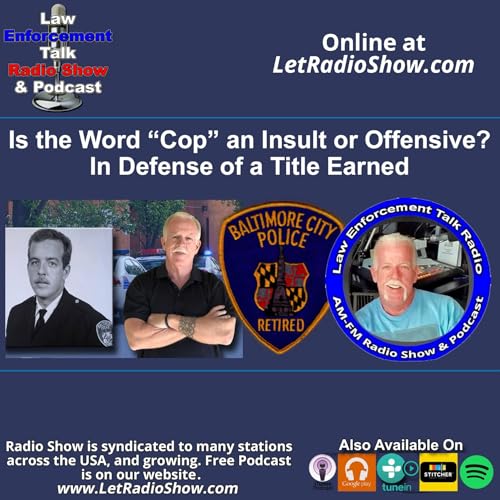
  • Is the Word Cop an Insult or Offensive?
    Dec 10 2025
    Is the Word Cop an Insult or Offensive? In Defense of a Title Earned. Few words tied to law enforcement spark online arguments as quickly, or as emotionally, as the word cop. For some, it’s an instant trigger. For others, it’s harmless shorthand. But for many who have worn the badge, worked the streets, and answered the calls, cop is neither an insult nor a slur. It’s a title of respect, earned through action, accountability, sacrifice, and service. This special episode is streaming for free on the Law Enforcement Talk Radio Show and Podcast website, on Apple Podcasts, Spotify, YouTube, and most every major Podcast platform That’s why this conversation matters, and why a special episode of the Law Enforcement Talk Radio Show and Podcast was dedicated to defending the word “Cop.” Look for The Law Enforcement Talk Radio Show and Podcast on social media like their Facebook , Instagram , LinkedIn , Medium and other social media platforms. Why One Word Creates Such Big Reactions. Ask ten people what comes to mind when they hear “cop,” and you’ll likely get ten different answers. Online, the word ignites debate at lightning speed, often led by people with little to no firsthand connection to the profession itself. The disconnect is striking. Opinions about the word rarely come from the street, the squad car, or the midnight shift. They come from the outside looking in. Is the Word Cop an Insult or Offensive? In Defense of a Title Earned. Supporting articles about this and much more from Law Enforcement Talk Radio Show and Podcast in platforms like Medium , Blogspot and Linkedin . As a retired Baltimore Police Sergeant, I use the word intentionally and unapologetically. Growing up in the job, cop was always a compliment. It was what fellow cops called you when they knew you were reliable, when they trusted you to show up, back them up, and do the work. It was never whispered as an insult or tossed around in a derogatory way. It was a term of respect shared among people who understood exactly what the job demanded. A Word Big Enough for the Whole Profession One of the greatest misconceptions about law enforcement is the idea that it’s a single job with a single title. In reality, it’s a massive profession made up of countless roles: Police Officers, Deputy Sheriffs, State Troopers, Highway Patrol, Game Wardens, Wildlife Officers, Park Rangers, Corrections Officers, Probation and Parole Officers, Federal Agents, and many more. Available for free on their website and streaming on Apple Podcasts, Spotify, Youtube and other podcast platforms. Each agency has its own mission, culture, and rank structure: Officer, Agent, Corporal, Sergeant, Lieutenant, Captain, Major, Chief. Titles and ranks matter in this profession because they’re earned. Technically, the most accurate way to address someone is by their full title. That’s exactly where the word cop fits. It’s universal. It cuts across agencies, uniforms, patches, and ranks without erasing them. Whether someone works urban streets, rural highways, a jail tier, or a federal task force, “cop” recognizes the shared commitment to a job most people wouldn’t last a week doing. It acknowledges the brotherhood and sisterhood beneath the badges. Is the Word Cop an Insult or Offensive? What “Cop” Really Means on the Inside Among those who lived the job, being called a cop meant something very specific: you actually did the work. The Law Enforcement Talk Radio Show and Podcast episode is available for free on their website , Apple Podcasts , Spotify and most major podcast platforms. The uncomfortable truth is that not everyone who wears a badge lives up to that standard. Every agency has individuals who technically show up but avoid the real work whenever possible. They dodge hot calls, arrive late to dangerous scenes by choice, and stay “clean” by doing the bare minimum. Ironically, those are often the people who climb the promotional ladder the fastest, because staying invisible protects them from scrutiny. In the Baltimore Police Department, there was a word for officers like that: humps. They mastered the art of stretching simple calls into hour-long events, lingering in the station, and letting other officers absorb the risk. That behavior didn’t just burden coworkers, it hurt the community by reducing real response and proactive policing. A cop, what our old-timers called “real police”, was different. A cop showed up. A cop backed their partners without hesitation. A cop stepped into chaos, took responsibility, and handled business when it mattered. The job wasn’t about comfort, popularity, or fast promotions. It was about service and accountability. That’s the standard behind the word. Is the Word Cop an Insult or Offensive? In Defense of a Title Earned. Check out The Law Enforcement Talk Radio Show and Podcast website, on Apple podcasts, Spotify, Youtube and on LinkedIn, Facebook, Instagram, and across ...
    Más Menos
    11 m
  • A Stranger Saved a Retired NYPD Officer's Life on Christmas Eve
    Dec 7 2025
    A Stranger Saved a Retired NYPD Officer’s Life on Christmas Eve, A Special Episode Worth Hearing. This is more than a headline. It is a true story of survival, loss, depression, and an unexpected moment of human connection that changed everything. Look for The Law Enforcement Talk Radio Show and Podcast on social media like their Facebook , Instagram , LinkedIn , Medium and other social media platforms. Dean Simpson is a retired police officer from the New York City Police Department. Years before this Christmas Eve, he was shot in the line of duty during a violent, life-and-death encounter. He survived the attack, but the shooting left him permanently disabled. What followed was a slow, painful unraveling that many first responders know too well. The inpsiring episode is streaming for free on the Law Enforcement Talk Radio Show and Podcast website, on Apple Podcasts, Spotify, YouTube, and most every major Podcast platform Purpose disappeared. Pain remained. Alcohol filled the silence. By December of 2001, Dean’s life had narrowed to drinking, isolation, and attending one police funeral after another. Just three months earlier, the Twin Towers had fallen. While his fellow officers ran toward the chaos on September 11, Dean woke up late, hungover, and drowning in guilt. He still put on his uniform and reported to Ground Zero, working at “The Pile” for weeks, until he realized he wasn’t helping anymore. A Stranger Saved a Retired NYPD Officer’s Life on Christmas Eve, A Special Episode Worth Hearing. Supporting articles about this and much more from Law Enforcement Talk Radio Show and Podcast in platforms like Medium , Blogspot and Linkedin . Then came Christmas Eve. That morning, Dean put his father’s revolver in one pocket and his father’s worn Bible in the other. He boarded a train at Penn Station with a one-way ticket upstate. He had already decided that once he reached his destination, his life would end. He chose a secluded place so no one would have to clean up the mess, a thought that haunted him even then. While the train rolled north through snow-covered landscapes, a stranger sat down next to him. Her name was Erin. She was a chatty grandmother with a red scarf and a warm smile, exactly the kind of person Dean did not want to talk to. She spoke about the beauty of the city, the holidays, life, and love. Dean sat in silence, angry at her optimism, angry at everything. When she finally asked what he loved about New York City, his response was cold and sharp. Available for free on their website and streaming on Apple Podcasts, Spotify, Youtube and other podcast platforms. “I love being left alone.” Instead of snapping back or moving seats, Erin stayed. When Dean apologized, she accepted. Slowly, gently, she drew him into conversation. She shared her own story, her late husband, her children, her grandchildren. And for the first time in a long while, Dean talked about his life. About being shot. About losing his father. About feeling useless and invisible. A Stranger Saved a Retired NYPD Officer’s Life on Christmas Eve, A Special Episode When the train reached Albany, Erin handed him a small pink note. “I don’t know where you’re headed,” she told him, “but when you get there, read this.” They hugged, and she was gone. Dean continued on to Black Mountain, climbing toward Lake George with ice-capped water below. At the summit, he opened his father’s Bible. A scrap of paper fell out, marking a verse: Corinthians 10:13. To a cop, that number meant something else entirely, police code for officer needs assistance. The Law Enforcement Talk Radio Show and Podcast episode is available for free on their website , Apple Podcasts , Spotify and most major podcast platforms. Then he read Erin’s note: “Dean, life is a gift meant to be shared. Don’t ever give up hope. Merry Christmas. Erin.” In that moment, something lifted. The weight inside him eased. Dean emptied the revolver and threw it into the abyss. Then he turned around and walked back down the mountain. A Stranger Saved a Retired NYPD Officer’s Life on Christmas Eve. That was the day a stranger saved his life. In this special episode of the Law Enforcement Talk Radio Show and Podcast, Dean Simpson tells his story openly, not for attention, but to reach others who may be standing on the same edge. He speaks about trauma, addiction, purpose, and recovery. He shares how the badge shaped him, how it nearly broke him, and how one unexpected act of kindness redirected his life. His interview can be found on The Law Enforcement Talk Radio Show and Podcast website, on Apple podcasts, Spotify, Youtube and on LinkedIn, Facebook, Instagram, and across most podcast platforms where listeners will find authentic law enforcement stories. Dean is also the author of two books: The Blue Pawn: A Memoir of an NYPD Foot Soldier, a raw and unfiltered account of life in law enforcement, and Godless v. Trust: The ...
    Más Menos
    40 m