Forking Off Podcast Por Forking Off arte de portada

Forking Off

Forking Off

De: Forking Off
Escúchala gratis

A podcast by former feds who got the fork out of government service. In 2025, hosts and former FBI intelligence analysts Jill and Philip Fields joined the exodus of public servants leaving federal service under the deferred resignation program. Conflicted over what to do next, they began encountering other recently departed feds fighting to find their voice. They started Forking Off as a platform to lift them up, preserve the public record, and document the destruction of American governance. Join us the last Tuesday of every month as we share their stories.Forking Off Ciencia Política Política y Gobierno
Episodios
  • Alec Chapa Builds Community
    Mar 31 2026

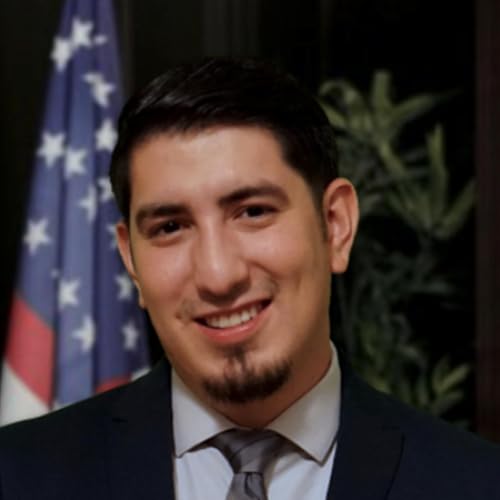
    Alec Chapa found his ideal role as a conciliator with DOJ's Community Relations Service (CRS). From a young age, Alec was interested in bringing people together to talk through conflict. He was fascinated by Gandhi's strategy of civil disobedience. In 2016, he participated in a private mentorship with Philosopharian in Astoria, Oregon, where he learned about empowering individuals and communities through philosophy. After running his own dispute resolution consulting business for several years, Alec found his dream job with CRS in 2024.

    When the second Trump administration began, Alec saw CRS sidelined and felt that he and his colleagues were being forced out of their jobs. When the second deferred resignation offer was presented in April 2025, Alec accepted it because he could not afford the risk of staying. After leaving CRS, Alec continued his life's work of helping groups work together more collaboratively, transparently, and effectively. He launched HousingShield, a new housing dispute resolution program, through his company Mosaic Collaborative Consulting.

    In this episode, we speak with Alec about the void left by the decimation of Community Relations Service and what we can do in its absence. We also provide listeners with actionable advice on how to engage local leaders, preserve digital evidence, and prepare for future reconciliation efforts.

    Highlights & Topics:

    Tracking the Exodus: Philip introduces Separation Anxiety, our new data project exploring separations across federal agencies between January 2025 and January 2026.

    The Legacy and Loss of CRS: A look back at CRS's history of averting violence after Bloody Sunday in Selma in 1965 contrasted against it's loss in 2025 and what that means for cities like Minneapolis.

    Whistleblower Complaints: Discussion of a recent whistleblower complaint by a former senior CRS official alleging the DOJ misled a federal court regarding the dismantling of the agency.

    Congressional Pushback: Highlighting Representative Jamie Raskin's letter emphasizing that CRS was built for moments of crisis and could have surged mediators to Minneapolis.

    Weaponizing 2339a: Concerns over the administration's willingness to pursue 2339a "material support to terrorism" cases against activists and non-profits rather than coming to the table for mediation.

    Revenge vs. Reconciliation: An argument for removing "retribution" from the journalistic lexicon when describing the administration's actions, identifying it instead as political revenge while advocating for true, measured reconciliation in the future.

    Historical Activism: Drawing parallels between modern social media and the historic information-sharing tactics of Martin Luther and Alexander Hamilton.

    Local Engagement & Documenting Injustice: A call to action urging listeners to engage with state and local officials, while also emphasize the importance of actively documenting injustice wherever it is found.


    Learn more about this episode on our ⁠website⁠.

    If you enjoy Forking Off with us, consider supporting us on ⁠⁠Ko-fi⁠⁠, and ⁠⁠follow us⁠⁠⁠ on ⁠⁠⁠Instagram⁠⁠⁠, ⁠⁠⁠TikTok⁠⁠⁠, ⁠⁠⁠Bluesky⁠⁠⁠, ⁠⁠⁠LinkedIn⁠⁠⁠, ⁠⁠⁠YouTube⁠⁠⁠, or wherever you get your podcasts.

    ----------

    The views expressed in this episode are solely those of the individuals providing them and do not necessarily represent the views of the FBI, the DOJ, the United States, or any past or current employers.

    Más Menos
    42 m
  • Dan Tully Talks Elections
    Feb 24 2026
    Dan Tully left the U.S. Department of Commerce in protest of the administration's destructive foreign policy approach. Dan's background as a Judge Advocate in the Army Reserve gave him experience advising on counter-Chinese influence efforts in the Indo-Pacific. While Dan was building an anti-corruption program for Ukraine's Ministry of Reconstruction, the administration abandoned critical partnerships, echoed Kremlin talking points, and berated Ukraine's President, Volodymyr Zelenskyy in the White House. Dan is now running for the U.S. House of Representatives in Chicago, Illinois, where he hopes to implement his Trump Accountability Plan and restore the rule of law by wielding Congress's power of inherent contempt and puncturing sovereign immunity for federal agents acting outside the scope of the law. As we approach the midterm elections, the election conspiracies of 2020 and 2024 are making a comeback alongside threats of voter suppression and intimidation from the White House and MAGA-sphere. In this episode, we cut through the noise of election conspiracies. We discuss how same-day voter registration led to false claims of "more votes than voters" during the 2024 elections. We also explain how a voter fraud prevention tool led to false claims of one state having "more registered voters than voting-age population."We round out our examination of election fraud conspiracies by explaining why the Election Truth Alliance's conspiracy theories masked as statistical analysis did not prove voter fraud in the 2024 presidential race. We discuss how misinterpreting academic research and ignoring important methodological distinctions to justify demands for hand counts doesn't begin to address the actual threats voters could face at the polls in 2026, such as the weaponization of federal law enforcement as recently seen in Fulton County, Georgia.As the executive branch tramples constitutional boundaries in an effort to centralize power, we discuss the constitutional remedies available to Congress, the States, and the People, as well as legislative proposals that would further strengthen checks on executive power, including the Bivens Act, the Universal Constitutional Remedies Act, and inherent contempt.Finally, we discuss historical precedents that allowed the States to regulate federal law enforcement activity within their borders. We highlight how first principles such as federalism and separation of powers create a system of governance designed to protect the rights of the people. We recently saw this system in action when the Supreme Court ruled on Learning Resources, Inc. v. Trump in a 6-3 decision to reject the President's unilateral imposition of tariffs, which are reserved for the contemplative processes of the legislature.Read about Dan's platform on his website or connect with him on LinkedIn.Learn more about this episode on our website.If you enjoy Forking Off with us, consider supporting us on ⁠Ko-fi⁠, and ⁠follow us⁠⁠ on ⁠⁠Instagram⁠⁠, ⁠⁠TikTok⁠⁠, ⁠⁠Bluesky⁠⁠, ⁠⁠LinkedIn⁠⁠, ⁠⁠YouTube⁠⁠, or wherever you get your podcasts.----------The views expressed in this episode are solely those of the individuals providing them and do not necessarily represent the views of the FBI, the DOJ, the Department of Commerce, the Army Reserve, the United States, or any past or current employers.
    Más Menos
    55 m
  • Allan Dinkoff Bears Witness
    Feb 9 2026

    Allan Dinkoff didn't plan to bear witness to the destruction of the civil service when he enrolled in the International Center of Photography's documentary photography program, but he couldn't ignore the story of civil servants targeted by the second Trump administration. Allan spent the last year interviewing and photographing over 65 civil servants across at least 19 federal agencies who left their jobs because of the administration.

    Through his project, Targeted: Portraits of Civil Servants Under Trump, Allan challenges the administration's claim that civil servants are just "collateral damage" caused by a need for efficiency. He tells stories of the resilience he witnessed while interviewing a cross-section of America, and how many of the employees pivoted to new roles. In the wake of Reductions-in-Force at the Department of Health and Human Services, Allan highlights the rapid response effort of wellfed to create a support network for fired feds, and the startup micro-bakery Gingersnap Jess Cookies.

    Allan's work didn't stop in DC though. He also traveled to Poland to interview former USAID employees who funded their own travel there to assist Ukrainian refugees. More recently, Allan made his way to sunny Los Angeles and sat down with Forking Off hosts Jill and Philip Fields for an in-person interview.

    Through our discussion, we explored the idea of what it has meant to be an American for the last 250 years and the existential threat authoritarianism imposes on that idea. Allan also delves deeper into our stories by asking some of the questions we never would have thought to ask each other.

    Check out Allan's portfolio on his website, or connect with him on LinkedIn.


    Learn more about this episode on our ⁠⁠website⁠⁠.

    If you enjoy Forking Off with us, consider leaving a tip on ⁠Ko-fi⁠, and ⁠follow us⁠⁠ on ⁠⁠Instagram⁠⁠, ⁠⁠TikTok⁠⁠, ⁠⁠Bluesky⁠⁠, ⁠⁠LinkedIn⁠⁠, ⁠⁠YouTube⁠⁠, or wherever you get your podcasts.

    ----------

    The views expressed in this episode are solely those of the individuals providing them and do not necessarily represent the views of the FBI, the DOJ, the United States, or any past or current employers.

    Más Menos
    43 m
Todavía no hay opiniones