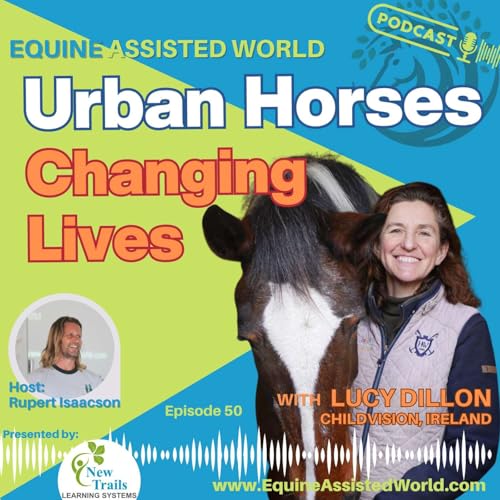
Equine Assisted World with Rupert Isaacson Podcast Por Rupert Isaacson arte de portada

Equine Assisted World with Rupert Isaacson

Equine Assisted World with Rupert Isaacson

De: Rupert Isaacson
Escúchala gratis

Here on Equine Assisted World. We look at the cutting edge and the best practices currently being developed and, established in the equine assisted field. This can be psychological, this can be neuropsych, this can be physical, this can be all of the conditions that human beings have that these lovely equines, these beautiful horses that we work with, help us with. Your Host is New York Times bestselling author Rupert Isaacson. Long time human rights activist, Rupert helped a group of Bushmen in the Kalahari fight for their ancestral lands. He's probably best known for his autism advocacy work following the publication of his bestselling book "The Horse Boy" and "The Long Ride Home" where he tells the story of finding healing for his autistic son. Subsequently he founded New Trails Learning Systems an approach for addressing neuro-psychiatric conditions through horses, movement and nature. The methods are now used around the world in therapeutic riding program, therapy offices and schools for special needs and neuro-typical children.  You can find details of all our programs and shows on www.RupertIsaacson.com.Horse Boy LLC Desarrollo Personal Higiene y Vida Saludable Medicina Alternativa y Complementaria Éxito Personal
Episodios
  • Curiosity Over Fear: Building Resilience in Horses and Humans | Kira Julius | EAW 52
    Apr 16 2026
    ✨ "The healing process is there in service of your life, not the other way around. Do the healing in order to live." – Kira Julius Kira Julius is a German-Danish horse trainer and equine assisted practitioner whose career has taken her from working young horses in Tanzania at 16, to eight years alongside Australian warmblood specialist Will Rogers — first in the Netherlands, then Germany — to therapeutic work with autistic children and families across Germany, Denmark, Ireland, and the UK. She now runs her own practice through horserealms.com, working with horses, families, and individuals at the intersection of horsemanship and resilience.What makes Kira's perspective unusual is that she has lived the subject she now teaches. A lifelong relationship with anxiety and fear around horses, a family crisis at 18 when her father suffered a stroke that pulled her into an early adult role, and years inside the hyper-demanding world of sport horse training — including a period where her own anxiety became so acute she could barely ride — all of it has shaped a practitioner who speaks from earned experience, not theory.In this conversation, Rupert and Kira go deep on what resilience actually means — for horses, for humans, and for the practitioners who work with both. They move through the groundwork methodology Kira developed starting sensitive warmbloods, the specific exercises that release tension and build connection, and how those same principles apply when working with autistic children. They explore why always being calm may be the wrong goal, how to move through fear rather than wait for it to pass, and why the trauma conversation risks tipping into a place that keeps people stuck. This is a wide-ranging, experience-backed conversation that will resonate with anyone who works with horses, with neurodivergent individuals, or with their own inner life.If you want to support the show, you can do so at Patreon: https://www.patreon.com/LongRideHome🔍 What You'll Learn in This Episode How curiosity overrides anxiety — and why doing the thing is often more healing than waiting until you feel ready Why "always being calm" is not the goal for horses or humans, and what heart rate variability tells us about genuine resilience How to distinguish between protective fear and anxious mental noise — and how gut instinct becomes the tool for telling them apartThe groundwork methodology Kira used starting sensitive warmbloods: approach and retreat, shoulder yields, hindquarter yields, and why crossing the midline triggers BDNF and neuroplasticityWhy the shoulder-in position is both a tension-release tool and a safety tool — and how having it reliably in place can get a handler out of serious troubleHow Kira's experience of her father's stroke at 18 shaped her understanding of grief, family strain, and the cost of going into management mode when you're struggling yourselfHow Kira's own severe anxiety crisis mid-career — when she could barely get on a horse — became the turning point that led her toward therapeutic work with humansWhy seeing possibilities rather than problems is the key reframe in both horse training and equine assisted work with neurodivergent clientsWhy the trauma conversation risks becoming a place people stay rather than move through — and what the spiral model of grief and healing offers insteadHow projecting limitations onto horses or children blocks their capacity to surprise us, and why listening to the person in front of you matters more than the story others gave youWhy joy and play are not extras in equine assisted work — they are the mechanism by which change happensWhy practitioners who want horses or clients to make big changes need to be making changes themselves🎤 Memorable Moments from the Episode[00:12:38] Kira explains why waiting to feel "ready" often keeps anxiety alive — the doing of the thing is what changes your storyline[00:15:00] Kira describes what happened when her father had a stroke at 18 — and how managing practical needs meant disconnecting from her family emotionally at the same time[00:30:17] Kira takes us inside the Will Rogers yard: how they started sensitive warmbloods using groundwork, approach and retreat, and the principle of explaining the human world to the horse rather than demanding compliance[00:37:12] The connection between lateral movement, crossing the midline, and BDNF — why these classical exercises produce neuroplasticity in horses just as they do in humans[00:45:16] Why shoulder yields and hindquarter yields are not just gymnastic tools but safety tools — and how they can get a handler out of serious trouble when a horse reacts unexpectedly[00:49:08] Tarp training in front of thousands of people: how Will Rogers conditioned sharp warmbloods to treat a crashing plastic sheet as a signal to exhale, not explode[00:56:57] Kira's own anxiety crisis at Will's yard — when the pressure to produce calm horses while ...
    Más Menos
    2 h y 12 m
  • From Problem Horse to Professional Practice: What Trauma Teaches Us About Training | Petra Vlasblom of 2Moons.nl, Netherlands | EAW 51
    Apr 2 2026
    Petra Vlasblom is a Dutch horse behavior specialist based in the Netherlands, founder of 2Moons, and one of Europe's most sought-after trainers for problem horses — particularly in the high-stakes world of elite sport horses. She came to the profession not through a traditional equestrian route, but as a former graphic designer from the city who fell in love with an "unrideable" horse that nobody else could manage, and whose path to becoming a professional was shaped as much by personal crisis as by equine knowledge.What makes Petra's story and her work unusual is the degree to which her own life has mirrored the horses she works with. Her first horse, Two Moons — still alive today — broke her arm, dislocated her hip, and ultimately catalyzed years of deep personal work. A later riding accident broke her neck and forced a four-month recovery period that fundamentally changed how she listens: not with her head, not with her heart, but with her gut. That shift is now at the core of everything she teaches.In this conversation, Rupert and Petra cover the full arc of her journey — from a childhood with no horses and a career in graphic design, to buying an impossible horse on a whim in Belgium, to running a professional school for horse behavior in France, to the neck injury that changed everything. They go deep on her methods for trailer loading, her framework for reading horse body language at the moment of decision, her "software install" philosophy for training both horse and owner, and what she believes all therapeutic equine programs need to address around herd dynamics and horse wellbeing. The conversation closes with a shared invitation: Petra and Rupert will be running a joint workshop in the Netherlands in June 2026 — details at https://longridehome.com/events.If you want to support the show, you can do so at Patreon: https://www.patreon.com/LongRideHome🔍 What You'll Learn in This Episode How a horse that no professional trainer could ride became the catalyst for Petra's entire career — and what that says about the horses that come to therapeutic programs as "donations"Why Petra distinguishes between listening to the heart versus listening to the gut — and why the gut is the more reliable guide for both horse and human practitionersHow to read the precise moment a horse is making a mental decision during trailer loading: what to look for in the eyes, ears and head carriage, and why forcing that moment produces a dangerous animal in transitWhy Petra's trailer loading method involves letting the horse exit freely after going in voluntarily — and how this counterintuitive step produces lasting compliance versus temporary complianceHow the "software install" metaphor helps owners understand why training the horse without training the owner always fails — and how Petra uses this framing to set up her client education eveningsWhat the rehab of a problem horse offers as its own form of therapy — for people returning from military service, abuse, or chronic anxiety — and why Rupert's programs use prospective therapy horse rehabilitation as a standalone treatment modalityWhy the chronic use of stabled horses in therapeutic settings creates specific stress and behavioral problems, and what practical solutions — including "crazy time" and companion animals — can address these without large financial outlayHow Petra's approach differs from classical natural horsemanship in one key respect: the horse is not asked to make the wrong thing harder, but to make a genuine, uncoerced choiceWhat a broken neck, a dislocated hip, and a broken arm taught Petra about the difference between professional obligation and gut instinct — and how running on exhaustion impairs even experienced practitioners' ability to read horses accuratelyWhy Petra now requires all horse owners to attend a three-hour education evening before she will train their horse — and what changed in her success rate when she introduced that conditionHow self-disconnection — particularly through overwork and screen-based living — undermines a handler's ability to connect with a horse, and what both Rupert and Petra suggest as entry-level solutions for practitioners facing this🎤 Memorable Moments from the Episode[00:01:00] Rupert introduces Petra — the Dutch problem-horse specialist he first saw in action with a nervous horse at one of his retreats[00:06:10] Petra describes the moment she saw Two Moons in Belgium: eight years old, "very dangerous, very untrainable" — and fell in love immediately[00:11:00] "I thought with my love, everything will be okay" — Petra on what happened next, and why she spent a lot of time in hospitals[00:15:06] The big accident: Petra describes breaking her neck after seven weeks of back-to-back teaching, arriving exhausted, and ignoring her gut[00:38:03] The shift after the neck break: from running on obligation to listening to intuition — the lesson she took from four months in ...
    Más Menos
    2 h y 9 m
  • Urban Horses, Hidden Access & Equine Therapy in the City | Lucy Dillon of ChildVision Dublin | EAW 50
    Mar 19 2026

    In this episode of Equine Assisted World, Rupert Isaacson speaks with Lucy Dillon, who runs the equine unit at ChildVision in Drumcondra — right in the center of Dublin, Ireland.

    ChildVision (formerly St. Joseph’s School for the Blind) provides services for children and young people with visual impairments and complex needs. Unlike most equine‑assisted programs located in rural areas, Lucy’s program operates in the middle of a major city — serving populations who would otherwise have little or no access to horses.

    Lucy shares the realities of running an urban equine therapy program: balancing horse welfare with limited space, designing programs for children with visual impairment and multiple disabilities, and maintaining high standards of horsemanship within a therapeutic setting.

    The conversation explores Lucy’s path through traditional British horse training, riding schools, equine education, and professional qualifications before transitioning into therapeutic work. She discusses how the structure and discipline of classical horsemanship become essential foundations for safe and effective equine‑assisted programs.

    Together, Rupert and Lucy examine how horses support children with sensory and neurological challenges, how urban equine programs can remain sustainable, and why good horsemanship remains the backbone of any meaningful therapeutic practice.

    If you want to support the show, you can do so at Patreon: https://www.patreon.com/LongRideHome

    🔍 What You’ll Learn in This Episode

    • How Lucy Dillon built and now leads the equine unit at ChildVision in Dublin
    • What makes an urban equine therapy program fundamentally different from rural centers
    • How children with visual impairments experience horses and equine environments
    • Why horses can support sensory integration and body awareness in visually impaired riders
    • How to design equine programs for children with multiple disabilities and complex needs
    • Why strong horsemanship foundations are essential in therapeutic riding
    • How Lucy’s background in traditional British riding schools shaped her approach to therapy work
    • The importance of horse welfare when programs run in limited urban space
    • How urban programs provide access for communities who would otherwise never encounter horses
    • Why therapeutic programs must balance clinical needs with genuine horse knowledge
    • How equine units operate within larger educational and medical institutions
    • The daily logistical realities of maintaining horses in a city environment
    • Why joy, fun, and relationship with the horse remain central to therapeutic outcomes

    🎤 Memorable Moments from the Episode

    • [00:00:44] Introducing Lucy Dillon and the ChildVision equine unit in central Dublin
    • [00:05:31] Lucy’s early path through British horse training and equine education
    • [00:13:04] Working in traditional riding yards before moving toward therapy work
    • [00:22:40] How horses help children with visual impairments experience movement and space
    • [00:34:10] Designing equine programs for children with multiple disabilities
    • [00:46:18] Why strong horsemanship matters inside therapeutic riding programs
    • [01:02:14] Managing horse welfare and logistics inside a city‑based equine facility
    • [01:15:22] The realities of maintaining horses for therapy in a dense urban environment
    • [01:32:40] Why access to horses matters for children growing up in cities
    • [01:47:12] What makes equine‑assisted work sustainable over the long term

    📚 Contact, Projects, and Resources Mentioned

    Lucy Dillon – ChildVision Equine Unit (Dublin) Search: Lucy Dillon ChildVision Dublin https://childvision.ie/what-we-do/equine-assisted-activities/

    New Trails Learning Systems – Horse Boy Method, Movement Method & Takhin Equine Integration https://ntls.co

    Rupert Isaacson / Long Ride Home https://rupertisaacson.com

    Patreon Support https://www.patreon.com/LongRideHome

    🌍 Follow Us

    Long Ride Home
    https://longridehome.com
    https://facebook.com/longridehome.lrh
    https://instagram.com/longridehome_lrh
    https://youtube.com/@longridehome

    New Trails Learning Systems
    https://ntls.co
    https://facebook.com/horseboyworld
    https://instagram.com/horseboyworld
    https://youtube.com/newtrailslearningsystems

    📊 Affiliate Disclosure

    Links to books and products may include affiliate tracking. We may earn a commission if you make a purchase, at no extra cost to you. Thank you for supporting the show.

    Más Menos
    1 h y 54 m
Todavía no hay opiniones