Episodios

  • How do India's poor use cash transfers? | Myths busted!
    Mar 11 2026

    Episode 7, Season 4

    Host: Rathish Balakrishnan, Co-founder & Managing Partner, Sattva Consulting

    Guest: Pankhuri Shah & Muzamil Baig, Co-founders, Project DEEP

    Do you believe we could lift India out of poverty with the help of cash transfers?Because the evidence says yes: direct and unconditional cash transfers improve recipients’ incomes, asset ownership, and mental well-being. Instead of “being wasted on alcohol” and “making people lazy,” the cash is directed into building houses, buying livestock, paying off debt, and making investments.


    In this episode, Co-founders of Project DEEP (Devising an End to Extreme Poverty), Pankhuri Shah and Muzamil Baig join Rathish Balakrishnan for an opinion-shifting conversation as they uncover:

    - Myths we have about the poor (and the rich)

    - How communities actually use cash transfers to grow income and build assets

    - The role of the government in enabling these schemes

    - Types of transfers, their benefits and limitations, and what is needed to make them most effective

    - The what and why of Universal Basic Income

    This is an episode you don’t want to miss out on. Tune in here!

    Más Menos
    51 m
  • A social sector leader’s BEST advice for NGOs in India | Govind Iyer
    Feb 19 2026

    Episode 6 | Decoding Impact - Season 4

    Host: Rathish Balakrishnan, Co-founder & Managing Partner, Sattva Consulting

    Guest: Govind Iyer, a Member on the Board of Trustees of The Rockefeller Foundation, Chairperson, SVP India, and Independent Director of Infosys & Karmayogi Bharat


    Social sector spending in India is gaining momentum. Domestic philanthropy grew 7% y-o-y to ₹1.31 lakh crore (FY24), while CSR investments reached ₹34,000 crore in FY23–24 (Bain–Dasra India Philanthropy Report 2025; Sattva Consulting, CSR’s Next Act 2025).


    As funding becomes more strategic and systems-focused, how can nonprofits position themselves to truly leverage this shift?


    Govind Iyer, drawing on his experience across philanthropy, NGOs, and leadership, shares grounded, actionable insights with Rathish on what it takes to create long-term impact. Together, they unpack:

    • Why leadership skills are essentials—not overheads—for nonprofits

    • How NGOs can build and sustain donor trust

    • What growing CSR and domestic philanthropy mean for the sector

    • What real systems change looks like—and where India’s most urgent challenges lie


      Topics covered:

      1. Intro to the current social sector spending landscape

      2. Lessons for nonprofit leaders

      3. How can we encourage Indians to give more & how nonprofits can build trust among (potential) donors

      4. Rethinking what a “return” looks like in impact

      5. How to unlock giving at scale

      6. How CSR strategies are evolving

      7. The importance of CSR forums & platforms for collaborations

      8. How philanthropy can leverage government social spending + systems change

      9. How to strengthen nonprofit delivery capabilities & why donors should care

    Más Menos
    43 m
  • Every Indian deserves good health (not just healthcare) ft. Dr Srinath Reddy
    Jan 29 2026

    Episode 5 | Decoding Impact - Season 4


    Host: Rathish Balakrishnan, Co-founder & Managing Partner, Sattva Consulting


    Guest: Dr K. Srinath Reddy, Cardiologist & Founder, Public Health Foundation of India, Recipient of Padma Bhushan in 2005


    We’re consulting doctors over video calls. Tracking our sleep on smartwatches. Decoding health reports in seconds on ChatGPT.


    Technology is reshaping how we learn about and engage with healthcare. With information at our fingertips, it’s tempting to assume that tech is automatically advancing health equity, the right of every individual to live as healthily as possible.


    But health equity isn’t just about access to healthcare services. In its truest sense, it’s about circumstances, recognising how social determinants like class, caste, gender, and environmental exposure shape health outcomes long before someone enters a clinic.


    India’s urban mobile phone penetration stands at 125%; however rural penetration is only 58.8% (Mapping India’s Digital Landscape - Mobile Connectivity and Its Impact on Rural India, Affandy Johan, Ookla, 2025). The digital divide is stark, spanning device ownership, internet access, and digital literacy. This raises a critical question: will technology bridge healthcare gaps, or risk widening them further?


    To unpack this complexity, we’re joined by Dr. K. Srinath Reddy, Founder and former President of the Public Health Foundation of India, to explore the nuanced intersection of health equity and technology.


    Topics of discussion

    1. Introducing health equity in India, the role of technology, and Dr Srinath


    2. Why health equity doesn’t end with healthcare access


    3. New challenges to our healthcare system + the impact of climate change on health


    4. How do we build state capacity to deliver quality, accessible healthcare?


    5. What's coming up in health-tech & what impact can these innovations have?


    6. Why contextual health data matters for accurate diagnoses


    7. What risks does tech carry? Which gaps can it widen in healthcare?


    8. How do we design an equitable health system using technology?


    9. The role of digital public infrastructure & building state capacity


    10. AI in healthcare (pros & cons)


    11. Financing an equitable health system


    12. The power of Ayushman Bharat Health Accounts


    Más Menos
    53 m
  • 40% Indians at risk by 2030 | How communities are fighting back
    Jan 7 2026

    Episode 4 | Decoding Impact - Season 4

    Host: Rathish Balakrishnan, Co-founder & Managing Partner, Sattva

    Consulting Guest: Dr Shraman Jha, CEO, Hindustan Unilever Foundation (HUF)


    By 2030, India’s demand for water could be double the supply, according to NITI Aayog. Nearly 40% of the population may lack access to drinking water. The crisis is real, and solving it is only possible through collaboration.


    At the heart of India’s water challenge are farming communities. With 78–90% of freshwater routed to agriculture, they are among the worst affected by water insecurity, yet they hold deep, practical knowledge critical to managing water sustainably. When communities lead water management, it doesn’t just conserve water; it can also empower women to take ownership of budgeting, conservation, and local decision-making.


    In this essential episode of Decoding Impact, Rathish Balakrishnan and Dr Shraman Jha break down:

    • What water security really means
    • How data enables smarter water decisions
    • How to design community-led interventions that work
    • Why livelihoods and conservation don’t have to be trade-offs


    Grounded in real-world experiences and case studies, this must-watch discussion reinforces the importance of centring communities. When impact practitioners work with communities in ways that resonate with their lived realities, it could unlock pathways to lasting water security


    Key topics discussed:

    1. India’s water gaps & the vision of Hindustan Unilever Foundation

    2. Water shortages impact us all, but it’s an invisible problem!

    3. What is water security actually?

    4. The regional realities of water in India

    5. Engaging communities through water data & demonstration

    6. How rural women are championing water budgets

    7. The beautiful tradition of Halma

    8. How much water data is currently available?

    9. Aligning stakeholders in the ecosystem + metrics for outcomes + collaboration model

    10. Common agenda, independent action


    Más Menos
    49 m
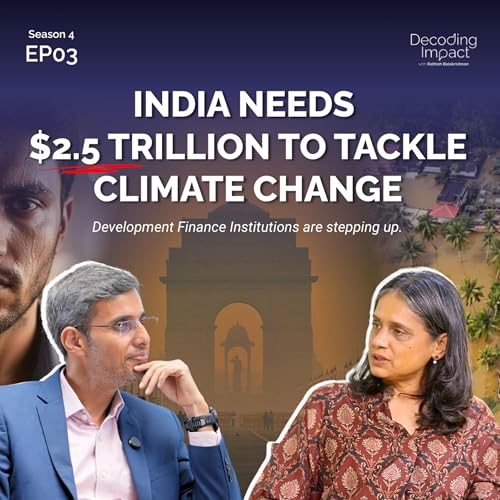
  • Is it really possible to fight climate change? | Climate action starts with #climatefinance
    Nov 27 2025

    Episode 3 | Decoding Impact – Season 4

    Host: Rathish Balakrishnan, Co-founder & Managing Partner, Sattva Consulting

    Guest: Shilpa Kumar, Managing Director & Head of India, British International Investment

    India needs $2.5 trillion by 2030 to reach its Nationally Determined Contributions (NDCs) - climate action plans submitted under the Paris Agreement. As the climate crisis worsens, the role of climate finance and especially Development Finance Institutions, in becoming a catalyst for transformative solutions is more important than ever. In this illuminating episode, Shilpa Kumar decodes climate finance: its purpose, gaps, and types of funders. From smart metres to the Mumbai metro, she draws on her own work to offer sharp perspectives on solving for climate change at scale. Through their complementary experiences and viewpoints, Rathish and Shilpa bring context-rich insights on India’s climate landscape, while exchanging stories that show it is possible to combat climate change.


    Key Topics Discussed


    1. Current state of climate finance (India and internationally), the existing gaps, and the role DFIs play

    2. Enabling tailwinds for climate finance

    3. Climate interventions in mobility

    4. What initiatives are powered under climate finance?

    5. The case of smart metres: the importance of last-mile distribution

    6. How to manage the perceived risk of climate investment

    7. How India can attract more capital for climate action

    8. Adaptation & resilience - gaps, stories, and climate financing for it

    9. Why MSMEs struggle to go green

    10. State capacity at the city level

    11. Role of philanthropy in climate finance

    Más Menos
    58 m
  • Beyond free bus rides | Panic button & posters for safe transit | Small acts challenge patriarchy
    Nov 6 2025

    Episode 2 | Decoding Impact – Season 4

    Host: Rathish Balakrishnan, Co-founder & Managing Partner, Sattva Consulting

    Guests:

    Sohini Bhattacharya, Independent Consultant - Gender and Leadership & Senior Advisor, Accelerator for Shifting Gender Norms Through Education

    Erin Ganju, Managing Director - Accelerator for Shifting Gender Norms through Education

    What are gender norms? How do they impact a woman’s ability to work or study? And most importantly, can they be changed?In this episode of #DecodingImpact, Sohini Bhattacharya and Erin Ganju weigh in with deep insights, inspirational stories, and moving anecdotes drawn from their decades-long experience in working with communities and shifting gender norms.

    The conversation explores the reality of deeply embedded norms, the negative impact of women’s limited participation in the workforce, and the role of all stakeholders - from schools to families - in bringing about societal transformation.

    Key Topics Discussed

    1. Understanding gender norms

    2. The negative impact of women’s limited participation in the workforce on families, communities, and nations

    3. Gender norms are hard to change, but it’s possible

    4. Engaging adolescents in important conversations

    5. How patriarchy also harms boys and men

    6. The role of schools, teachers, and parents

    7. Mobilising communities to support gender equality

    8. How systems and organisations can drive lasting change


    Más Menos
    1 h y 17 m
  • Transforming India’s State Capacity with Mission Karmayogi | Real Challenge of State Capacity
    Oct 9 2025

    Episode 1 | Decoding Impact – Season 4

    Host: Rathish Balakrishnan, Co-founder & Managing Partner, Sattva Consulting

    Guest: Dr. R. Balasubramaniam (Dr. Balu), Member–HR, Capacity Building Commission (Government of India) and Chairperson, Social Stock Exchange Advisory Committee (SEBI)This thought-provoking episode of Decoding Impact spotlights the evolution of state capacity in India and its critical role in India's development. It features an in-depth conversation with Dr Balu, an acclaimed development scholar, author, and founder of the Swami Vivekananda Youth Movement (SVYM), as he shares powerful insights from over four decades of work spanning grassroots development, advising major institutions, and shaping public policy from within the system.Together, they explore the paradoxes of India’s relationship with its government, the tension between public reliance and skepticism, the evolution of the state from a colonial apparatus to a citizen-centric enabler, and the deep-rooted challenge of building effective state capacity.Rathish and Dr. Balu also unpack the historical, philosophical, and practical lessons behind public administration in India, with reflections from the Ramayana to the present-day Mission Karmayogi initiative.Key Topics Discussed1. The true meaning and evolution of state capacity in India2. Why “training is for circus animals”, rethinking capacity building beyond repetitive skills3. Lessons from India’s heritage on governance4. The shift from individual heroism in bureaucracies to system-wide effectiveness5. Why civil service competencies must be rooted in historical and cultural contexts6. The on-ground realities: workforce shortages and systemic performance barriers in public service7. How Mission Karmayogi aims to future-proof India’s civil services for a tech-enabled, citizen-centered future8. The shared responsibility of citizens and the state in nation-building#StateCapacity #Governance #India #PublicPolicy #SocialImpact #MissionKarmayogi #Leadership #podcast

    Más Menos
    46 m
  • Are jobs in India pulling people out of poverty? ft. Manish Sabharwal
    Nov 26 2024

    From the macro to the micro and everything in between, in this episode of Decoding Impact, Manish Sabharwal illuminates the economics of India's current job market and the systemic levers needed to thrust India into grasping its full potential as an economy, society and nation. As one of the foremost experts on India's job market and the plight of Education in India today, Manish shares his expert insights, critical frameworks, and orbit-shifting views on how India can address its challenges at scale across its diverse geography, complex beaurocracy, and challenging education system. Some of the key insights he shares with host Rathish Balakrishnan include: • India does not have an unemployment issue, but a wages issue & there are five key levers where this can be addressed • However, across these five drivers regulatory cholesterol is a key limiting factor to India's labour market • Addressing the discrepancies between formality and informality means solving for poverty • Moving beyond the current drudgery in education requires five key design principles • Apprenticeships need to play a more significant role in how India is skilling its future workforce • We need clarity of vision in what education is giving children in India, which includes the traditional three "r's", but also important soft skills Manish elucidates each insight with clarifying data and global comparisons to ground the Indian story of where our labour market is today, and where it could be in as little as five years time with certain critical changes. Tune into the latest episode from season three of Decoding Impact today! Manish Sabharwal is is Vice-Chairman of TeamLease Services, one of India’s leading staffing and human capital firm. Additionally, he co-founded India Life, an HR outsourcing company in 1996, and is a member of the National Skill Mission, Central Advisory Board of Education and has served on various policy committees for education, employment and employability.

    Más Menos
    1 h y 11 m