

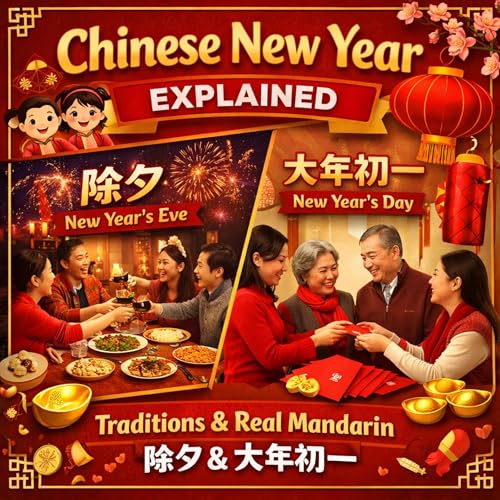
Chinese New Year Explained: Real Traditions, Real Mandarin (除夕 & 大年初一)
No se pudo agregar al carrito
Add to Cart failed.
Error al Agregar a Lista de Deseos.
Error al eliminar de la lista de deseos.
Error al añadir a tu biblioteca
Error al seguir el podcast
Error al dejar de seguir el podcast

Chinese New Year Explained: Real Traditions, Real Mandarin (除夕 & 大年初一)
-
Narrado por:
-
De:
What really happens during Chinese New Year — beyond the fireworks and red envelopes? 🧧
In this episode, we walk you through Chinese New Year’s Eve (除夕) and New Year’s Day (大年初一) as they’re actually celebrated in everyday life. You’ll learn essential real-world Mandarin, common traditions, and the cultural logic behind things like family reunions, staying up late, greeting elders, and why nobody sweeps the floor on New Year’s Day.
Perfect for Chinese learners, heritage speakers, and anyone curious about modern Chinese culture.
In this episode you'll learn:
- Where the name 除夕 (Chinese New Year’s Eve) comes from
- That 年夜饭 (the reunion dinner) often matters more than the holiday itself
- What 守岁 is — and why people do it
- What happens on 大年初一 (New Year’s Day)
- The meaning of 拜年 and when it's done.
- Everyday Mandarin you’ll actually hear during Spring Festival
All Mandarin is explained clearly, with natural examples and cultural context, so you don’t just memorize words — you understand how Chinese New Year really works.
🎉 新年快乐!万事如意!
🎆 Chinese New Year’s Eve(除夕)
中文:除夕这一天,大家最重要的事情就是回家团圆。
Pinyin:Chúxī zhè yì tiān, dàjiā zuìzhòngyào de shìqing jiùshì huí jiā tuányuán.
English:On Chinese New Year’s Eve, themost important thing is going home for a family reunion.
中文:晚上,全家人会一起吃年夜饭。
Pinyin:Wǎnshang, quánjiā rén huì yìqǐchī niányèfàn.
English:In the evening, the whole familyeats the New Year’s Eve dinner together.
中文:餐桌上常见的菜有饺子、鱼,还有象征好运的年菜。
Pinyin:Cānzhuō shàng chángjiàn de càiyǒu jiǎozi, yú, hái yǒu xiàngzhēng hǎo yùn de nián cài.
English:Often included on the dinner table, are dishes such as dumplings, fish and others that symbolize goodluck.
中文:吃完饭后,很多人会看春晚,一起守岁,迎接新年的到来。
Pinyin:Chī wán fàn hòu, hěn duō rénhuì kàn Chūnwǎn, yìqǐ shǒusuì, yíngjiē xīnnián de dàolái.
English:After dinner, many people watch theSpring Festival Gala and stay up late to welcome the New Year.
🧨 Chinese New Year’s Day(初一)
中文:大年初一,大家通常会起得比较晚。
Pinyin:Dànián chūyī, dàjiā tōngchánghuì qǐ de bǐjiào wǎn.
English:On New Year’s Day, people usuallywake up a bit later.
中文:一醒来,就要给家人拜年,说一些吉利的话。
Pinyin:Yí xǐnglái, jiù yào gěi jiārénbàinián, shuō yìxiē jílì de huà.
English:As soon as they wake up, they greetfamily members and say auspicious wishes.
中文:孩子们最期待的,就是收到红包。
Pinyin:Háizimen zuì qīdài de, jiùshìshōudào hóngbāo.
English:What children look forward to themost is receiving red envelopes.
中文:这一天,很多人不扫地、不吵架,希望新的一年有个好开始。
Pinyin:Zhè yì tiān, hěn duō rén bùsǎodì, bù chǎojià, xīwàng xīn de yì nián yǒu gè hǎokāishǐ.
English:On this day, many people avoidsweeping the floor or arguing, hoping for a good start to the year.
For the full transcript, click here:
https://turboscribe.ai/transcript/share/8980177657064100715/7Fxm_UxP9AJ26zEURve0ZJni7vsn4ftjfMJybEcxxxE/chinese-new-year
Music: Li River by Zimpzon
https://track.pstmrk.it/3s/uppbeat.io%2Ft%2Fzimpzon%2Fli-river/vZub/AFXDAQ/AQ/083f6ce2-49f5-4655-afe0-af85484a41ba/4/rcr0--dCae