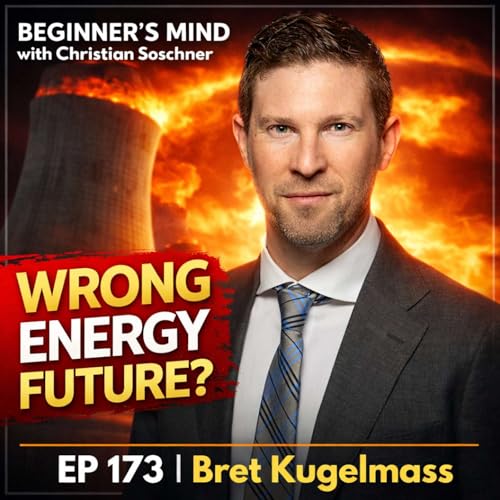
Beginner's Mind Podcast Por Christian Soschner arte de portada

Beginner's Mind

Beginner's Mind

De: Christian Soschner
Escúchala gratis

Blueprints for Builders and Investors

Hosted by Christian Soschner


From pre-seed to post-IPO, every company—especially in deep tech, biotech, AI, and climate tech—lives or dies by the frameworks it follows.


On Beginner’s Mind, Christian Soschner uncovers the leadership principles behind the world’s most impactful companies—through deep-dive interviews, strategic book reviews, and patterns drawn from history’s greatest business, military, and political minds.


With over 250 interviews, panels, and livestreams, the show ranks in the Top 10% globally—and is recognized as the #1 deep tech podcast.


With 35+ years across M&A, company building, board roles, business schools, ultrarunning, and martial arts, Christian brings a rare lens:


What it really takes to turn breakthrough science into business—how to grow it, lead it, and shape the world around it.


🎙 Expect each episode to deliver:

  • Founder & Investor Blueprints: How breakthrough technologies scale from lab to IPO
  • Historical & Biographical Frameworks: Timeless playbooks from the world's great builders
  • Leadership & Communication Mastery: Tools to inspire, persuade, and lead at scale


Whether you're building the next biotech success, investing in AI, or leading a climate tech company through hypergrowth—this podcast gives you the edge.


Listen in. Apply what matters. Build companies that last.


📬 Join the newsletter & community: https://lsg2g.substack.com/

© 2026 Christian Soschner
Economía Finanzas Personales Gestión y Liderazgo Liderazgo
Episodios
  • EP 173: Bret Kugelmass | The West Bet on the Wrong Energy Future
    Mar 28 2026

    Power demand is rising faster than the systems meant to support it.
    AI, electrification, and industry all need stable energy, but the dominant story sold to the public was far simpler than reality.
    In this episode, Bret Kugelmass explains why the real bottleneck was never just climate ambition, but how the West misunderstood energy itself.

    For years, nuclear was framed as too dangerous, too slow, too expensive, and politically untouchable. Meanwhile, electricity demand kept rising, industrial resilience became strategic again, and the gap between energy ambition and physical reality widened.

    This conversation gets underneath the narrative.

    Bret Kugelmass, Founder and CEO of Last Energy, argues that the nuclear debate was never only about science or safety. It was also about incentives, regulation, public perception, delivery models, and the failure to distinguish what is inherent to the technology from what is imposed by the system around it.

    Drawing on his path from Silicon Valley entrepreneurship into deep energy infrastructure, Bret explains why he believes the West solved for the wrong variables, why wind and solar alone cannot carry modern industrial societies in many regions, and why the real breakthrough in nuclear may not come from reinventing the reactor, but from reinventing how power plants are built, sold, and deployed.

    As he puts it:
    (00:33:11) “Solve the wrong problem brilliantly and you’ll be the only one who cares.”

    This episode is not just about nuclear energy.
    It is about first-principles thinking, product-market fit in deep tech, and the kind of contrarian founder logic required to build where politics, infrastructure, and capital collide.

    What You’ll Learn in This Episode
    1️⃣ Why Bret says the West misunderstood the real energy bottleneck
    2️⃣ Why net zero may be the wrong framing for climate ambition
    3️⃣ What most people still get wrong about nuclear waste, safety, and Fukushima
    4️⃣ Why nuclear’s real challenge is cost and construction, not physics
    5️⃣ How Last Energy reframed the business by selling electricity, not reactors
    6️⃣ What founders can learn from solving the right problem before scaling

    Selected Timestamps
    (00:04:29) Introduction
    (00:04:29) Defining climate goals beyond net zero
    (00:13:46) Bret discovers nuclear mission and truth
    (00:19:44) Chernobyl versus Fukushima what truly matters
    (00:21:39) Nuclear's unmatched physics for abundant energy
    (00:30:08) Ideal world nuclear plants in 18 months
    (00:36:02) Solving the right problem before building
    (00:42:58) First principles simplicity as Last Energy’s edge
    (00:51:16) Securing 30 billion through true product market fit
    (00:54:05) Last Energy vision for tens of thousands of gigawatts
    (00:56:12) Taking ultimate responsibility to drive massive global progress

    🎙️ Beginner’s Mind
    Top 10% globally. Conversations for founders, investors, executives, and policymakers shaping biotech, deep tech, energy, and industrial transformation.

    Follow the show for more long-form conversations on technology, capital, and the people building what the future will actually run on.

    Send us Fan Mail


    Join Christian Soschner for expert coaching.
    50% Off - With 35+ years in deep tech, startups/scaleups, and public companies, Christian offers power video sessions. Elevate strategy, execution, and leadership. Book Now.

    Support the show

    Join the Podcast Newsletter: Link

    Más Menos
    1 h y 4 m
  • #172 - Fast Forward Thinking: Why Most Investments Fail — And How Elite VCs Think Differently
    Mar 8 2026

    Most investors think they’re rational.

    Most founders think they’re disciplined.

    Most boards think they’re strategic.

    They’re usually wrong.

    In this episode, we unpack Fast Forward Thinking by Luis Pareras — a physician turned deep-tech venture capitalist who distilled decades of investing under scientific uncertainty into 40 brutally structured rules.

    This is not a summary.

    It’s a decision upgrade for founders, operators, board members, and capital allocators navigating the high-stakes terrain from Series A to IPO and beyond — where bias compounds, capital misallocates, and timing determines survival.

    Across seven tightly structured lessons, we explore how elite investors actually think:

    Why consensus is often a red flag
    Why opportunity abundance demands ruthless selectivity
    Why the first meeting should never close
    Why innovation compounds through milestones — not miracles
    Why exit logic must exist from day one
    Why managing error asymmetry beats being “right”
    And why teams — not ideas — determine survival under pressure

    This episode translates Pareras’ venture logic into executive practice — with direct applications for capital allocation, hiring, governance, and strategic design.

    You’ll walk away with frameworks, sharper filters, and board-level questions that immediately improve judgment.

    Key Takeaways

    Bias Is the Silent Capital Killer
    Consensus feels safe. It often destroys upside.

    Selectivity Is Survival
    Abundance demands disciplined rejection.

    Curiosity Beats Closure
    The first meeting earns the second.

    Innovation Is Staged
    Breakthroughs are milestone-based progressions.

    Exit Thinking Is Structural
    Capital is deployed against time horizons.

    Error Asymmetry Shapes Returns
    Managing Type I and Type II errors defines long-term performance.

    Teams Outperform Ideas
    Execution discipline and cognitive flexibility win under uncertainty.

    Timestamps

    (00:00) Introduction
    (04:17) The Big Idea
    (08:33) Who Is Luis Pareras
    (12:03) Takeaway 1: Cognitive Bias Is the Hidden Enemy of Good Decisions
    (18:55) Takeaway 2: Deal Flow Is Abundant — Selectivity Is the Real Skill
    (24:16) Takeaway 3: The First Meeting Is Not About Closing
    (29:04) Takeaway 4: Innovation Is a Process
    (35:20) Takeaway 5: Exit Awareness Shapes Investment Logic
    (39:59) Takeaway 6: Error Types Matter More Than Individual Outcomes
    (44:38) Takeaway 7: Teams and Judgment Matter More Than Ideas
    (49:15) Key Takeaways: The Fast Forward Operating System
    (54:25) Personal Reflection and End

    Why Listen

    Upgrade how you evaluate opportunities — before committing capital.

    Sharpen how you structure innovation — before chasing breakthroughs.

    Design decision systems that reduce catastrophic error.

    And build organizations that survive uncertainty.

    If this episode sharpens your thinking:

    Follow the show.
    Share it with someone who allocates capital.
    And bring these questions into your next board meeting.

    Because in venture, public markets, and corporate strategy alike —

    returns are rarely accidental.

    Send a text

    Support the show

    Join the Podcast Newsletter: Link

    Más Menos
    1 h
  • EP 171 - Björn Cochlovius: Why Brilliant Biotech Breaks at Manufacturing
    Feb 3 2026

    Most biotech breakthroughs don’t fail in the lab.
    They fail when science meets manufacturing reality.
    And by the time this bottleneck appears, tens of millions are already sunk.

    This episode examines the most under-discussed failure point in modern biotech: the gap between scientific discovery and scalable, usable healthcare solutions.

    While science has never been stronger—and big pharma excels at market access—companies that can translate breakthrough biology into industrialized medicines remain rare. Manufacturing, regulation, clinical design, usability for patients and physicians, and global scalability still form a narrow bottleneck where most value is lost.

    In this conversation, Björn Cochlovius, CEO of Eleva, explains why so many promising biologics fail late—and how Eleva deliberately built a platform designed not to replace existing systems, but to rescue projects that would otherwise be abandoned.

    Drawing on decades across immunology, biotech leadership, and translational medicine, Björn offers a grounded, operator-level view on what it actually takes to move from elegant science to real-world impact.

    As he puts it:
    (00:28:59) “In biotech, courageous decisions often look wrong—until years later.”

    This discussion goes beyond manufacturing alone. It explores why turning scientific concepts into ready-to-deploy healthcare solutions—complete with clinical data, regulatory pathways, scalable production, and high usability—remains one of the hardest industrial challenges of our time.

    What You’ll Learn in This Episode
    1️⃣ Why biologics often fail late—after science already worked
    2️⃣ Why manufacturing is only one part of a deeper industrial bottleneck
    3️⃣ How Eleva approaches risk when others walk away
    4️⃣ Why courage, not optimization, drives breakthrough biotech decisions
    5️⃣ How AI supports discovery—without replacing human judgment
    6️⃣ What Europe gets right—and still gets wrong—about scaling biotech

    🧭 Selected Timestamps
    (00:03:00) Why biotech breakthroughs fail at manufacturing
    (00:07:18) Three takeaways for founders and investors short on time
    (00:08:36) Why biologics production breaks at scale
    (00:11:41) Salvaging proteins that standard systems cannot produce
    (00:15:27) The hidden opportunity in “failed” proteins
    (00:17:21) Why late-stage manufacturing failure destroys value
    (00:19:35) Why Eleva builds its own pipeline, not just a platform
    (00:22:46) Glycosylation as a source of better efficacy
    (00:27:03) Courageous decisions when everyone else has failed
    (00:30:04) Risk management through parallel scientific bets
    (00:32:08) Why similar proteins behave differently in patients
    (00:37:08) AI as a tool, not a replacement for human judgment
    (00:41:02) Why humans must remain accountable in drug discovery
    (00:44:25) The tension between basic research and development
    (00:46:01) Managing the handover between scientific universes
    (00:50:38) The CEO’s real job: building teams smarter than yourself
    (00:53:11) Leadership humility and protecting the team
    (00:56:11) How leaders recharge under long-term pressure
    (00:59:13) Europe’s biotech bottleneck and why there is still hope
    (01:02:20) Final reflection: turning science into systems that scale

    🎙️ Beginner’s Mind
    Top 10% globally. Conversations for founders, investors, executives, and policymakers shaping the future of biotech, deep tech, and healthcare.

    Follow the show for more episodes where science meet

    Send us a text

    Support the show

    Join the Podcast Newsletter: Link

    Más Menos
    1 h y 6 m
Todavía no hay opiniones