Episodios

  • AF-1261: 10 "Must-Do" Genealogy Projects for April | Ancestral Findings Podcast
    Apr 13 2026

    Are you looking for some productive genealogy projects to do in April? As the first full month of spring, April offers some interesting and unique genealogy opportunities that just don't fit in as well during other months of the year. If you want to stay on top of things in your genealogy research, these projects should be on your "to-do" list this month. I hope you enjoy them….

    Podcast Notes: https://ancestralfindings.com/10-must-genealogy-projects-april/

    Ancestral Findings Podcast:

    https://ancestralfindings.com/podcast

    This Week's Free Genealogy Lookups:

    https://ancestralfindings.com/lookups

    Genealogy Giveaway:

    https://ancestralfindings.com/giveaway

    Genealogy eBooks:

    https://ancestralfindings.com/ebooks

    Follow Along:

    https://www.facebook.com/AncestralFindings

    https://www.instagram.com/ancestralfindings

    https://www.youtube.com/ancestralfindings

    Support Ancestral Findings:

    https://ancestralfindings.com/support

    https://ancestralfindings.com/paypal

    #Genealogy #AncestralFindings #GenealogyClips

    Más Menos
    9 m
  • AF-1260: What I Accomplished Last Month in My Family History | Ancestral Findings Podcast
    Apr 9 2026

    Last month was one of those good, steady months in family history where I didn't uncover some huge surprise, but I still got a lot done. I didn't add a long line of new names just to make the tree bigger. I didn't solve every question that's been sitting there waiting on me, either. But I did make real progress, and when I look back on it now, I can see that the kind of progress I made is the kind that helps later.

    I spent most of my time working on one family line instead of bouncing all over the place. That alone helped a lot. When I let myself drift from one branch to another, it's easy to end up with a pile of notes, too many open tabs, and not much that feels settled. Last month, I wanted to be more careful than that. I wanted to stay with one line, look at it closely, and really see what I had, what I still needed, and what I may have assumed too quickly before.

    That turned out to be a good way to spend the month. By the end of it, I hadn't finished every single thing I wanted to finish, but I knew that line better than I did when the month began. I had a clearer view of the people in it. I had a better sense of which records were helping me and which ones were raising new questions. I also had a much better idea of what I want to do next.

    That's a solid month of family history work in my book...

    Podcast Notes: https://ancestralfindings.com/what-i-accomplished-last-month-in-my-family-history/

    Ancestral Findings Podcast:

    https://ancestralfindings.com/podcast

    This Week's Free Genealogy Lookups:

    https://ancestralfindings.com/lookups

    Genealogy Giveaway:

    https://ancestralfindings.com/giveaway

    Genealogy eBooks:

    https://ancestralfindings.com/ebooks

    Follow Along:

    https://www.facebook.com/AncestralFindings

    https://www.instagram.com/ancestralfindings

    https://www.youtube.com/ancestralfindings

    Support Ancestral Findings:

    https://ancestralfindings.com/support

    https://ancestralfindings.com/paypal

    #Genealogy #AncestralFindings #GenealogyClips

    Más Menos
    20 m
  • AF-1259: Remembering the Founding, From 1776 to 2026 | Ancestral Findings Podcast
    Apr 6 2026

    The founding of the United States is often treated as a closed chapter, something contained in a handful of documents, a few familiar names, and a short list of dates that everyone is expected to know. That version is easy to recognize, but it is much smaller than the real story. The founding did not stop when the Declaration of Independence was adopted, nor did it become fixed once the war ended. From the beginning, it was being carried forward in another way, through letters that were saved, papers that were organized, broadsides that were printed, speeches that were repeated, and collections that were built by people who understood that these years would not remain clear unless the record itself survived.

    That is one of the most useful ways to approach the 250th anniversary. It is not only an opportunity to look back at what happened in the 1770s. It is also a chance to consider how those events were preserved, explained, and handed down. The founding has always depended on more than the original moment. It has depended on memory, selection, preservation, and the steady return of later generations to the documents and voices that remained. The official America250 effort frames July 4, 2026, as a national moment to reflect on the nation's past and future, which makes this question especially fitting now.

    From the start, the Declaration itself was part of that process. It was not merely approved and set aside. The National Archives notes that on the night of July 4, 1776, John Dunlap printed what became known as the Dunlap broadside, the first printed version of the Declaration, and copies were distributed immediately. The document was meant to move outward, not remain inside Congress. That early movement set the pattern for everything that followed. The founding would survive not only because it happened, but because it was printed, read, copied, collected, and preserved...

    Podcast Notes: https://ancestralfindings.com/remembering-the-founding-from-1776-to-2026/

    Ancestral Findings Podcast:

    https://ancestralfindings.com/podcast

    This Week's Free Genealogy Lookups:

    https://ancestralfindings.com/lookups

    Genealogy Giveaway:

    https://ancestralfindings.com/giveaway

    Genealogy eBooks:

    https://ancestralfindings.com/ebooks

    Follow Along:

    https://www.facebook.com/AncestralFindings

    https://www.instagram.com/ancestralfindings

    https://www.youtube.com/ancestralfindings

    Support Ancestral Findings:

    https://ancestralfindings.com/support

    https://ancestralfindings.com/paypal

    #Genealogy #AncestralFindings #GenealogyClips

    Más Menos
    16 m
  • AF-1259: Why Easter Changes Dates Every Year | Ancestral Findings Podcast
    Apr 5 2026

    Easter is on a different date each year. It can get confusing. How do you keep up with a holiday whose date is constantly changing? It can be especially confusing if you have a calendar that doesn't list holidays and other important dates. So, how can you determine when Easter will be each year, and why does the date change every year, anyway? Here are your answers...

    Podcast Notes: https://ancestralfindings.com/why-easter-changes-dates-every-year/

    Ancestral Findings Podcast:

    https://ancestralfindings.com/podcast

    This Week's Free Genealogy Lookups:

    https://ancestralfindings.com/lookups

    Genealogy Giveaway:

    https://ancestralfindings.com/giveaway

    Genealogy eBooks:

    https://ancestralfindings.com/ebooks

    Follow Along:

    https://www.facebook.com/AncestralFindings

    https://www.instagram.com/ancestralfindings

    https://www.youtube.com/ancestralfindings

    Support Ancestral Findings:

    https://ancestralfindings.com/support

    https://ancestralfindings.com/paypal

    #Genealogy #AncestralFindings #GenealogyClips

    Más Menos
    9 m
  • AF-1258: What Early Americans Read, Heard, and Shared | Ancestral Findings Podcast
    Apr 4 2026

    In the years surrounding 1776, the American colonies were not shaped by a single voice or a single source of information. There was no unified message that reached everyone at once, and no system that delivered events in real time. Instead, understanding developed gradually, built from what people read, what they heard, and what they passed along to others. That process shaped how the founding period was experienced on the ground.

    The familiar documents from this era, the Declaration of Independence, congressional debates, and later presidential writings, were part of that process, but they did not stand alone. They moved through a broader system of communication that included newspapers, pamphlets, sermons, and public conversation. Each of these carried ideas in different ways, and together they created a network that connected people across distance.

    To see the period clearly, it helps to look at how that network functioned. It was not fast, but it was active. Information did not arrive all at once, but it continued to move, spreading from one place to another and taking on new meaning as it went...

    Podcast Notes: https://ancestralfindings.com/early-americans-read-heard-shared/

    Ancestral Findings Podcast:

    https://ancestralfindings.com/podcast

    This Week's Free Genealogy Lookups:

    https://ancestralfindings.com/lookups

    Genealogy Giveaway:

    https://ancestralfindings.com/giveaway

    Genealogy eBooks:

    https://ancestralfindings.com/ebooks

    Follow Along:

    https://www.facebook.com/AncestralFindings

    https://www.instagram.com/ancestralfindings

    https://www.youtube.com/ancestralfindings

    Support Ancestral Findings:

    https://ancestralfindings.com/support

    https://ancestralfindings.com/paypal

    #Genealogy #AncestralFindings #GenealogyClips

    Más Menos
    9 m
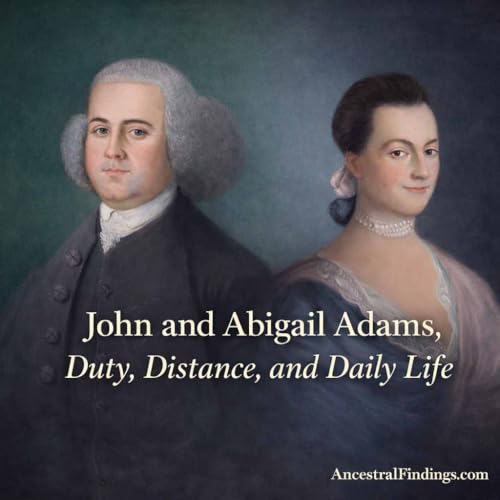
  • AF-1257: John and Abigail Adams, Duty, Distance, and Daily Life | Ancestral Findings Podcast
    Mar 31 2026

    The founding of the United States is usually told through public moments. Documents, debates, and decisions take center stage. The Declaration of Independence, the Continental Congress, and the arguments that led toward separation from Britain are often where the story begins and ends. Those moments are important, but they don't show how those same years were actually lived.

    While independence was being debated and eventually declared, daily life continued. Families still had to manage homes, raise children, and deal with illness, shortages, and uncertainty. The founding period didn't unfold only in assembly rooms. It unfolded in kitchens, farms, and letters written across long distances.

    That's where the lives of John Adams and Abigail Adams come into focus. Their correspondence gives a parallel record of the same years, one that shows how public events and private life moved together.

    John spent long stretches of time away from home. He served in the Continental Congress and later took on diplomatic work that kept him overseas for extended periods. His role placed him close to the center of decisions that shaped the direction of the colonies.

    Abigail remained in Massachusetts, where those decisions were felt in practical ways. She managed the household, oversaw finances, raised their children, and handled responsibilities that didn't stop while political change was underway. The distance between them was not unusual for the time, but the record they left behind is unusually detailed.

    They wrote often, and they wrote plainly. Their letters move between public events and private concerns without separating the two. That's what makes them so valuable. They show how the same moment could be experienced from very different positions...

    Podcast Notes: https://ancestralfindings.com/john-and-abigail-adams-daily-life/

    Ancestral Findings Podcast:

    https://ancestralfindings.com/podcast

    This Week's Free Genealogy Lookups:

    https://ancestralfindings.com/lookups

    Genealogy Giveaway:

    https://ancestralfindings.com/giveaway

    Genealogy eBooks:

    https://ancestralfindings.com/ebooks

    Follow Along:

    https://www.facebook.com/AncestralFindings

    https://www.instagram.com/ancestralfindings

    https://www.youtube.com/ancestralfindings

    Support Ancestral Findings:

    https://ancestralfindings.com/support

    https://ancestralfindings.com/paypal

    #Genealogy #AncestralFindings #GenealogyClips

    Más Menos
    9 m
  • AF-1256: George Washington and the Voice of a New Nation | Ancestral Findings Podcast
    Mar 27 2026

    When the United States first began to take shape as a nation, it didn't just need laws and structure. It needed a voice people could recognize and trust. That voice, more than anyone else's, came from George Washington. He wasn't the loudest figure of his time, and he didn't speak constantly, but when he did, people paid attention. Not because he was trying to draw attention, but because he wasn't. His words were steady, measured, and deliberate, and in a country that could've easily felt uncertain, that kind of tone helped hold things together.

    When Washington took office in 1789, there was no model for the presidency. The Constitution was new, the structure of government was still being tested, and people were watching closely to see what leadership would look like in practice. Every public word carried weight because there was nothing to compare it to. Washington understood that. He knew that how he spoke would shape expectations just as much as what he did. That awareness shows up immediately in his First Inaugural Address, where instead of projecting confidence or ambition, he speaks with caution and a clear sense of responsibility...

    Podcast Notes: https://ancestralfindings.com/george-washington-voice-of-a-new-nation/

    Ancestral Findings Podcast:

    https://ancestralfindings.com/podcast

    This Week's Free Genealogy Lookups:

    https://ancestralfindings.com/lookups

    Genealogy Giveaway:

    https://ancestralfindings.com/giveaway

    Genealogy eBooks:

    https://ancestralfindings.com/ebooks

    Follow Along:

    https://www.facebook.com/AncestralFindings

    https://www.instagram.com/ancestralfindings

    https://www.youtube.com/ancestralfindings

    Support Ancestral Findings:

    https://ancestralfindings.com/support

    https://ancestralfindings.com/paypal

    #Genealogy #AncestralFindings #GenealogyClips

    Más Menos
    6 m
  • AF-1255: 1776 in Public Words | Ancestral Findings Podcast
    Mar 25 2026

    By July of 1776, the arguments had been building for a long time. Tensions with Britain were no longer new. Colonists had already spent years listening to speeches, reading newspapers, hearing sermons, arguing in taverns and homes, and watching events move from protest to open conflict. So when the Declaration of Independence was approved, it didn't arrive in a vacuum. It entered a world already charged with language about rights, liberty, duty, tyranny, and public responsibility.

    Still, something changed when the Declaration was adopted.

    Until then, many of the words had been building toward a point. With the Declaration, the point was finally made in public. The colonies were no longer only resisting. They were declaring. They were no longer only complaining. They were separating. And once those words were approved in Philadelphia, they didn't stay there. They were printed, distributed, read aloud, and heard by ordinary people across the colonies.

    That's one of the most useful ways to think about 1776. The Declaration wasn't just a document written by leading figures in a room. It became a public event. It moved from Congress into streets, newspapers, meeting places, and town centers. It became something people heard from others around them, and that gave it a kind of force that silent reading alone could never provide.

    To understand July 1776 well, it helps to pay attention not only to what the Declaration said, but to how it entered public life...

    Podcast Notes: https://ancestralfindings.com/1776-in-public-words

    Ancestral Findings Podcast:

    https://ancestralfindings.com/podcast

    This Week's Free Genealogy Lookups:

    https://ancestralfindings.com/lookups

    Genealogy Giveaway:

    https://ancestralfindings.com/giveaway

    Genealogy eBooks:

    https://ancestralfindings.com/ebooks

    Follow Along:

    https://www.facebook.com/AncestralFindings

    https://www.instagram.com/ancestralfindings

    https://www.youtube.com/ancestralfindings

    Support Ancestral Findings:

    https://ancestralfindings.com/support

    https://ancestralfindings.com/paypal

    #Genealogy #AncestralFindings #GenealogyClips

    Más Menos
    13 m