American Thought Leaders Podcast Por The Epoch Times arte de portada

American Thought Leaders

American Thought Leaders

De: The Epoch Times
Escúchala gratis

At a time when our nation is portrayed as increasingly polarized, media often ignore viewpoints and stories that are worthy of attention. American Thought Leaders, hosted by The Epoch Times Senior Editor Jan Jekielek, features in-depth discussions with some of America’s most influential thought leaders on pertinent issues facing our nation today.Copyright 2026 The Epoch Times Ciencia Política Política y Gobierno
Episodios
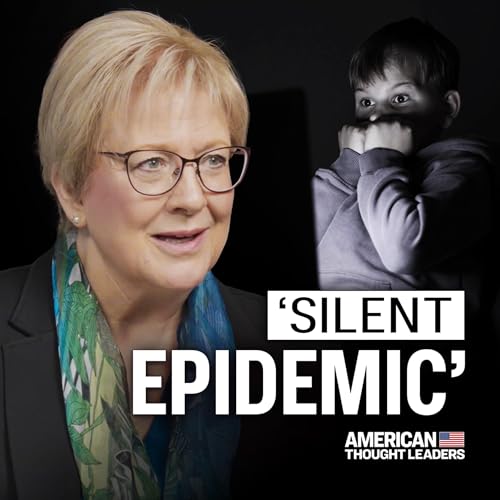
  • How Rampant Explicit Material Is Poisoning the Minds of America’s Children | Kristen Jenson
    Apr 17 2026

    “Pornography is like a silent epidemic ... but nobody wants to talk about it much,” says child protection advocate Kristen Jenson.

    She’s the author of the “Good Pictures Bad Pictures” series of read-aloud books that teach children how to recognize and reject pornography.

    In America, kids are encountering porn at younger and younger ages—often without their parents knowing, Jenson says. Once a child has a smartphone, it is only a matter of time until the child is exposed to porn—often by other children. And it’s having a devastating impact on their impressionable young minds, Jenson says.

    “Every school bus in America is a triple X theater because children are showing pornography to other children in buses. I’ve heard so many stories of five-year-olds getting shown hardcore pornography on a school bus,” she says.

    Retroactive studies found that the average age kids first view pornography is around 11 years old, but Jenson concluded from her work and research that the average age is much lower.

    In our in-depth interview, she walks me through many aspects of porn consumption and how children are impacted by it: How does porn affect children’s overall development and their chances of meaningful sexual relationships later on in life? How does porn affect children’s mental health? How does it affect their sexual health? Do children get addicted to porn? How are girls impacted by porn? How do sexual predators use porn as a grooming tool for kids?

    Violent porn, in particular, is a huge problem in itself, Jenson said. By the age of 18, the vast majority of teenagers—about 80 percent—have been exposed to violent porn: “That’s the main fare out there. It’s violent porn. It’s hitting, it’s slapping, hair-pulling, strangling.”

    Many children’s perception of sex is poisoned by violent pornography. She told me a story of a girl who was kissed by her 12-year-old boyfriend for the first time: “And he strangled her because that’s what he'd seen in porn.”

    It is perhaps unsurprising then that there has been a steep increase in what is called child-on-child sexual abuse over the last decade. In fact, about 70 percent of all sexual child abuse cases are now child-on-child, she said: “Kids love to imitate. When you add in the factor of pornography ... it is not surprising that some of these children want to go ahead and act out what they see in pornography,” Jenson says.

    So what should parents do to protect their children?

    Simply telling your children that porn is bad is not good enough, she said. Children need to be given three basic things: a vocabulary to talk about pornography, a warning against it, and a plan of what to do when they are exposed to it.

    To help parents in this endeavor, she wrote her book series “Good Pictures, Bad Pictures.” These books, geared to different age groups, are meant as a tool to help parents with such conversations: “The point is to model parents talking to their children. It’s really important to open that conversation.”

    “One of the most loving things that you can do for your child is to give them a defense against not only pornography, but all forms of sexual exploitation,” she says.

    Views expressed in this video are opinions of the host and the guest, and do not necessarily reflect the views of The Epoch Times.

    Más Menos
    1 h y 2 m
  • Why 28- and 29-Year-Olds Are Disappearing From China’s Uyghur Concentration Camps | Ethan Gutmann
    Apr 11 2026

    For two decades, investigative journalist Ethan Gutmann has been researching how the Chinese Communist Party secretly harvests the organs of prisoners of conscience and kills them in the process.

    He authored the groundbreaking 2014 work “The Slaughter” and, more recently, “The Xinjiang Procedure.”

    In his latest book, he gathers evidence of how the regime—which has long targeted Falun Gong practitioners for their organs—is now exploiting captive Uyghurs for this same macabre industry.

    Gutmann traveled to Kazakhstan, Tajikistan, Kyrgyzstan, Uzbekistan, and Turkey to interview dozens of Uyghurs and Kazaks who had managed to escape after being imprisoned in camps in Xinjiang, China, also known as East Turkestan. Many spoke to him at great personal risk to themselves and their loved ones.

    What they revealed to him was nothing short of horrific.

    A central witness named “Samal” described working in one of four medical labs located several stories below the concentration camp. One of the clinics—the one she worked in—was used for intestinal removal.

    “The other three clinics were there to remove organs. You couldn’t see them, but occasionally the door would open. You‘d see somebody handling a kidney, a liver, and so forth. Every day that she worked there … there’d be eight or nine bodies. Sometimes it was as many as 20,” Gutmann said.

    During his research, Gutmann realized a disturbing pattern. Many of those who disappeared in the middle of the night from the camps were typically 28 or 29 years old.

    He believes the CCP has made this age demographic its primary target for forced organ harvesting.

    “You are at the peak of your health. At that point, your organs have stopped growing,” Gutmann says.

    In this episode, he breaks down the devastating evidence he’s uncovered—and the failure of Western institutions to address these crimes.

    The spread of extracorporeal membrane oxygenation (ECMO) technology—which keeps organs oxygenated and viable for many hours—has made the CCP’s organ trade even more lucrative than before.

    “Suddenly,” he told me, “you can pull a lot more organs off a single person and get them to distribute them around. And so the profit margin goes way up on a single human being from $100,000 up to almost a million dollars, if they were selling to foreigners.”

    Views expressed in this video are opinions of the host and the guest, and do not necessarily reflect the views of The Epoch Times.

    Más Menos
    59 m
  • The Failures of Multiculturalism in the United Kingdom | Peter McIlvenna
    Apr 10 2026

    A series of devastating inquiries have documented how networks of men—primarily of Muslim Pakistani heritage—groomed, trafficked, and gang-raped thousands of children, mostly white girls, in English towns such as Rotherham, Rochdale, and Telford for decades.

    Independent reviews found that local authorities downplayed allegations and failed to crack down on these crimes in large part out of fear of being accused of racism or Islamophobia.

    At the same time, dozens of sharia councils have emerged across the United Kingdom that run an informal legal system handling divorces, inheritances, and family disputes within Muslim communities. But they often leave women with virtually no rights and protections, especially if the marriage was not officially recognized by UK civil law in the first place.

    British converts from Islam to Christianity, such as Nissar Hussain, describe years of targeted harassment, demonization, and even brutal physical assaults simply for choosing to change their faith, an act branded as “apostasy.”

    Many are now asking: Have we witnessed the failures of the multiculturalism experiment in the United Kingdom? To what extent should immigrants be expected to integrate and assimilate into the cultural and civic norms, such as equal protection under the law and gender equality? How should police and other authorities enforce the laws impartially when cultural and religious sensitivities are involved?

    These questions are all coming to a head in the United Kingdom—and the cultural clashes there serve as a cautionary tale for America, says Peter McIlvenna, co-founder of Hearts of Oak.

    Views expressed in this video are opinions of the host and the guest, and do not necessarily reflect the views of The Epoch Times.

    Más Menos
    23 m
Todavía no hay opiniones