AgEmerge Podcast Podcast Por Hosted by Monte Bottens arte de portada

AgEmerge Podcast

AgEmerge Podcast

De: Hosted by Monte Bottens
Escúchala gratis

New ideas, grower insights, research, emerging technology — The AgEmerge Podcast. Join our host, Monte Bottens and producer Kim Sheese, as they engage with guests from diverse agriculture interests to discuss experiences, practices and scalable applications for any operation. Tune in to new episodes every other Tuesday to regenerate your ideas, soil, crops, livestock and livelihood.All rights reserved
Episodios
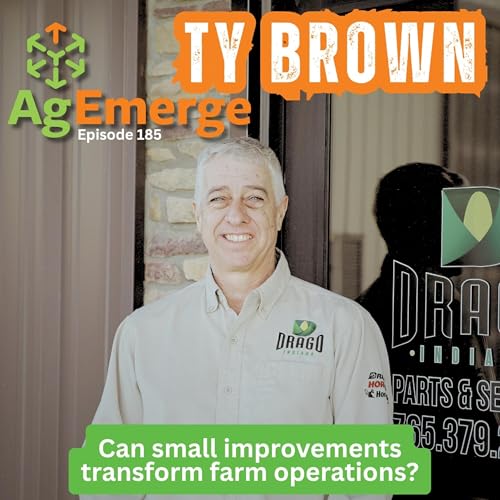
  • AgEmerge Podcast 185 with Ty Brown | Incremental Improvements Transform Farm Operations
    Apr 7 2026
    Discover how Ty Brown, founder and owner of Drago Indiana, uses innovative practices like cover crop breeding, drone technology, and water quality management to enhance sustainability, crop yields, and farm productivity. Hold on tight—this isn’t just about incremental improvements; it’s about transforming your entire farming operation for the better, one innovative step at a time. Monte and Ty break down the crucial role of modern plant breeding, highlighting how genetic markers for traits like seed shatter resistance and hard seed are revolutionizing cover crop reliability. Plus, get insights into how water quality, via reverse osmosis systems, is dramatically enhancing pesticide chemistry effectiveness and crop health—potentially cutting herbicide and fungicide costs by up to 40%. Understand the practicalities of integrating drone technology for precision spraying, and why selecting the right machinery is vital for large-scale applications. In this episode: - The evolution of cover crop breeding and its role in sustainable farming - How genetic selection is improving hairy vetch and cereal rye traits - The impact of water quality on foliar applications and herbicide effectiveness - Using drones and aircraft for efficient crop spraying and farm management - The benefits of diversifying cover crop species, including legumes and ancient grains - The importance of farm-research collaboration and long-term development strategies - Strategies for managing weed suppression, disease risks, and crop rotation complexities - Technological tools for nitrogen estimation and nutrient cycling optimization - The role of peer groups and continuous education in farm success About the Guest: About the Guest: Ty Brown is a 1992 graduate of Rossville High School and a 1996 graduate of Purdue University where he holds a B.S. in Agronomy. While at Purdue he was named the top student in Agronomy 3 of 4 years, and was part of the Purdue Soils Judging Team and Agronomy Club all 4 years. After graduation he returned to the farm as the 6th generation to do so. He married his college sweetheart, Sacha, whom he met in college in 1997. Sacha and he immediately became actively involved in the community. Ty and Sacha both served on Purdue Club of Clinton County, were 4-H leaders, served a 2.5 year term on the Farm Bureau State Young Farmer Committee and Ty took State level 4-H responsibilities, served on the soil and water board, as well as numerous other advisory roles. He started Drago Indiana in 2007 because he wanted to make available to farmers what we felt was a better option for a corn header. In 2013 he added Horsch and 2017 he added Honey Bee and all for the same reasons; they just simply offered a better product than what the major OEM’s were offering. Timestamps: (00:00) – Introduction: Unveiling farm innovations with industry leaders (03:48) – Equipment and drone technology transforming crop management (05:01) – Precision foliar nitrogen application and drone night-time spraying (07:20) – Compatibility of drones with John Deere Operations Center (08:35) – Breeding efforts in hairy vetch and cereal rye for nitrogen and weed control (12:10) – The story behind the evolution of the equipment dealership (15:45) – The innovative service model with aerial farm management (18:02) – Water quality’s impact on fungicide and herbicide efficiency (22:05) – Exploring rye's adaptability and seed diversity based on genetics (25:58) – Nitrogen fixation potential and selecting cover crop varieties (33:44) – Reducing seed shattering and seed cost through breeding (41:40) – Developing cereal rye varieties tailored for cover cropping purposes (58:57) – Relay cropping and interspecies plantings for diverse farming systems (60:45) – The importance of selecting varieties suited to harsh environments (61:23) – Upcoming cover crop varieties from the Cover Crop Breeding Network (62:15) – Long-term research and the importance of perseverance in breeding
    Más Menos
    1 h y 9 m
  • AgEmerge Podcast 184 with Dr. Michael McNeill | The Saga of Soggy Sauerkraut
    Mar 24 2026
    Many farmers assume glyphosate is a reliable tool for weed control with minimal downsides, but Dr. Michael McNeill shows how this herbicide quietly disrupts the very foundation of productive farming—from soil biology to crop health and long-term field resilience. In this eye-opening episode, Dr. McNeill explains the hidden journey of glyphosate through the farm system: how it lingers in manure from treated feed, carries over to contaminate even organic fields, and boosts pathogenic fungi and other disease pressures that hit yields hard. He shares research revealing glyphosate's antibiotic-like effects on soil microbes—shifting the microbial balance, weakening natural disease suppression, and making plants more vulnerable to outbreaks that cost farmers in inputs and lost production. You'll hear about practical, farmer-tested ways to fight back, including using raw sauerkraut juice (loaded with beneficial fermentative microbes like Lactobacillus plantarum) to rapidly break down glyphosate residues in soil and feed crops—potentially slashing contamination by 80-90% in just months and freeing up bound nutrients for better plant uptake. The discussion dives deep into proven regenerative strategies to reclaim fields: strategic cover crops, targeted microbial inoculants, balanced soil nutrition, and other biological practices that naturally crowd out weeds, curb pests and diseases, and rebuild robust soil structure—without leaning on chemicals that create dependency and hidden costs over time. This episode lays bare how over-reliance on glyphosate often leads to nutrient lockups, escalating disease pressure, and rising input needs that eat into profits. But it also delivers real hope: a path to more resilient crops, healthier soils, lower long-term costs, and stronger farm sustainability. Ideal for row-crop farmers, livestock producers, agronomists, and anyone managing land who wants to cut through the noise and explore science-backed ways to reduce chemical dependency while boosting productivity and soil vitality. If you're ready to rethink weed management and invest in farming biologically, this conversation is essential listening. Read the journal article here: https://journals.ashs.org/view/journals/hortsci/59/11/article-p1618.xml About Dr. Michael McNeill: Over the past four decades, Dr. McNeill's focus as an agronomist has been in teaching the agricultural community an understanding of soil and plant nutrition, emphasizing its’ importance for animal and human health. His emphasis has been placed on developing farming systems that promote soil and plant health, as well as, conducting on farm research to develop efficient bio-remediation of soil and water contaminated with farm chemicals and fertilizer nutrients. Also, a major focus of his has been to teach farmers methods to evaluate soil health by measuring soil microbial life, water infiltration rates, soil density, soil compaction, soil fertility levels and how to develop corrective measures if problems are discovered. Positions, Scientific Appointments 1983 – Present President of Ag Advisory, Ltd. (an agricultural consulting company) 1971 – 1983 Research Scientist and Manager of a regional corn breeding station located in Algona, Iowa. 1969 – 1971 U.S. Army research pathologist, study of soybean and corn disease epiphytology. 1964 – 1969 Iowa State University, research associate. Contributions to Science: Published papers in the following: Crop Science, Horticulture Science, Egyptian Journal of Genetics, Plant Disease Reporter, Journal of Genetics, Journal of Economic Entomology, Agronomy Journal, Iowa State University Extension Service Bulletins Popular Press articles: Farm Journal, Successful Farming, Farm Industry News, Iowa Farmer Today, Soybean Digest, Furrow
    Más Menos
    1 h y 2 m
  • AgEmerge Podcast 183 with James Hepp
    Mar 10 2026
    Rockwell City native James Hepp aspired to farm, but with no direct ties to land, that dream seemed out of reach. So how did he get to be farming thousands of acres and a Soil and Water Conservation District Commissioner? About Our Guest: James Hepp aspired to farm, but with no direct ties to land, that dream seemed out of reach. Hepp attended Northwest Missouri State University, where he earned a degree in agricultural business and started his career as a crop insurance adjuster after graduation. In 2019, the opportunity to work with a high school friend’s father, who was nearing retirement, led to a crop-share arrangement and opened the door for Hepp to farm full time. At the same time, Hepp started up his own crop insurance agency. Hepp now manages about 1,400 acres of corn, soybeans, and small grains as a first-generation farmer. Hepp also runs an ag retail business selling lots of regenerative products he uses on his acres. With support from his landlord, Hepp incorporates a wide range of conservation and soil-health building practices on his acres, including cover crops, buffer strips, no-till, strip-till, split-applied nitrogen, variable rate seeding, and much more. Hepp is passionate about showing others how to implement conservation practices that protect soil and water quality through field days held annually on his farm. He is also involved in the local fire department and is a past president of the Calhoun County Farm Bureau. In 2024, James earned the Iowa Farm Bureau Young Farmer Environmental Leadership Award. Navigating Farm Transitions, Conservation, and Innovation with James Hepp In this episode, James Hepp shares his inspiring journey from a non-traditional farming background to becoming a full-time, innovative no-till farmer. He discusses transitioning practices, cover crops, soil health, and water quality—offering practical advice for farmers looking to adapt and improve sustainably. Timestamps 00:29 - Introduction to James Hepp's farming story and background 05:44 - Growth of farm acreage and shift to no-till and regenerative practices 06:35 - Balancing family life and farming full-time with young children 07:05 - Diversification: cover crops, regenerative products, and livestock 08:14 - The challenge of farm succession and transition for older farmers 11:55 - Foundations of risk management: having legal agreements in writing 12:24 - Financial and land management strategies with landowners 13:07 - The benefits of innovative lease agreements and crop share options 16:22 - The mindset of free-thinking farmers and stepping outside of traditional practices 17:25 - Risk mitigation: equipment setup, safety, and exit strategies 22:31 - The advantages of simulated rent and crop sharing models 30:02 - Fertilizer timing, fertilizer reduction, and nutrient placement strategies 34:15 - Cover crop choices: triticale, rye, camelina, and their benefits 36:11 - The economics of strip tillage and equipment investment 38:48 - Practical tips for planting soybeans no-till in different row widths 43:18 - Managing cover crop seeding with drone technology and timing considerations 44:36 - Growing seed oats and low-input, high-return cover crops 54:20 - Water quality challenges, policy, and personal responsibility in Iowa 55:48 - The need for a systems approach, collaboration, and conservation policies 65:21 - Final thoughts: encouragement for farmers to innovate and lead Resources & Links Rockwell City, Iowa (local context) Des Moines Water Works Soil health research by Richard Mulvaney Crop insurance programs Cover crop seed providers No-till conference insights Crop and soil testing services Regenerative ag products: Spray Tech Iowa Farm Bureau Roots Program Water quality policy initiatives in Iowa Connect with James Hepp LinkedIn Twitter Rockwell City farm website
    Más Menos
    1 h y 6 m
Todavía no hay opiniones