Advanced Refrigeration Podcast Podcast Por Brett Wetzel & Kevin Compass arte de portada

Advanced Refrigeration Podcast

Advanced Refrigeration Podcast

De: Brett Wetzel & Kevin Compass
Escúchala gratis

This podcast is for the education of supermarket and commercial refrigeration systems. We will be going over operation troubleshooting and diagnostic on multiple types of systems including mechanical and energy managementBrett Wetzel & Kevin Compass Economía Exito Profesional
Episodios
  • Temperature Sensors & Pressure Transducers O MY, You Look Tired -- Episode 513 Audio
    Mar 30 2026

    Sensors and Pressure Transducers: Ranges, Power Requirements, and Troubleshooting TipsThe hosts discuss travel fatigue, long commutes, and airport TSA delays that led to canceling a flight and driving instead, then shift to field work issues during store startups and CO2 conversions, including controller communication problems caused by cabling, IT security port shutdowns from new MAC addresses, and router performance differences. The main technical focus is identifying and troubleshooting pressure transducers and temperature sensors: common signal ranges (1–6V, 0.5–4.5V, 0–5V, 0–10V, and 4–20 mA), matching transducer power requirements (5V, 12V, 24V/24–36V), and selecting correct pressure ranges for applications up to CO2 gas coolers. They cover sensor types (PT1000, 10K2 vs 10K3, 2.2K, 3K, 86.3K), wiring/offset issues with PT1000 over distance, and using linear interpolation apps to convert measured voltage to expected pressure or controller readings. They briefly mention megger use and plan to discuss CO2 leak detection and drain-related concerns next week.

    Más Menos
    39 m
  • Temperature Sensors & Pressure Transducers O MY, You Look Tired -- Episode 513 Video
    Mar 30 2026

    Sensors and Pressure Transducers: Ranges, Power Requirements, and Troubleshooting TipsThe hosts discuss travel fatigue, long commutes, and airport TSA delays that led to canceling a flight and driving instead, then shift to field work issues during store startups and CO2 conversions, including controller communication problems caused by cabling, IT security port shutdowns from new MAC addresses, and router performance differences. The main technical focus is identifying and troubleshooting pressure transducers and temperature sensors: common signal ranges (1–6V, 0.5–4.5V, 0–5V, 0–10V, and 4–20 mA), matching transducer power requirements (5V, 12V, 24V/24–36V), and selecting correct pressure ranges for applications up to CO2 gas coolers. They cover sensor types (PT1000, 10K2 vs 10K3, 2.2K, 3K, 86.3K), wiring/offset issues with PT1000 over distance, and using linear interpolation apps to convert measured voltage to expected pressure or controller readings. They briefly mention megger use and plan to discuss CO2 leak detection and drain-related concerns next week.

    Más Menos
    39 m
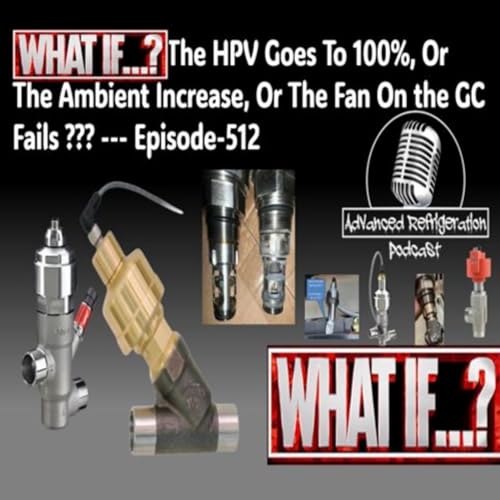
  • WHAT IF… ??? The HPV Goes To 100%, Or The Ambient Increase, Or The Fan On the GC Fails ??? --- Episode-512 Audio
    Mar 23 2026

    CO2 Rack ‘What-If’ Simulations: Gas Cooler Control, Fan/Motor Issues, and Low-Charge BehaviorBrett Wetzel and Kevin Compass open Episode 511 of the Advanced Refrigeration Podcast discussing busy travel, severe weather, and Brett’s final field training day, where they ran CO2 rack “what-if” simulations. They focus on gas cooler TD control via the gas cooler outlet temperature sensor, stressing proper sensor placement and comparing Danfoss limitations to other EMS options (including saturation-based control and fan lockouts). Brett describes attempts to override sensor values on a pack controller, using offsets instead, and demonstrates how warmer gas cooler outlet temperatures (or fan loss) increase flash gas, driving the BGV and medium-temp suction/compressors. They simulate an I-pressure valve stuck open and discuss pitfalls of overriding valves in multiple Danfoss screens. They troubleshoot inverted/programmable EC fan motors, documentation challenges, daisy-chained control wiring issues, and discuss low-charge behavior causing HPV and BGV to close while cases may starve. They also debate liquid piping pickup location (side vs bottom), heat exchanger effects, superheat settings, and hot gas injection setpoints versus Copeland minimum superheat guidance.

    Más Menos
    53 m
Todavía no hay opiniones