Episodios

  • #100 - I Was Told I Might Never Walk Again. Now I'm Running the Boston Marathon
    Feb 23 2026

    Summary

    In this conversation, Caylie McMahon shares her inspiring journey from realizing a lifelong dream to facing a life-altering diagnosis of a spinal tumor. She recounts her experiences during the pandemic and the challenges of surgery and recovery. With unwavering support from her family and the University of Michigan community, Caylie navigates her rehabilitation, relearning to walk and eventually returning to the field. She now has her sights set on the Boston Marathon this April, giving back to an organization that did so much for her.

    Subscribe to the AdaptX Podcast for more inspiring stories like Caylie's.

    Takeaways

    • Caylie's journey highlights the importance of resilience in the face of adversity.
    • The support system from family and friends is crucial during rehabilitation.
    • Relearning to walk after surgery was a significant mental and physical challenge.
    • Training for the Boston Marathon symbolizes her recovery and determination.
    • Her athletic background helped her navigate the challenges of recovery.
    • The experience taught her to appreciate and celebrate the little things in life.
    • Caylie plans to apply the lessons learned from her journey to her professional career.

    Chapters

    00:00 Introduction to Caylie's Journey

    00:56 The Stanford Commitment and Its Challenges

    03:47 Gap Year in England: A New Direction

    06:10 The Tumor Diagnosis: A Life-Altering Moment

    10:03 Surgery and Recovery: The Road to Healing

    13:52 Support from Michigan: A Team Family

    17:59 Relearning to Walk: The Mental Battle

    22:08 Returning to the Field: A New Perspective

    26:01 Training for the Boston Marathon: A New Challenge

    30:00 Transitioning to Professional Life: Lessons Learned

    Thank you to our show sponsor, Resolution Fitness. Resolution supplies commercial, home, and adaptive fitness equipment, supporting gyms, condos, and rehabilitation centers, and community spaces in creating inclusive, durable environments built to perform.

    Learn more at https://www.resolutionfitness.ca/

    Más Menos
    38 m
  • #099 - Making Communication Accessible and Empowering for All: The Story of Verbali with Shay Cohen
    Oct 29 2025

    Summary

    In this episode of the AdaptX Podcast, Brendan Aylward speaks with Shay Cohen, co-founder and CEO of Verbali, an innovative AAC platform designed to enhance communication for children with speech challenges. Shay shares the personal story behind Verbali, inspired by his son Matan, who is nonverbal. The conversation delves into the limitations of traditional AAC tools and how Verbali leverages AI to create a more fluid and natural communication experience. The discussion also covers customization options, the role of user feedback, and the future vision for the product, including potential integrations with fitness environments and eye gaze technology.

    Takeaways

    • Shay Cohen's motivation for Verbali stems from his son Matan's communication challenges.
    • Verbali aims to provide a more natural conversation flow for AAC users.
    • AI is used to predict and suggest responses, enhancing communication speed.
    • Customization is key to making AAC tools effective for individual users.
    • The app learns from user interactions to improve its suggestions over time.
    • User feedback is actively sought to enhance the app's features.
    • The vision includes expanding Verbali's capabilities to various devices, including smartwatches.
    • Social stories can be created using AI to prepare children for new environments.
    • Eye gaze technology is on the roadmap for future integration.
    • The goal is to make AAC accessible and engaging for all users.

    Chapters

    00:00 - Introduction to Verbali and Its Mission

    02:53 - The Personal Story Behind Verbali

    06:06 - Enhancing Communication with AI

    08:55 - Customization and User Experience

    12:01 - The Role of AI in AAC Technology

    15:12 - Addressing Concerns and Challenges with AI

    17:54 - User Personas and Their Needs

    21:09 - Integrating Contextual Signals for Better Communication

    23:47 - Future Plans and Pricing Models

    30:47 - The Evolution of Communication Tools

    39:23 - User Feedback and Iteration

    43:15 - Expanding Use Cases in Different Environments

    49:20 - Future Innovations and Inclusivity

    56:57 - Accessing and Supporting the Technology

    Verbali - links

    Website: https://www.verbali.io

    Ma-Talk on the App Store: https://apps.apple.com/us/app/ma-talk-ai/id6747360381?platform=ipad

    Ma-Talk on Google Play: https://play.google.com/store/apps/details?id=com.verbali.matalkai&pcampaignid=web_share

    Verbali on the social networks:

    Youtube: https://www.youtube.com/@Verbali-AI

    X: https://x.com/verbaliAI

    Linkedin: https://www.linkedin.com/company/verbali-ai

    Facebook: https://www.facebook.com/verbaliAI

    Más Menos
    59 m
  • #098 - Bridging Communication Gaps: The Hi There Solutions Story with Chase and John Prieve
    Oct 7 2025

    Summary

    In this episode of the AdaptX Podcast, Brendan Aylward speaks with Chase and John Prieve, founders of Hi There Solutions, a company dedicated to creating communication solutions for the deaf and hard of hearing community. They discuss their personal connections to the deaf community, the development of their products Hi There and Just Talk, and the challenges they face in scaling their business while ensuring compliance with the Americans with Disabilities Act. The conversation highlights the importance of community feedback, the need for awareness in the market, and their vision for the future of accessibility technology.

    Takeaways

    • Hi There Solutions was inspired by personal experiences with hearing loss.
    • The company offers two main products: Hi There and Just Talk.
    • Hi There provides instant video calling with captions in multiple languages.
    • Just Talk facilitates face-to-face communication between deaf and hearing individuals.
    • The business model includes both B2C and B2B approaches.
    • Compliance with the ADA is crucial for businesses using their technology.
    • The founders emphasize the importance of community feedback in product development.
    • Funding challenges are common for startups in the accessibility space.
    • The company aims to expand its reach to various industries and communities.
    • Future plans include innovations in education, music, and gaming.

    Chapters

    00:00

    Introduction to Hi There Solutions

    00:49

    The Origin Story of Hi There Solutions

    04:55

    Understanding the Business Model and Compliance

    11:55

    Challenges in Accessibility and Business Expansion

    17:20

    Demonstrating Value Beyond the Deaf Community

    22:33

    Overcoming Entrepreneurial Challenges

    25:02

    Navigating Software Development as Non-Technical Founders

    26:02

    Funding and Scaling Challenges

    26:53

    Targeting Diverse Business Verticals

    27:53

    The Importance of the Deaf Olympics

    30:13

    Fitness Industry's Role in Accessibility

    31:56

    Leveraging University Resources for Growth

    32:59

    Challenges with Major Tech Companies

    34:58

    The Spark of Innovation from Personal Experience

    35:51

    Improving Fitness Accessibility for All

    37:48

    Vision for the Future of Hi There Solutions

    Just Talk! : https://www.youtube.com/watch?v=n_4S5uhstu0

    Hi There!!! : https://www.youtube.com/watch?v=-yhNWknAWNA

    Website: www.hitheresolutions.com

    Hi There Solutions Instagram: https://www.instagram.com/hithere_solutions/?hl=en

    Más Menos
    44 m
  • #097 - Strategies to Support the Sensory Needs of Consumers with Lacey Artemis
    Sep 15 2025

    Summary

    In this episode of the AdaptX Podcast, Brendan Aylward speaks with Lacey Artemis, a neurodiversity and accessibility advocate. Lacey shares her personal journey from being diagnosed with autism in her late 20s to becoming a consultant focused on creating neuro-inclusive environments. The conversation explores the challenges faced by neurodivergent individuals in various settings, including workplaces and public spaces, and emphasizes the importance of understanding sensory sensitivities. Lacey discusses her experiences in event planning, the significance of sound in public spaces, and her approach to consulting for organizations. The episode concludes with insights into Lacey's public speaking engagements and her unique presentation titled 'Fish and Trees,' which highlights the strengths of neurodivergent individuals.

    Takeaways

    • Lacey's journey into advocacy began with her own experiences as an autistic individual.
    • Creating neuro-inclusive environments can significantly enhance experiences for everyone, not just neurodivergent individuals.
    • Sound sensitivity is a major concern for many neurodivergent people in public spaces.
    • Event planning should prioritize sensory-friendly environments to foster inclusivity.
    • Consulting for organizations can help them understand the value of neurodiversity in the workplace.
    • Public speaking allows Lacey to advocate for those who may not have a voice.
    • The 'Fish and Trees' presentation emphasizes that everyone has unique strengths.
    • Small changes in venues can make a big difference for neurodivergent patrons.
    • Data collection is essential for advocating for neuro-inclusive practices.
    • Lacey aims to create a database of accessible venues to help others navigate public spaces.

    Chapters

    00:00 Introduction to Neurodiversity and Accessibility Advocacy

    03:11 Personal Journey to Neurodiversity Advocacy

    06:06 Understanding Neurodiversity in Work Environments

    09:13 Creating Inclusive Spaces: The Gym Experience

    12:08 Event Planning for Neuro-Inclusivity

    14:51 The Importance of Sound in Public Spaces

    18:08 Consulting for Neuro-Inclusive Practices

    20:47 Public Speaking and Advocacy

    24:05 Fish and Trees: A Unique Perspective on Abilities

    27:04 Future Directions in Neurodiversity Advocacy

    Más Menos
    40 m
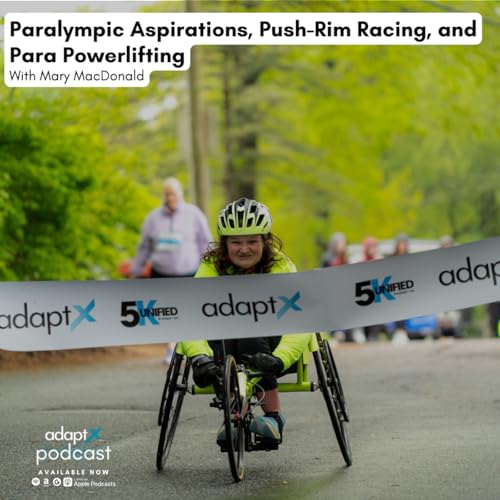
  • #096 - Paralympic Aspirations, Push-Rim Racing, and Para Powerlifting With Mary MacDonald
    Aug 18 2025

    In this episode of the AdaptX podcast, host Brendan Aylward speaks with Mary MacDonald, a 16-year-old adaptive athlete from Taunton, Massachusetts. Mary shares her journey into adaptive sports, her experiences in powerlifting and road racing, and the importance of confidence and community in her athletic pursuits. She discusses the challenges she faced, the support she received, and her aspirations for the future, including competing in the 2028 Paralympics. The conversation highlights the significance of visibility and representation in adaptive sports, as well as the barriers that young athletes may encounter.

    Takeaways

    Mary began her journey in adaptive sports through local clinics.

    She has a passion for music and theater, which boosts her confidence.

    Adaptive sports have helped Mary overcome personal barriers to health.

    She emphasizes the importance of community in sports.

    Mary has set records in the javelin and won multiple medals in competitions.

    She believes in showcasing adaptive sports to inspire others.

    Training for adaptive sports includes both gym work and outdoor practice.

    Mary aims to compete at the international level in the future.

    She encourages young athletes not to let stigma deter them from sports.

    Mary's ultimate goal is to participate in the 2028 Paralympics.

    Keywords

    adaptive sports, inclusion, para sports, Mary MacDonald, powerlifting, road racing, youth athletes, confidence, community, training

    Más Menos
    17 m
  • #095 - Challenging People with Disabilities to Discover Their Purpose, Talents, and Strengths With Dan Minnich, Waypoint Adventure
    Aug 11 2025

    In this conversation, Dan Minich, co-founder and executive director of Waypoint Adventure, shares his journey into disability advocacy and the founding of Waypoint, a nonprofit focused on providing accessible outdoor recreation. He discusses the importance of experiential learning, collaboration among nonprofits, and the challenges of measuring success in adaptive programs. The conversation also touches on legislation for accessibility, best practices for trail management, and the impact of COVID-19 on their operations. Dan emphasizes the need for sustainability in nonprofit funding and shares inspiring stories of participants, highlighting the organization's vision for a more inclusive future.

    Takeaways

    • Dan's introduction to disability came through volunteering in middle school.
    • Waypoint Adventure was founded to fill a gap in accessible outdoor recreation.
    • Experiential learning is central to Waypoint's mission.
    • Measuring success in adaptive programs involves qualitative metrics.
    • Collaboration with other nonprofits enhances Waypoint's impact.
    • Legislation like the Unpaved Trails for All aims to improve accessibility.
    • Best practices for trail accessibility include considering diverse needs.
    • Incremental improvements in accessibility are crucial for inclusivity.
    • Education and training are essential for staff and community partners.
    • COVID-19 prompted innovative adaptations in program delivery.

    Keywords

    Waypoint Adventure, disability advocacy, outdoor recreation, experiential learning, nonprofit collaboration, accessibility legislation, adaptive sports, community engagement, COVID-19 response, sustainability

    Más Menos
    45 m
  • #094 - The Value Proposition of Disability Inclusion with Robert Ludke
    Aug 4 2025

    In this episode of the AdaptX Podcast, Brendan speaks with Bob Ludke, co-founder of Value Inclusion and author of 'Case-Studies in Disability-Driven Innovation'. Value Inclusion is the only consultancy that brings together actionable, c-suite strategy, evidence-based research, and first-hand experience of driving competitive, integrated employment of persons across the disability spectrum in a way that drives brand, reputation, and bottom-line growth. They discuss Ludke's personal journey with disability, the importance of disability inclusion in business, and the role of both public and private sectors in advancing these initiatives. Ludke emphasizes the need for organizations to create inclusive environments and the significant impact investors can have in promoting disability-driven innovation.

    Bob has authored two books:

    Case Studies in Disability-Driven Innovation: Just published and currently an Amazon best

    seller, the book showcases the strategies that will not only future-proof businesses but

    also unlock markets worth trillions of dollars. Think of it as a masterclass in unlocking

    potential. It guides companies, investors, and entrepreneurs toward a goldmine of

    talent, innovation, and profitability.

    Transformative Markets: This is a book about the role of markets in fostering a more

    sustainable society.

    Learn more about Bob's Work

    Value Inclusion - https://valueinclusion.com/

    Ludke Consulting - https://ludkeconsulting.com/

    Harkin Institute - https://harkininstitute.drake.edu/

    Takeaways

    • Bob Ludke's journey began with personal experiences of disability.
    • Disability can drive innovation and improve business outcomes.
    • The private sector has a crucial role in the adoption of disability inclusion.
    • Investors can influence companies to adopt inclusive practices.
    • Empathy is important, but economic incentives are more effective for encouraging inclusion.
    • Organizations should create space for employees to be their authentic selves.
    • Allies can support individuals with disabilities by being resources and advocates.
    • Finding the right roles for people with disabilities can lead to mutual success.
    • Employee retention requires understanding individual motivations.
    • Storytelling is crucial for raising awareness about disability inclusion.
    • Perseverance is a common trait among entrepreneurs with disabilities.
    • AI tools must be developed with disability nuances in mind.
    • Gyms can foster a culture of belonging and support.
    • Socioeconomic barriers remain a challenge in disability inclusion.

    Keywords

    disability inclusion, Bob Ludke, Value Inclusion, adaptive sports, entrepreneurship, public policy, private sector, case studies, innovation, accessibility, disability inclusion, employee loyalty, workplace diversity, advocacy, innovation, AI, socioeconomic barriers, gym accessibility, storytelling, perseverance

    Más Menos
    1 h y 9 m
  • #093 - Innovations in Prosthetic Technology with Vessl CEO, Sydney Robinson
    Jul 25 2025

    In this episode of the AdaptX Podcast, Brendan Aylward speaks with Sydney Robinson, founder and CEO of Vessl, a company dedicated to creating innovative prosthetic solutions for amputees. Sydney shares her journey from childhood to college to her career as a passionate entrepreneur in the field of biomedical engineering. The conversation delves into her experiences during a pivotal fellowship that ignited her interest in prosthetics, the challenges of developing the Kinn socket, and the importance of making assistive technology accessible. We cover how essential it is to consistently seek feedback from users and clinicians, the pressures of being a CEO, and her vision for the future of Vessel and the prosthetics industry.

    Links for Vessl’s Pages

    • LinkedIn: https://www.linkedin.com/company/vessl-prosthetics/?originalSubdomain=ca
    • Sydney's LinkedIn: https://www.linkedin.com/in/sydneymrobinson/
    • Instagram: https://www.instagram.com/vesslprosthetics/?hl=en

    Takeaways

    • Sydney's early interest in engineering stemmed from her love of math and science.
    • Capstone and fellowship experiences were crucial in shaping her career path.
    • Vessl aims to solve the problem of static sockets in prosthetics.
    • Kinn is designed to adapt to the changing size of the residual limb.
    • The product focuses on mechanical solutions for reliability and ease of use.
    • Feedback from clinicians and users has been overwhelmingly positive.
    • Sydney's evolution and emphasis as a leader
    • The company's goals of global expansion
    • Building a brand behind a product
    • The importance of networking for aspiring innovators

    Keywords

    Vessl, Sydney Robinson, prosthetics, innovation, entrepreneurship, assistive technology, Kinn, engineering, accessibility, adaptive solutions

    Más Menos
    36 m