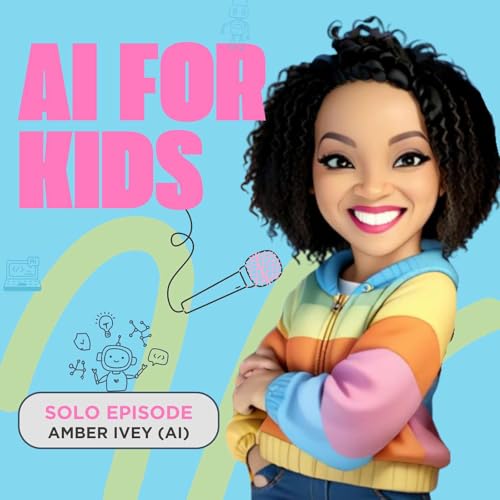
AI for Kids Podcast Por Amber Ivey (AI) arte de portada

AI for Kids

AI for Kids

De: Amber Ivey (AI)
Escúchala gratis

Welcome to AI for Kids, a podcast made for kids, with parents and teachers there to support and guide them, without adding more screen time.


This podcast is made for kids ages 4–12 (and curious teens too) and the adults who support them. You’ll hear fun, easy-to-follow conversations with fellow kids and even AI experts. We break down what AI is, how it shows up in everyday life, and how to talk about it at the dinner table or on the drive to school.


Whether you’re multitasking, carpooling, or winding down for the night, AI for Kids fits your life. It’s screen-free, engaging, and created to spark curiosity, not replace it.


Because kids don’t need more screen time to stay ahead, just better ways to understand the world they’re growing up in.

© 2026 AI for Kids - AiDigiTales
Episodios
  • Is AI Really Your Friend? What Kids (and Parents) Need to Know (Middle School +)
    Mar 31 2026

    Send us Fan Mail

    AI can feel like a mind that knows you, agrees with you, and never gets tired, which is exactly why we need to talk about how it shows up in real life. I’m joined by Dr. Tiffany Petricini , who studies AI and relationships, and Dr. Sarah Zipf, who researches technology in education, to unpack what kids actually need to know about AI beyond the hype and scary movie plots.

    We get into why technology is never neutral, why there are always benefits and disadvantages, and why schools should start with one grounding question before adopting any AI tool: what is it for? We also challenge a big myth about “digital natives.” Being great on a phone does not automatically mean strong computer literacy, and that gap matters when AI tools enter the classroom. Along the way, we talk AI literacy for kids, digital citizenship, and how families can ask better questions instead of letting fear make decisions for them.

    Then we tackle AI chatbots and AI friends head-on. AI can sound comforting because it responds instantly and tells you what you want to hear, but it cannot be a real friend, and it cannot replace trusted adults or real peers. We break down why “AI is math” helps demystify what’s happening, how bias can sneak into AI outputs, and how play-based learning (like cooking recipes and hands-on games about algorithms) can teach big ideas without adding more screen time.

    If this conversation helps your family, subscribe, share it with a friend, and leave a review so more parents and kids can find it. What is one rule you think every household should have for using AI?

    Support the show

    Hey parents and teachers, if you want to stay on top of the AI news shaping your kids’ world, subscribe to our weekly AI for Kids Substack: https://aiforkidsweekly.substack.com/

    Help us become the #1 podcast for AI for Kids and best AI podcast for kids, parents, teachers, and families.

    Buy our debut book “AI… Meets… AI”

    Social Media & Contact:

    • Website: www.aidigitales.com
    • Email: contact@aidigitales.com
    • Follow Us: Instagram, YouTube
    • Books on Amazon or Free AI Worksheets

    Listen, rate, and subscribe!

    • Apple Podcasts
    • Amazon Music
    • Spotify
    • YouTube
    • Other

    Like our content? ...

    Más Menos
    46 m
  • Can You Spot a Fake AI Video on YouTube? (Elementary)
    Mar 31 2026

    Send us Fan Mail

    A kids’ video can be bright, catchy, and totally wrong. We’re seeing more AI-generated videos for kids show up on YouTube and tablets, and some of them slip mistakes into the middle where a quick parent check might miss it. That matters because “small” errors can teach unsafe ideas, confuse real-world rules, and spread misinformation while looking like normal cartoons and sing-alongs.

    We break down what’s going on in plain language: how AI can create videos fast, why some creators push quantity over quality, and why automated content moderation does not always catch problems in time. If you’ve been wondering about YouTube Kids safety, parental controls, or how to build media literacy for kids, this conversation gives you a clear starting point. We also share a simple example of how a video can teach the opposite of a basic safety lesson, even though everything looks friendly on the surface.

    Most important, we talk directly to kids about a real superpower: noticing when something feels off. Weird movement, odd voices, sentences that don’t make sense, or a lesson that clashes with real life are all signals to pause, pick something else, and tell a trusted adult. That one habit supports digital safety and critical thinking in a world filled with AI-generated content.

    If this helps your family, subscribe wherever you get your podcasts or on YouTube, share the episode with a parent or teacher, and leave a review so more people can learn how to spot these videos faster. What’s the strangest “kids” video you’ve ever seen?

    Support the show

    Hey parents and teachers, if you want to stay on top of the AI news shaping your kids’ world, subscribe to our weekly AI for Kids Substack: https://aiforkidsweekly.substack.com/

    Help us become the #1 podcast for AI for Kids and best AI podcast for kids, parents, teachers, and families.

    Buy our debut book “AI… Meets… AI”

    Social Media & Contact:

    • Website: www.aidigitales.com
    • Email: contact@aidigitales.com
    • Follow Us: Instagram, YouTube
    • Books on Amazon or Free AI Worksheets

    Listen, rate, and subscribe!

    • Apple Podcasts
    • Amazon Music
    • Spotify
    • YouTube
    • Other

    Like our content? ...

    Más Menos
    5 m
  • 3 Rules to Keep Young Brains Strong, Healthy AI Use & Homework Balance
    Mar 17 2026

    Send us Fan Mail

    AI can do homework-level tasks in seconds, which is exactly why so many parents and teachers feel uneasy. After a short break, we’re back with a solo check-in that tackles the question showing up all over parent message boards: how much AI is too much for kids, and what does “healthy” AI use actually look like when school and screens are already competing for attention?

    We dig into a concept called cognitive offloading, where we hand our thinking over to a machine and slowly lose the mental “muscle” that comes from struggling through a hard problem. I use a simple analogy: AI can either be autopilot, where the tool flies the plane and the learner checks out, or it can be a copilot, where your child stays in control and the AI supports with directions, hints, and explanations. That difference matters for learning, writing, and long-term critical thinking.

    You’ll leave with three practical rules you can use right away at home or in the classroom: try first and use AI second, prompt for tutoring instead of asking the bot to do the work, and always fact-check because large language models can hallucinate. We also talk about why this isn’t just a kids issue, how adults can slide into the same habits, and why the best approach is sitting alongside kids to build real AI literacy without giving up curiosity or creativity.

    Subscribe for more parent-friendly AI guidance, share the show with a friend, and leave a review so more families can find it. What’s one boundary you want to set for AI use this week?

    Solo check-in from AI for Kids for parents & teachers: AI can do homework-level tasks in seconds, and that’s raising questions about over-reliance. This episode explains why that matters and gives 3 practical rules to keep kids’ thinking strong while using AI, at home or school. Clear, screen-friendly guidance for kids (ages 4–12) and the adults who support them.

    Support the show

    Hey parents and teachers, if you want to stay on top of the AI news shaping your kids’ world, subscribe to our weekly AI for Kids Substack: https://aiforkidsweekly.substack.com/

    Help us become the #1 podcast for AI for Kids and best AI podcast for kids, parents, teachers, and families.

    Buy our debut book “AI… Meets… AI”

    Social Media & Contact:

    • Website: www.aidigitales.com
    • Email: contact@aidigitales.com
    • Follow Us: Instagram, YouTube
    • Books on Amazon or Free AI Worksheets

    Listen, rate, and subscribe!

    • Apple Podcasts
    • Amazon Music
    • Spotify
    • YouTube
    • Other

    Like our content? ...

    Más Menos
    7 m
Todas las estrellas
Más relevante
These are amazing podcasts. These podcasts are so good, very informative. Great for the kids and adults!

Ai for kids

Se ha producido un error. Vuelve a intentarlo dentro de unos minutos.