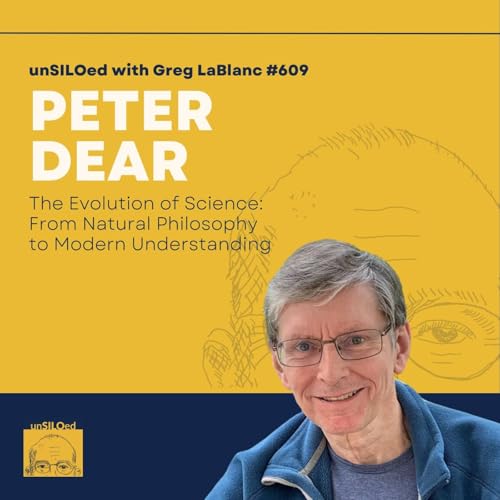
609. The Evolution of Science: From Natural Philosophy to Modern Understanding feat. Peter Dear Podcast Por  arte de portada

609. The Evolution of Science: From Natural Philosophy to Modern Understanding feat. Peter Dear

609. The Evolution of Science: From Natural Philosophy to Modern Understanding feat. Peter Dear

Escúchala gratis

Ver detalles del espectáculo

OFERTA POR TIEMPO LIMITADO | Obtén 3 meses por US$0.99 al mes

$14.95/mes despues- se aplican términos.
What was the role of experimentation in early science? How did past scientific paradigms continue to influence current scientific discourse? What is the utility of understanding the history of science for modern scientists?Peter Dear is a professor emeritus of history at Cornell University, and the author of several books, including The World as We Know It: From Natural Philosophy to Modern Science and Discipline and Experience: The Mathematical Way in the Scientific Revolution.Greg and Peter discuss the evolution of science from natural philosophy, addressing how scientific progress is not simply a linear journey towards greater knowledge. Peter talks about the transformative periods like the Renaissance and the scientific revolution, and the debate over the definition and significance of terms like 'scientific revolution.' They also explore how today's scientific practices are deeply rooted in 19th-century developments. Their conversation also covers the historical context behind Newton's and Darwin's work among other famous scientists throughout history.*unSILOed Podcast is produced by University FM.*Episode Quotes:The two “registers” of science09:50: Science nowadays, and through the course of the last, well, developing over the last two centuries, really in the 19th and 20th centuries, science is still talked of as if it were a naturaln actual philosophy, even if that term is not used very much anymore. Science is sometimes regarded as something that is about understanding the universe, understanding the natural world as if it is an intellectual enterprise and just an intellectual enterprise. And at the same time, it is also regarded as something that is practically useful, practically valuable, and these two different registers for talking about science, I think, sort of ride alongside one another and switch back and forth depending on how it is that people want to represent any particular kind of knowledge.The birth of experimentation22:23: One of the things about experimentation, is that it was a matter of developing practices, procedures for generating knowledge claims about nature that were different from the ways in which experience had been used, particularly in Aristotelian or quasi-Aristotelian context, to talk about the behavior of nature. Experiments are a particular way of understanding what experience is useful for in making sense of the world.The twin dimensions of science40:30: I think all scientists have always relied on the twin dimensions of science, the fact that science can be regarded as an actual philosophy when it's talking about the way things are, and the fact that science can be regarded as, or talked about in terms of, instrumentality. When you are focusing on the capabilities, the practical capabilities, the particular ideas and procedures enable you to do, and at different times and places, scientists will sometimes play up the natural philosophy side of things and at other times play up the instrumentality side of things, depending on what it is interested in talking about at the time. But I think everyone, all scientists, regard those as both essential elements, so to speak, of what scientific inquiry is all about.Show Links:Recommended Resources:Scientific RevolutionFrancis BaconParacelsusAristotleNicolaus CopernicusGalileo GalileiIsaac NewtonRené DescartesRobert BoyleTaxonomyCharles LyellAlbert EinsteinThomas KuhnGuest Profile:Academia PapersProfessors Emeriti List at Cornell UniversityGuest Work:Amazon Author PageThe World as We Know It: From Natural Philosophy to Modern ScienceRevolutionizing the Sciences: European Knowledge in Transition, 1500-1700Revolutionizing the Sciences: European Knowledge and Its Ambitions, 1500-1700Discipline and Experience: The Mathematical Way in the Scientific RevolutionThe Intelligibility of Nature: How Science Makes Sense of the WorldMersenne and the Learning of the SchoolsResearchGate Page Hosted by Simplecast, an AdsWizz company. See pcm.adswizz.com for information about our collection and use of personal data for advertising.
Todavía no hay opiniones