

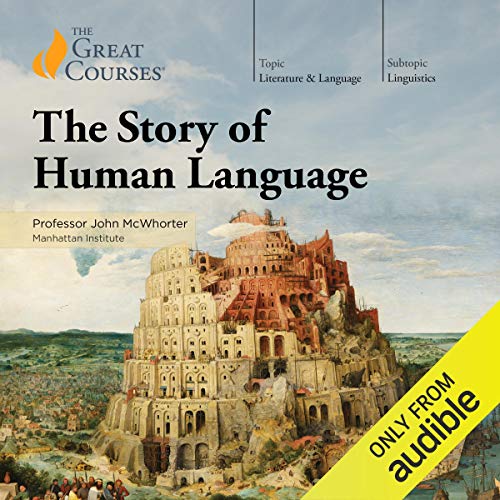
The Story of Human Language
No se pudo agregar al carrito
Add to Cart failed.
Error al Agregar a Lista de Deseos.
Error al eliminar de la lista de deseos.
Error al añadir a tu biblioteca
Error al seguir el podcast
Error al dejar de seguir el podcast
Obtén 3 meses por US$0.99 al mes
 Exclusivo para miembros Prime: ¿Nuevo en Audible? Obtén 2 audiolibros gratis con tu prueba.

The Story of Human Language
Compra ahora por $24.94
-
Narrado por:
-
John McWhorter
Language defines us as a species, placing humans head and shoulders above even the most proficient animal communicators. But it also beguiles us with its endless mysteries, allowing us to ponder why different languages emerged, why there isn't simply a single language, how languages change over time and whether that's good or bad, and how languages die out and become extinct. Now you can explore all of these questions and more in an in-depth series of 36 lectures from one of America's leading linguists.
You'll be witness to the development of human language, learning how a single tongue spoken 150,000 years ago evolved into the estimated 6,000 languages used around the world today and gaining an appreciation of the remarkable ways in which one language sheds light on another.
The many fascinating topics you examine in these lectures include: the intriguing evidence that links a specific gene to the ability to use language; the specific mechanisms responsible for language change; language families and the heated debate over the first language; the phenomenon of language mixture; why some languages develop more grammatical machinery than they actually need; the famous hypothesis that says our grammars channel how we think; artificial languages, including Esperanto and sign languages for the deaf; and how word histories reflect the phenomena of language change and mixture worldwide.
PLEASE NOTE: When you purchase this title, the accompanying reference material will be available in your Library section along with the audio.
©2004 The Teaching Company, LLC (P)2004 The Great Courses
Los oyentes también disfrutaron:








Editor's Pick
A whole world of words
"Language is so weird. It can never be fully pinned down, and it evolves in fascinating and unpredictable ways. That’s what makes this course so fun. By examining the evolution of language, Professor John McWhorter elucidates a cross-section of history from a perspective we all take for granted. McWhorter knows all of the factoids behind the factoids, in multiple languages, making this course endlessly entertaining and eye-opening."
—Michael D., Audible Editor
Las personas que vieron esto también vieron:


Engaging, witty, and deeply informative!
Se ha producido un error. Vuelve a intentarlo dentro de unos minutos.
Would you recommend this audiobook to a friend? If so, why?
I would recommend it to friends interested in understanding the natural processes involving languages evolution.What did you like best about this story?
I was able to understand how languages develop, merge and branch and things like "a language is a dialect with an army and borders".Which character – as performed by Professor John McWhorter – was your favorite?
The professor himself. His analogies with his own life and metaphors are great.Did you have an extreme reaction to this book? Did it make you laugh or cry?
Yes, many times I was surprised about how things got to be the way they are. My mother tongue is portuguese and I always wondered, for example, how it came to remain beautiful and "complicated" while english became this easy ugly language we all love to use.Any additional comments?
I also read "Myths, Lies, and Half-Truths of Language Usage" also a great book. It is nice to read both, but they have a huge overlap but the former is english centric.Worth every minute
Se ha producido un error. Vuelve a intentarlo dentro de unos minutos.
Mr.McWhorter has an enthusiastic and lively narration style and it engages you! I am an engineer who picked up this audiobook because the topic interested me and I have always been fascinated about how many languages are similar. After listening to this, I am a linguistics fan now. I have already started listening to another course on languages by Professor John.
The content is well structured, detailed and not just touching upon theoretical topics. Mr.McWhorter cites examples for everything that he's presenting and also presents both sides of the arguments on areas of contention.
Its a great listen!
John McWhorter is amazing!
Se ha producido un error. Vuelve a intentarlo dentro de unos minutos.
And little to say about modern English
Very interesting
Se ha producido un error. Vuelve a intentarlo dentro de unos minutos.
Interesting material, great delivery
Se ha producido un error. Vuelve a intentarlo dentro de unos minutos.