

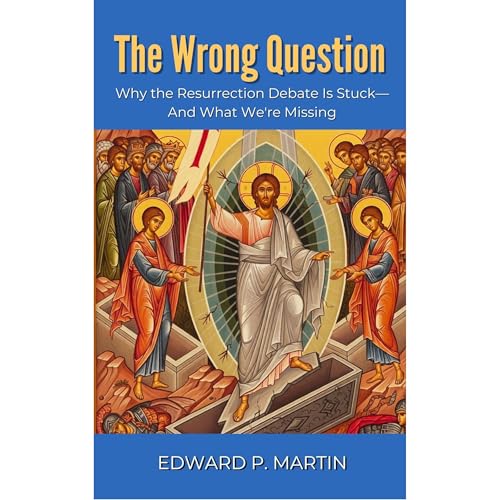
The Wrong Question
Why the Resurrection Debate Is Stuck—And What We're Missing
No se pudo agregar al carrito
Add to Cart failed.
Error al Agregar a Lista de Deseos.
Error al eliminar de la lista de deseos.
Error al añadir a tu biblioteca
Error al seguir el podcast
Error al dejar de seguir el podcast
Prueba gratis de 30 días de Audible Standard

The Wrong Question
Compra ahora por $12.99
-
Narrado por:
-
Virtual Voice
-
De:
-
Edward P. Martin

Este título utiliza narración de voz virtual
—and Why No One Can Win It
For centuries, Christians and skeptics have argued about one question:
Did the resurrection really happen?
The arguments are brilliant.
The books are endless.
The results never change.
Believers stay believers.
Skeptics stay skeptics.
What if the problem isn’t the evidence—but the question itself?
In This Book You’ll Discover:
Why resurrection debates never change anyone’s mind
The hidden assumption believers and skeptics share
Why history alone cannot decide the resurrection
How the Incarnation reframes the entire discussion
What the earliest Christians were actually proclaiming
The Debate That Goes Nowhere
Apologists argue the resurrection is the best historical explanation.
Skeptics argue miracles exceed historical probability.
Both sides argue well.
Both sides publish endlessly.
And both sides remain unconvinced.
Because both sides are asking history to do something it cannot do.
The Mistake at the Heart of the Argument
This book makes a simple but disruptive claim:
The resurrection is not primarily a historical hypothesis.
It is a theological proclamation—a claim about who God is and how God acts.
That doesn’t make it unreal.
It places it in the right category.
One Question Changes Everything
Christians confess that God became human in Jesus of Nazareth.
No one demands historical proof of the Incarnation.
No one claims faith collapses without empirical verification.
Why?
Because the Incarnation is a theological truth.
What if the resurrection is the same kind of claim?
A Way Beyond the Stalemate
This book explains why historical arguments will never settle the resurrection—and why that doesn’t weaken Christianity.
It offers a clearer framework, rooted in theology, that honors history without reducing faith to probability.
The debate is stuck because we keep asking the wrong question.
This book shows what we’ve been missing.