Episodios

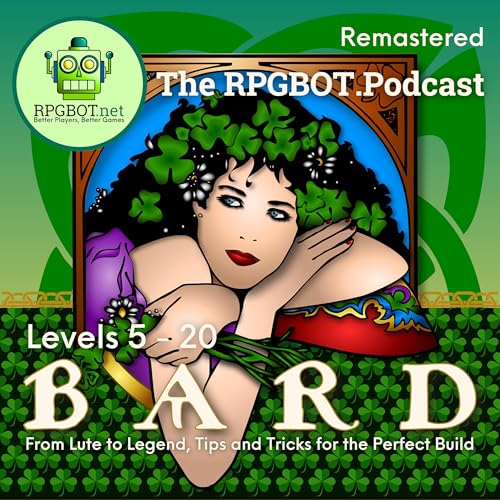
  • 2014 DnD 5e BARD Levels 5–20 (Remastered): From Lute to Legend, Tips and Tricks for the Perfect Build
    Apr 11 2026
    Show Notes Once the Bard survives the awkward early levels, levels 5 through 20 are where the class stops being the party's emotional support musician and becomes a full-blown tactical menace. This episode of the RPGBOT.Podcast explores how Bards evolve from flexible generalists into highly optimized specialists while still keeping their trademark versatility. The hosts break down the critical turning point at level 5, where Bardic Inspiration refreshes on a short rest. This shift turns your support engine from a limited resource into something you can use freely in nearly every encounter. From there, the discussion focuses on spell scaling, action economy, and how to fully leverage your role as the party's ultimate problem solver. A major focus is Magical Secrets, which allows the Bard to snag powerful spells from other classes. By selecting top-tier spells from any class, whether for battlefield control, healing, or raw damage, the Bard becomes a hybrid caster capable of competing with specialists in their own niche. The episode also explores how different Bard Colleges perform at higher levels. Lore Bards lean further into spellcasting dominance, while Valor and Swords Bards become legitimate front-line options. Other subclasses offer strong identities in social or narrative-heavy campaigns. The hosts consistently highlight that high-level Bard play is not about dealing the most damage, but about control, utility, and enabling the rest of the party. As the episode moves into late-game play at levels 15 through 20, the tone shifts toward survival and decision-making. High-level encounters require careful positioning, smart spell selection, and a strong understanding of action economy. The Bard is not the toughest or the most explosive class, but in the hands of a skilled player, it often becomes the reason the party succeeds. The Bard does not just scale in power, it expands in capability. Every level adds new tools, new options, and new ways to outthink the game itself. Key Takeaways Bard levels 5 through 10 represent a major power spike due to short-rest Bardic Inspiration and stronger spell accessCharisma remains the primary stat, but Dexterity and Constitution become more important for survivabilityMagical Secrets defines mid-to-high-level Bard play by granting access to powerful spells from any classBards shine as support casters, controllers, and party problem-solvers rather than primary damage dealersSubclass choice strongly influences playstyle: Lore focuses on spell flexibility and dominance, Valor and Swords support hybrid martial builds: and other subclasses emphasize niche strengths such as social influence or thematic utilityAction economy is critical, and choosing when to buff, control, or cast matters more than raw damage outputHigh-level Bard play rewards creativity and system masteryThe Bard's greatest strength is adaptability, allowing it to fill nearly any party role when built well Welcome to the RPGBOT Podcast. If you love Dungeons & Dragons, Pathfinder, and tabletop RPGs, this is the podcast for you. Support the show for free: Rate and review us on Apple Podcasts, Spotify, or any podcast app. It helps new listeners find the best RPG podcast for D&D and Pathfinder players. Level up your experience: Join us on Patreon to unlock ad-free access to RPGBOT.net and the RPGBOT Podcast, chat with us and the community on the RPGBOT Discord, and jump into live-streamed RPG podcast recordings. Support while you shop: Use our Amazon affiliate link at https://amzn.to/3NwElxQ and help us keep building tools and guides for the RPG community. Meet the Hosts Tyler Kamstra – Master of mechanics, seeing the Pathfinder action economy like Neo in the Matrix. Randall James – Lore buff and technologist, always ready to debate which Lord of the Rings edition reigns supreme. Ash Ely – Resident cynic, chaos agent, and AI's worst nightmare, bringing pure table-flipping RPG podcast energy. Join the RPGBOT team where fantasy roleplaying meets real strategy, sarcasm, and community chaos. How to Find Us: In-depth articles, guides, handbooks, reviews, news on Tabletop Role Playing at RPGBOT.net Tyler Kamstra BlueSky: @rpgbot.netTikTok: @RPGBOTDOTNET Ash Ely Professional Game Master on StartPlaying.GamesBlueSky: @GravenAshesYouTube: @ashravenmedia Randall James BlueSky: @GrimoireRPGAmateurjack.comRead Melancon: A Grimoire Tale (affiliate link) Producer Dan @Lzr_illuminati
    Más Menos
    1 h y 4 m
  • MAPS - Spaghetti Layouts and Bad Decisions
    Apr 9 2026
    Show Notes The hosts have surprisingly practical discussion: maps in tabletop RPGs and why so many of them just don't work. At their core, maps aren't just visuals. They help players navigate, understand space, and engage with the world. But not all maps serve the same purpose. Some guide movement, some highlight important features, and others exist purely for combat or immersion. But there are so many ways that maps can go wrong. Maps should be built around intent and scale. A single room, a dungeon, a city, and a world map all need different levels of detail and serve different roles. Treating them the same is where things fall apart. At the room level, simplicity wins. You don't need perfect art, but provide just enough detail to support the scene. A few objects, a clear focal point, and something interesting to discover can turn even a basic box map into something memorable. But every detail you include matters because players will assume it's important. Dungeons scale that idea up. They're just collections of rooms, but they need to make sense. Layout, distance, and flow all affect gameplay, especially when combat, stealth, or noise comes into play. A good dungeon map isn't just connected rooms; it's a space that feels intentional and playable. City maps shift focus again. You don't need every building, just the parts players care about. A few landmarks, key districts, and notable locations are enough to give the city identity without overwhelming the table. And at the largeer scales the advice is simple: don't overbuild. Focus on major features and let the rest grow as the campaign does. Players won't see most of it anyway. The takeaway is clear: maps don't need to be perfect but they do need to be useful. Whether you're sketching quick shapes or using advanced tools, the goal is always the same: help your players understand the world and make interesting decisions inside it. Key Takeaways Maps serve multiple roles in tabletop RPGs including navigation, immersion, combat clarity, and storytellingNot all maps are created equal and design depends heavily on scale such as room, dungeon, city, region, and worldGood map design starts with intent and what the map is meant to help players doOverly detailed maps can mislead players because anything visible will be treated as importantSimple maps can work effectively when supported by clear description and purposeA strong room design includes set dressing, a focal point, and a hidden or revealed elementDungeon maps should make logical and mechanical sense including layout, sound distance, and flowHallways and room placement directly impact encounter design and player strategyCity maps should focus on landmarks, districts, and important locations rather than every buildingRegional and world maps should prioritize major features such as mountains, rivers, and capitalsPlayers rarely explore everything so maps should focus on likely points of interactionMaps can enhance immersion in virtual tabletop play but may hinder roleplay if overusedPre-made maps can inspire encounters but may require improvisation to match the sceneTools like Dungeon Alchemist, Inkarnate, and Dungeon Scrawl can speed up map creationThe best maps are not the most detailed but the ones that support gameplay and storytelling effectively Welcome to the RPGBOT Podcast. If you love Dungeons & Dragons, Pathfinder, and tabletop RPGs, this is the podcast for you. Support the show for free: Rate and review us on Apple Podcasts, Spotify, or any podcast app. It helps new listeners find the best RPG podcast for D&D and Pathfinder players. Level up your experience: Join us on Patreon to unlock ad-free access to RPGBOT.net and the RPGBOT Podcast, chat with us and the community on the RPGBOT Discord, and jump into live-streamed RPG podcast recordings. Support while you shop: Use our Amazon affiliate link at https://amzn.to/3NwElxQ and help us keep building tools and guides for the RPG community. Meet the Hosts Tyler Kamstra – Master of mechanics, seeing the Pathfinder action economy like Neo in the Matrix. Randall James – Lore buff and technologist, always ready to debate which Lord of the Rings edition reigns supreme. Ash Ely – Resident cynic, chaos agent, and AI's worst nightmare, bringing pure table-flipping RPG podcast energy. Join the RPGBOT team where fantasy roleplaying meets real strategy, sarcasm, and community chaos. How to Find Us: In-depth articles, guides, handbooks, reviews, news on Tabletop Role Playing at RPGBOT.net Tyler Kamstra BlueSky: @rpgbot.netTikTok: @RPGBOTDOTNET Ash Ely Professional Game Master on StartPlaying.GamesBlueSky: @GravenAshesYouTube: @ashravenmedia Randall James BlueSky: @GrimoireRPGAmateurjack.comRead Melancon: A Grimoire Tale (affiliate link) Producer Dan @Lzr_illuminati
    Más Menos
    1 h y 9 m
  • PLANE OF AIR - "It Doesn't Suck… It Blows"
    Apr 5 2026
    This week on the RPGBOT.Podcast, we dive into the Plane of Air—a place where gravity is optional, directions are meaningless, and your best travel strategy is throw yourself into a wind tunnel and see what happens. Tyler leans fully into his identity as a being of pure hot air, Randall realizes that falling forever is somehow worse than dying, and Ash compares the whole experience to falling into Jupiter… but without the decency of being crushed. It's weird. It's confusing. And somehow, it's one of the more playable planes we've covered. Show Notes The Plane of Air is exactly what it sounds like: endless sky in every direction. No ground, no horizon, no real sense of up or down—just air stretching out forever. But the twist—and the thing that makes it usable in a game—is how movement works. Gravity isn't constant here. You only start "falling" when you get close to something big enough to pull you in. Otherwise, you just drift, carried along by powerful wind currents that act like invisible highways. So getting from one place to another isn't about walking or even flying in a straight line. It's about finding the right current, jumping in, and hoping it takes you where you meant to go. The whole thing feels less like travel and more like being aggressively transported. What really sells the setting, though, is how alive it is in ways you don't immediately notice. Air elementals are often completely invisible unless they pick up dust or debris, which means you could be surrounded by intelligent creatures at any moment and never realize it. On top of that, you've got Djinn building cities on floating rock islands and solidified clouds, flying species that never bother to land, and ancient beings like the Wind Dukes quietly existing on their own isolated domains. It's not empty—it just feels empty until it suddenly doesn't. The episode also highlights a big difference between systems. In D&D, the Plane of Air is more of a concept with a few named locations. In Pathfinder, it's a fully fleshed-out setting with trade cities, hidden tunnel networks, elemental politics, and enough weird landmarks to support an entire campaign. It's the same idea, just taken much further. Getting there is about what you'd expect: portals, plane shift spells, or—if you're feeling reckless—flying into a powerful storm and letting the universe decide your fate. Getting back less clearly defined, which honestly feels appropriate. The Plane of Air doesn't follow normal logic, and trying to force it to is missing the point. It works best when you lean into the absurdity and let it be a place where navigation is vibes, physics is negotiable, and down is more of a suggestion than a rule. Key Takeaways The Plane of Air is infinite sky with no natural ground, and gravity only matters when something big enough pulls on you.Movement is defined by wind currents, which makes travel feel unpredictable and a little chaotic—in a good way.It's far more populated than it seems, especially with invisible or hard-to-detect creatures like air elementals.Pathfinder turns the concept into a much richer setting, with cities, factions, and enough structure to support a full campaign. The Plane of Air isn't about survival like the Plane of Fire—it's about disorientation. Nothing is actively trying to kill you… but you might drift forever, miss your destination entirely, or realize too late that you've been surrounded the whole time. And honestly? That's what makes it fun. Welcome to the RPGBOT Podcast. If you love Dungeons & Dragons, Pathfinder, and tabletop RPGs, this is the podcast for you. Support the show for free: Rate and review us on Apple Podcasts, Spotify, or any podcast app. It helps new listeners find the best RPG podcast for D&D and Pathfinder players. Level up your experience: Join us on Patreon to unlock ad-free access to RPGBOT.net and the RPGBOT Podcast, chat with us and the community on the RPGBOT Discord, and jump into live-streamed RPG podcast recordings. Support while you shop: Use our Amazon affiliate link at https://amzn.to/3NwElxQ and help us keep building tools and guides for the RPG community. Meet the Hosts Tyler Kamstra – Master of mechanics, seeing the Pathfinder action economy like Neo in the Matrix. Randall James – Lore buff and technologist, always ready to debate which Lord of the Rings edition reigns supreme. Ash Ely – Resident cynic, chaos agent, and AI's worst nightmare, bringing pure table-flipping RPG podcast energy. Join the RPGBOT team where fantasy roleplaying meets real strategy, sarcasm, and community chaos. How to Find Us: In-depth articles, guides, handbooks, reviews, news on Tabletop Role Playing at RPGBOT.net Tyler Kamstra BlueSky: @rpgbot.netTikTok: @RPGBOTDOTNET Ash Ely Professional Game Master on StartPlaying.GamesBlueSky: @GravenAshesYouTube: @ashravenmedia Randall James BlueSky: @GrimoireRPGAmateurjack.comRead Melancon: A Grimoire Tale (affiliate link) Producer Dan ...
    Más Menos
    51 m
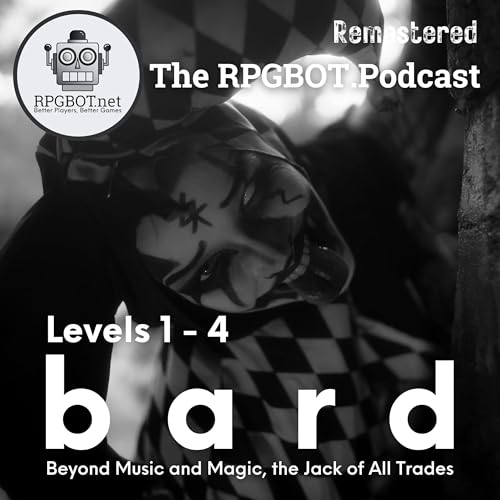
  • 2014 DnD 5e BARD Levels 1-4 (Remastered): Beyond Music and Magic, the Jack of All Trades
    Apr 3 2026
    Show Notes In this episode of the RPGBOT.Podcast, we dive deep into 2014 D&D 5e Bard from levels 1 through 4, breaking down how to build and optimize one of the most versatile classes in DnD. The Bard is explored not just as a performer, but as a true "jack of all trades" support class, capable of filling nearly any party role from face, to scout, to battlefield controller. Early-level Bard gameplay revolves around maximizing Charisma, leveraging Bardic Inspiration, and choosing the right skill proficiencies to complement party composition. Rather than trying to do everything yourself, the hosts stress the importance of intentional specialization within versatility: being broadly capable, but exceptional in key areas. We discuss how proper timing and resource management can dramatically influence combat, social encounters, and skill checks. Overusing limited resources can leave you to struggle when challenges arise. Spellcasting also takes center stage. As a full caster with limited spells known and limited ability to change them, the Bard requires careful spell selection. We highlight the importance of choosing spells that provide maximum flexibility and impact, especially control and support options rather than raw damage. Finally, the episode reinforces that while Bards can do almost anything, they are not front-line damage dealers or tanks. Much of their strength lies in adaptability, creativity, and enabling the rest of the party to succeed, making them one of the most strategically rewarding classes in early-level D&D play. Key Takeaways Jack of All Trades = Flexibility, Not Mediocrity Bards can fill nearly any role, but perform best when they specialize in a few key areas.Charisma Is Everything Your spells, social skills, and core features all depend on high Charisma—prioritize it early.Bardic Inspiration Is a Tactical Resource Use it at critical moments (saving throws, key attacks, clutch skill checks) rather than casually.Spell Selection Matters More Than Quantity Limited spells known means every choice must count—favor versatile, high-impact options.You're a Support Engine, Not a Damage Dealer Buffing allies and controlling encounters is more valuable than trying to out-damage other classes.Skills Are Your Superpower With broad proficiency and Expertise, Bards dominate social encounters and utility challenges.Party Synergy Is Key Choose skills and spells that fill gaps in your party composition.Early Levels Define Your Role Decisions made at levels 1–4 shape your effectiveness for the rest of the campaign.Positioning and Survival Matter Low durability means staying out of danger while influencing the battlefield from a safe distance.Creativity Wins Games The Bard rewards inventive problem-solving more than almost any other class in D&D 5e. Welcome to the RPGBOT Podcast. If you love Dungeons & Dragons, Pathfinder, and tabletop RPGs, this is the podcast for you. Support the show for free: Rate and review us on Apple Podcasts, Spotify, or any podcast app. It helps new listeners find the best RPG podcast for D&D and Pathfinder players. Level up your experience: Join us on Patreon to unlock ad-free access to RPGBOT.net and the RPGBOT Podcast, chat with us and the community on the RPGBOT Discord, and jump into live-streamed RPG podcast recordings. Support while you shop: Use our Amazon affiliate link at https://amzn.to/3NwElxQ and help us keep building tools and guides for the RPG community. Meet the Hosts Tyler Kamstra – Master of mechanics, seeing the Pathfinder action economy like Neo in the Matrix. Randall James – Lore buff and technologist, always ready to debate which Lord of the Rings edition reigns supreme. Ash Ely – Resident cynic, chaos agent, and AI's worst nightmare, bringing pure table-flipping RPG podcast energy. Join the RPGBOT team where fantasy roleplaying meets real strategy, sarcasm, and community chaos. How to Find Us: In-depth articles, guides, handbooks, reviews, news on Tabletop Role Playing at RPGBOT.net Tyler Kamstra BlueSky: @rpgbot.netTikTok: @RPGBOTDOTNET Ash Ely Professional Game Master on StartPlaying.GamesBlueSky: @GravenAshesYouTube: @ashravenmedia Randall James BlueSky: @GrimoireRPGAmateurjack.comRead Melancon: A Grimoire Tale (affiliate link) Producer Dan @Lzr_illuminati
    Más Menos
    56 m
  • HOW TO PLAY STAR WARS: EDGE OF THE EMPIRE 4: 10 out of 10, Would Play Again
    Apr 2 2026
    Show Notes In this final installment of the RPGBOT.Podcast How to Play Fantasy Flight Star Wars: Edge of the Empire series, the crew wraps things up with a deep dive into questions, answers, and overall system impressions after completing their multi-part Star Wars RPG actual play. After surviving pirate stations, clone cults, and barely escaping Imperial pursuit, the hosts analyze what worked, what didn't, and what makes the Fantasy Flight Games Star Wars RPG system stand out compared to other tabletop RPGs. The discussion opens with discusson of the system's signature narrative dice mechanics, widely praised for creating dynamic storytelling through success, advantage, threat, triumph, and despair results. The hosts emphasize how the dice system encourages collaborative storytelling and reduces reliance on binary success/failure outcomes, especially when supported by dice roller tools or the very cool but very expensive custom dice. From there, the conversation moves into practical gameplay considerations, including the pros and cons of using physical rulebooks vs digital tools. While the books are visually impressive, the lack of searchable digital resources creates friction (especially for online play) highlighting a common challenge in Fantasy Flight Star Wars RPG accessibility and cost in today's digital-heavy TTRPG landscape. We explore character effectiveness and build satisfaction, with players reflecting on how their builds performed during the actual play. What worked, what didn't, and how it help up against what we wanted from the fantasy of Star Wsars. The episode also pulls back the curtain on the adventure itself, with Tyler revealing behind-the-scenes design choices like the origin of the bizarre clone cult and reused campaign elements, offering insight into how to build memorable Star Wars RPG adventures and also whatever absolute madness drives Tyler's games. Key Takeaways The narrative dice system is the standout feature of Fantasy Flight Star Wars, enabling rich storytelling through multi-dimensional outcomes.Using a dice roller or custom dice is strongly recommended, as manual symbol interpretation slows gameplay significantly.Character roles feel impactful but uneven, with combat-focused builds shining more consistently than technical roles like slicing.Combat balance relies on GM intuition, as the system lacks traditional level-based scaling.The game can feel more lethal than Star Wars fiction, with player characters going down more easily than expected for cinematic heroes.Wound thresholds, strain, and critical injuries create meaningful tension, but may clash with the heroic fantasy tone.Enemy design (minions, rivals, nemeses) provides flexible encounter building and narrative pacing.Destiny Points add a strong collaborative storytelling element, allowing players and GMs to influence outcomes dynamically.Starship combat is cinematic but mechanically uneven, with shields feeling underpowered compared to other defensive options.Force powers scale through investment, offering flexibility but requiring XP commitment to reach cinematic potential.Lack of digital support is a major barrier, especially for online play and new players.Improvisation and GM creativity are essential, as the system thrives on narrative flexibility over rigid structure. Welcome to the RPGBOT Podcast. If you love Dungeons & Dragons, Pathfinder, and tabletop RPGs, this is the podcast for you. Support the show for free: Rate and review us on Apple Podcasts, Spotify, or any podcast app. It helps new listeners find the best RPG podcast for D&D and Pathfinder players. Level up your experience: Join us on Patreon to unlock ad-free access to RPGBOT.net and the RPGBOT Podcast, chat with us and the community on the RPGBOT Discord, and jump into live-streamed RPG podcast recordings. Support while you shop: Use our Amazon affiliate link at https://amzn.to/3NwElxQ and help us keep building tools and guides for the RPG community. Meet the Hosts Tyler Kamstra – Master of mechanics, seeing the Pathfinder action economy like Neo in the Matrix. Randall James – Lore buff and technologist, always ready to debate which Lord of the Rings edition reigns supreme. Ash Ely – Resident cynic, chaos agent, and AI's worst nightmare, bringing pure table-flipping RPG podcast energy. Join the RPGBOT team where fantasy roleplaying meets real strategy, sarcasm, and community chaos. How to Find Us: In-depth articles, guides, handbooks, reviews, news on Tabletop Role Playing at RPGBOT.net Tyler Kamstra BlueSky: @rpgbot.netTikTok: @RPGBOTDOTNET Ash Ely Professional Game Master on StartPlaying.GamesBlueSky: @GravenAshesYouTube: @ashravenmedia Randall James BlueSky: @GrimoireRPGAmateurjack.comRead Melancon: A Grimoire Tale (affiliate link) Producer Dan @Lzr_illuminati
    Más Menos
    49 m
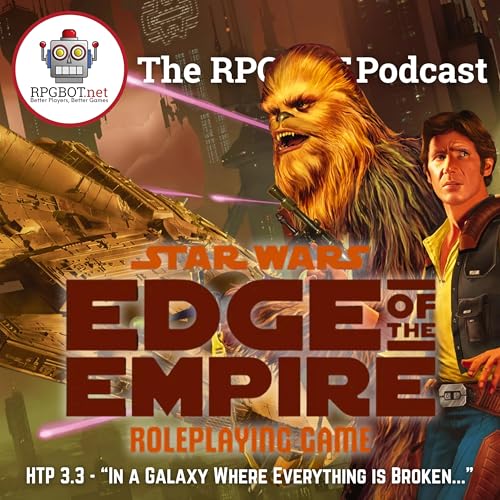
  • HOW TO PLAY STAR WARS: EDGE OF THE EMPIRE 3: Pt 3 - "In a galaxy where everything is broken..."
    Mar 30 2026
    Show Notes In Part 3 of this Star Wars Edge of the Empire actual play, the RPGBOT crew finally delivers on the promise teased since Episode 1: full-on Star Wars space combat! And it is every bit as chaotic, cinematic, and barely-survivable as you'd hope. Picking up immediately after their explosive escape from the pirate station, the crew aboard the Malarkey finds themselves pursued by TIE fighters. What follows is a crash course in Fantasy Flight Games Star Wars starship combat mechanics, including initiative slots, range bands, shield management, and the ever-chaotic narrative dice system. Ash's pilot (Nehl) takes center stage, showcasing how gunnery checks, autofire mechanics, and Destiny Points can turn a desperate dogfight into a highlight reel of explosions. Meanwhile, Randall's Wookiee slicer (Fricata) attempts to disable enemy ships mid-combat using computers checks and slicing mechanics, with… mixed results. The real wildcard? Brap-Brap. The party's astromech droid is tasked with performing astrogation calculations to escape to hyperspace, but apparenly no one told him that the party was in hurry. A series of stunnin failures turn what should be a tactical retreat into a frantic, high-stakes fight for survival, pushing the ship and the crew to the brink. Peak Star Wars, honestly. Key Takeaways Starship combat in Fantasy Flight's Star Wars RPG emphasizes narrative over precision, using range bands instead of grids. Initiative slots (not fixed turns) allow flexible team strategy, letting players choose optimal action order. Autofire is incredibly powerful, especially when stacking advantage—capable of destroying multiple enemies in one turn. Destiny Points are critical for survival, enabling upgrades that can swing entire encounters. Astrogation is a bottleneck mechanic for escape, creating tension when the party is under pressure. Critical hits don't end the fight—they escalate it, adding narrative consequences like engine damage instead of instant destruction. Support roles (like slicing or repairs) matter, but can feel situational depending on enemy design. Shield management and evasive maneuvers are essential for survivability in multi-enemy encounters. Failure can still generate advantage, reinforcing the system's focus on story over binary outcomes Welcome to the RPGBOT Podcast. If you love Dungeons & Dragons, Pathfinder, and tabletop RPGs, this is the podcast for you. Support the show for free: Rate and review us on Apple Podcasts, Spotify, or any podcast app. It helps new listeners find the best RPG podcast for D&D and Pathfinder players. Level up your experience: Join us on Patreon to unlock ad-free access to RPGBOT.net and the RPGBOT Podcast, chat with us and the community on the RPGBOT Discord, and jump into live-streamed RPG podcast recordings. Support while you shop: Use our Amazon affiliate link at https://amzn.to/3NwElxQ and help us keep building tools and guides for the RPG community. Meet the Hosts Tyler Kamstra – Master of mechanics, seeing the Pathfinder action economy like Neo in the Matrix. Randall James – Lore buff and technologist, always ready to debate which Lord of the Rings edition reigns supreme. Ash Ely – Resident cynic, chaos agent, and AI's worst nightmare, bringing pure table-flipping RPG podcast energy. Join the RPGBOT team where fantasy roleplaying meets real strategy, sarcasm, and community chaos. How to Find Us: In-depth articles, guides, handbooks, reviews, news on Tabletop Role Playing at RPGBOT.net Tyler Kamstra BlueSky: @rpgbot.netTikTok: @RPGBOTDOTNET Ash Ely Professional Game Master on StartPlaying.GamesBlueSky: @GravenAshesYouTube: @ashravenmedia Randall James BlueSky: @GrimoireRPGAmateurjack.comRead Melancon: A Grimoire Tale (affiliate link) Producer Dan @Lzr_illuminati
    Más Menos
    1 h y 2 m
  • UNDERWATER COMBAT (Remastered); Randall Sinks to the Bottom; Hilarity Ensues!
    Mar 28 2026
    The party stands heroically on the docks. The bard composes a sea shanty. The fighter sharpens his sword. The wizard prepares a speech about buoyancy physics he read on a forum at 3:00 AM. The rogue realizes sneak attack requires not drowning. The cleric discovers healing word does not cure lack of oxygen (or does it?). The DM Googles drowing rules mid-initiative because everyone forgot how breathing works. Welcome to underwater combat, where your character sheet becomes a flotation device and the real boss monster is physics. Show Notes In this episode the RPGBOT crew dives into underwater combat in tabletop RPGs (especially D&D 5e's mechanics), exploring how the environment radically changes tactics, character builds, spell effectiveness, and encounter design. From fighting sea monsters to exploring sunken cities, the episode focuses on helping both players and Dungeon Masters survive combat in aquatic environments. The hosts discuss how underwater encounters fundamentally alter normal assumptions about combat: movement slows, weapon effectiveness changes, ranged attacks suffer, and suddenly everyone cares deeply about breathing. Holding your breath and weapon limitations become major survival mechanics, sometimes more dangerous than the enemies themselves. They also cover adventure design inspiration from nautical campaigns and aquatic modules, emphasizing that underwater sessions feel memorable because they force players to rethink their habits. Instead of pure damage math, success often depends on preparation, environment-appropriate gear, teamwork, and creative problem solving. The episode balances mechanical analysis with humor, especially the universal tabletop experience of realizing too late that your character was designed exclusively for land combat and is now essentially a confused housecat thrown into the ocean. Ultimately, the crew frames underwater encounters as a powerful storytelling tool: when used intentionally, aquatic combat becomes less about hit points and more about tension, creative problem solving, and environmental immersion. Key Takeaways Underwater combat changes the meta: normal D&D 5e tactics don't always work the same way.Breathing mechanics and suffocation rules can be deadlier than monsters.Many weapons and ranged attacks are dramatically less effective underwater.Spell choice matters. Some spells become amazing while others become useless.Movement restrictions force teamwork and positioning strategy.Preparation (gear, magic, planning) beats raw DPR optimization.Aquatic encounters create memorable sessions because players must adapt.Environmental storytelling works best when mechanics reinforce danger.DMs should telegraph danger so failure feels fair, not arbitrary.Randall should not be trusted with physics experiments. Welcome to the RPGBOT Podcast. If you love Dungeons & Dragons, Pathfinder, and tabletop RPGs, this is the podcast for you. Support the show for free: Rate and review us on Apple Podcasts, Spotify, or any podcast app. It helps new listeners find the best RPG podcast for D&D and Pathfinder players. Level up your experience: Join us on Patreon to unlock ad-free access to RPGBOT.net and the RPGBOT Podcast, chat with us and the community on the RPGBOT Discord, and jump into live-streamed RPG podcast recordings. Support while you shop: Use our Amazon affiliate link at https://amzn.to/3NwElxQ and help us keep building tools and guides for the RPG community. Meet the Hosts Tyler Kamstra – Master of mechanics, seeing the Pathfinder action economy like Neo in the Matrix. Randall James – Lore buff and technologist, always ready to debate which Lord of the Rings edition reigns supreme. Ash Ely – Resident cynic, chaos agent, and AI's worst nightmare, bringing pure table-flipping RPG podcast energy. Join the RPGBOT team where fantasy roleplaying meets real strategy, sarcasm, and community chaos. How to Find Us: In-depth articles, guides, handbooks, reviews, news on Tabletop Role Playing at RPGBOT.net Tyler Kamstra BlueSky: @rpgbot.net TikTok: @RPGBOTDOTNET Ash Ely Professional Game Master on StartPlaying.Games BlueSky: @GravenAshes YouTube: @ashravenmedia Randall James BlueSky: @GrimoireRPG Amateurjack.com Read Melancon: A Grimoire Tale (affiliate link) Producer Dan @Lzr_illuminati
    Más Menos
    57 m
  • HOW TO PLAY STAR WARS: EDGE OF THE EMPIRE 3: Pt 2 - We accidentally started a Robot Cult.
    Mar 26 2026
    Last time on RPGBOT.Podcast: we attempted a stealth infiltration of a pirate space station and immediately turned it into a full-blown crisis involving the Empire. This time? It gets worse. Show Notes In Part 2 of this Star Wars Edge of the Empire actual play, the RPGBOT crew continues their mission to infiltrate a hidden pirate station and hack its central maintenance terminal—but things escalate in the most RPGBOT way possible. After escaping the chaos of the cantina and evading Imperial forces, the crew descends into the station's maintenance tunnels. What should have been a straightforward Star Wars RPG dungeon crawl equivalent quickly turns bizarre when they encounter a massive group of identical individuals—revealed to be a strange population of clone-like workers living in isolation. These clones appear confused, unhealthy, and deeply devoted to a mysterious figure known as Astromach—a partially dismantled astromech droid elevated to god-like status. This encounter becomes a perfect showcase of narrative roleplaying in the Fantasy Flight Games Star Wars system, where player improvisation drives the story far more than mechanics. While Fricata (the Wookiee slicer) attempts to complete the objective using computers checks and slicing mechanics, Nelbren (the Twi'lek smuggler) distracts the crowd using deception, persuasion, and sheer confidence. The session highlights how advantage, threat, and triumph results shape outcomes in unexpected ways—including triggering panic, suspicion, and near-disaster. Meanwhile, the slicing operation becomes a race against time, demonstrating how GMs can structure skill challenges in the Genesys / Edge of the Empire system. Just as the crew completes their objective and retrieves the data, they decide—naturally—to kidnap the clone cult's robotic deity and escape. Unfortunately, their exit is interrupted by the arrival of Imperial forces… including a familiar enemy from Nelbren's past. The episode ends with a dramatic cliffhanger as tensions explode into combat, showcasing initiative mechanics (Cool vs Vigilance) and setting the stage for a high-stakes confrontation. Key Takeaways Actual play sessions highlight the strength of narrative dice systems, especially how Advantage and Threat shape scenes beyond success/failure. Improvisation is core to Star Wars RPG gameplay—players turned a random encounter into a full cult infiltration scenario. Skill challenges (like slicing a terminal) can be structured as multi-roll objectives to build tension. Social encounters can be as complex as combat, especially when dealing with unstable NPC groups. Creative roleplay can bypass traditional obstacles, including turning enemies into allies (or followers). Force powers and talents add narrative depth, even when they don't fully succeed. Destiny Points and narrative control mechanics reinforce the push-and-pull between players and GM. Edge of the Empire thrives on chaos, especially in morally gray Outer Rim scenarios. Recurring character backstories (like Nel's Imperial ties) are powerful tools for introducing conflict. No plan survives contact with the players. Ever. Welcome to the RPGBOT Podcast. If you love Dungeons & Dragons, Pathfinder, and tabletop RPGs, this is the podcast for you. Support the show for free: Rate and review us on Apple Podcasts, Spotify, or any podcast app. It helps new listeners find the best RPG podcast for D&D and Pathfinder players. Level up your experience: Join us on Patreon to unlock ad-free access to RPGBOT.net and the RPGBOT Podcast, chat with us and the community on the RPGBOT Discord, and jump into live-streamed RPG podcast recordings. Support while you shop: Use our Amazon affiliate link at https://amzn.to/3NwElxQ and help us keep building tools and guides for the RPG community. Meet the Hosts Tyler Kamstra – Master of mechanics, seeing the Pathfinder action economy like Neo in the Matrix. Randall James – Lore buff and technologist, always ready to debate which Lord of the Rings edition reigns supreme. Ash Ely – Resident cynic, chaos agent, and AI's worst nightmare, bringing pure table-flipping RPG podcast energy. Join the RPGBOT team where fantasy roleplaying meets real strategy, sarcasm, and community chaos. How to Find Us: In-depth articles, guides, handbooks, reviews, news on Tabletop Role Playing at RPGBOT.net Tyler Kamstra BlueSky: @rpgbot.net TikTok: @RPGBOTDOTNET Ash Ely Professional Game Master on StartPlaying.Games BlueSky: @GravenAshes YouTube: @ashravenmedia Randall James BlueSky: @GrimoireRPG Amateurjack.com Read Melancon: A Grimoire Tale (affiliate link) Producer Dan @Lzr_illuminati
    Más Menos
    1 h y 8 m