Episodios

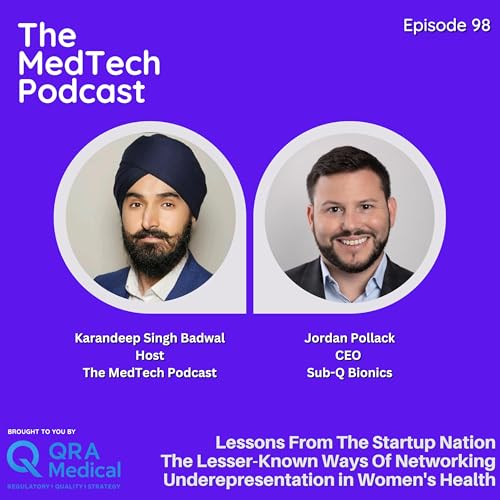
  • #98 The Hidden Cost of Bad MedTech Strategy: Women’s Health, Reimbursement and What Founders Miss with Jordan Pollack
    Mar 23 2026

    Jordan Pollack, biomedical engineer, entrepreneur and CEO of Sub-Q Bionics. Jordan began his career at Boston Scientific, later founded VeinWay in Israel and is now focused on building a new treatment paradigm for lymphoedema in cancer survivors.

    In this episode, we explore what actually creates momentum in MedTech, from networking with intent to building the resilience needed to survive the founder journey. Jordan shares why conferences alone rarely deliver results, how warm introductions and targeted roadshows outperform generic networking and what he had to unlearn after leaving corporate structure behind to become a startup CEO. He also offers a brutally honest take on entrepreneurship, explaining why the role is not for everyone and why persistence, resilience and equanimity matter more than titles or ambition alone.

    We also go deep into the story behind Sub-Q Bionics and why Jordan chose to focus on lymphoedema, particularly in women recovering from cancer treatment. He explains the clinical reality of the disease, the lack of meaningful treatment options beyond maintenance, and why reimbursement, not just good technology, is often the deciding factor in whether a device company succeeds. Along the way, he shares sharp insights on women’s health being chronically underfunded, the differences between the U.S. and Israeli startup ecosystems, and why mission-led companies are far more likely to stay the course when things get hard.

    Timestamps

    [00:00:32] Why Generic Conferences Rarely Create Real MedTech Opportunity
    [00:02:05] How Networking Shaped Jordan’s Move from Boston Scientific to Israel
    [00:03:29] What Corporate MedTech Taught Him and What He Had to Unlearn
    [00:05:54] Why Being a Founder Is Not for Everyone
    [00:08:49] The Origin of Sub-Q Bionics and the Shift Toward True Disease Treatment
    [00:11:53] What Lymphoedema Actually Is and Why It Is So Devastating
    [00:14:06] Why Women’s Health Remains Underfunded and Where Innovation Is Emerging
    [00:18:25] Why Reimbursement Matters More Than Technology Alone
    [00:20:58] U.S. vs Israel: Two Very Different Startup Ecosystems
    [00:25:10] Balancing Founder Life, Health, Travel and Relationships

    Connect with Jordan - ⁠https://www.linkedin.com/in/jordan-pollack-81464827/

    Learn more about Sub-Q Bionics - ⁠⁠https://subqbionics.com/

    Get in touch with Karandeep Badwal - ⁠⁠⁠⁠⁠⁠⁠https://www.linkedin.com/in/karandeepbadwal/ ⁠⁠⁠⁠⁠⁠⁠

    Follow Karandeep on YouTube - ⁠⁠⁠⁠⁠⁠⁠https://www.youtube.com/@KarandeepBadwal⁠⁠⁠⁠⁠⁠⁠


    Subscribe to the Podcast

    Más Menos
    25 m
  • #97 Beyond Ablation For Pain Management: Diagnostic-First FDA Strategy, Dual-Use Electrodes and the The Next Wave of Neurotechnology with Dave Rosa
    Mar 9 2026

    Dave Rosa, CEO and President of NeuroOne, medtech entrepreneur, board member and former executive at St. Jude Medical, Boston Scientific and C.R. Bard. With three decades in medical devices and more than $200 million raised, Dave brings a rare mix of operator, inventor and capital markets experience to the future of neurotechnology and pain care.

    In this episode, we unpack one of the biggest mistakes medtech companies make: building technology without enough real-world user feedback. Dave explains why innovation for the sake of innovation often fails, especially in larger companies, and why the best products are shaped by how physicians and patients actually use them. We also explore NeuroOne’s unique approach of combining diagnostics and therapeutics through the same electrode, and why that kind of multifunctional platform thinking can be both clinically powerful and commercially strategic.

    A major theme in this conversation is regulatory strategy. Dave walks through NeuroOne’s deliberate “diagnostic first, therapeutic second” FDA pathway, explaining why starting with an easier regulatory indication can de-risk the technology, shorten timelines and create a stronger platform for later therapeutic claims. We also discuss the value of reusing the same generator across multiple indications, how founders often wait too long to engage with FDA, and why platform leverage matters from both a business and development perspective.

    We also go deep on chronic pain and lower back pain. Dave shares why today’s pain solutions often fall short, how different triggers require different treatment approaches, and where technologies like ablation, stimulation and smarter electrode design could shift outcomes. He also highlights how seemingly small user-experience issues, like frequent recharging, can destroy patient adherence and wipe out billions in company value.

    Timestamps

    [00:00:08] Why MedTech Companies Fail When They Ignore Real User Feedback
    [00:02:04] Innovation vs Iteration: When “New” Adds No Real Value
    [00:02:22] Combining Diagnostics and Therapeutics With the Same Electrode
    [00:03:52] Why NeuroOne Chose a Diagnostic-First FDA Strategy
    [00:05:21] Pain Management Today: Ablation, Stimulation and Complex Back Pain
    [00:08:21] What Is Fundamentally Broken in Lower Back Pain Solutions
    [00:09:26] How Small Patient Frictions Can Destroy Adoption and Valuation
    [00:11:11] The Power of Reusing the Same Generator Across Multiple Indications
    [00:13:00] The FDA Mistake Many Founders Still Make
    [00:21:15] Where Neurotechnology and Pain Management Are Heading Next


    Connect with Dave - https://www.linkedin.com/in/daverosa/

    Learn more about NeuroOne - ⁠https://nmtc1.com/

    Get in touch with Karandeep Badwal - ⁠⁠⁠⁠⁠⁠https://www.linkedin.com/in/karandeepbadwal/ ⁠⁠⁠⁠⁠⁠

    Follow Karandeep on YouTube - ⁠⁠⁠⁠⁠⁠https://www.youtube.com/@KarandeepBadwal⁠⁠⁠⁠⁠⁠


    Subscribe to the Podcast

    Más Menos
    23 m
  • #96 Decentralising Healthcare: Hospital Buying, AI as Augmented Intelligence and Clinical Adoption with Dr. Amel Havkic
    Feb 23 2026

    Dr. Amel Havkic, founder of EvoMed Consulting and a lung and critical care specialist, hospital clinical lead. Amel works at the intersection of bedside medicine and MedTech strategy, helping innovators build clinician-approved solutions that scale safely across real healthcare systems.

    In this episode, we unpack why “clinicians love it” is rarely enough to win adoption, and what hospital purchasing actually looks like when procurement, IT, finance, compliance and workflows all have a seat at the table. Amel breaks down why switching away from legacy tools is painful, how integrations can break care pathways, and why solutions that feel like a natural part of the hospital ecosystem win faster. He also shares a practical lens for building frictionless implementation by aligning with standards like HL7, FHIR and DICOM, while proving measurable value for patients and payers.

    We also go deep on decentralising healthcare. Amel explains how the Dutch model centralises high-end expertise while decentralising access through remote monitoring and home-based onboarding, and why this becomes a winning approach as staffing pressures rise. On AI, he makes the case for reframing it as augmented intelligence, not autonomy, and shows where decision support can raise the baseline of care by supporting clinicians in time-critical situations, as well as offloading admin burden that drains capacity.

    Finally, Amel shares the thinking behind the EMC StarMap framework, a navigation tool built from real-world patterns of what makes MedTech succeed or fail. His core message is simple: regulatory approval is a milestone, but clinical adoption is the real finish line.

    Timestamps

    [00:00:05] Clinician + Consultant Lens: Seeing Adoption and Safety Risks

    [00:01:22] Why “Physicians Love It” Does Not Mean Hospitals Will Buy

    [00:03:27] What Hospitals Consider Beyond Cost: Workflow, Integration and Training

    [00:05:09] Frictionless Implementation: Standards, EHR Fit and “Team Player” Products

    [00:06:24] Real Clinical Workflow: ICU Reality and Why UI Clicks Matter

    [00:07:31] Decentralising Care: Centralised Expertise With Home-Based Delivery

    [00:10:37] AI in Healthcare: Reframing as Augmented Intelligence

    [00:12:55] Staffing Shortages: Where AI Can Remove Waste and Scale Expertise

    [00:14:38] If You Could Change One Thing: Put the Patient Back at the Center

    [00:16:59] StarMap: Measuring What Drives Clinical Adoption

    Connect with Amel - ⁠⁠⁠⁠https://www.linkedin.com/in/a-havkic/

    Learn more about Evomed Consulting - https://evomed-consulting.eu/

    Get in touch with Karandeep Badwal - ⁠⁠⁠⁠⁠https://www.linkedin.com/in/karandeepbadwal/ ⁠⁠⁠⁠⁠

    Follow Karandeep on YouTube - ⁠⁠⁠⁠⁠https://www.youtube.com/@KarandeepBadwal⁠⁠⁠⁠⁠


    Subscribe to the Podcast

    Más Menos
    25 m
  • #95 The Future of Acne Treatment: At Home Injections, Teledermatology and Building ClearPen with Rick Bente
    Jan 12 2026

    Rick Bente, co-founder and CEO of Indomo, the company behind ClearPen, an investigational at home corticosteroid injection for inflammatory acne. Rick brings over two decades of experience in drug delivery and diagnostics with previous roles at Medtronic, Insulet and YourBio.

    In this episode we trace Rick’s journey from insulin pumps, large volume wearable injectors and remote blood collection to tackling one of the most common yet under-served conditions in medicine: acne. Rick explains why dermatology has seen far less innovation than fields like diabetes, why 40 percent of acne sufferers in the US live with deep inflammatory lesions that topicals simply cannot reach and how ClearPen aims to replicate in-clinic injections safely in the home.

    We dig into how dermatologists and GPs perceive acne severity, the mental health burden of adult acne and why telehealth has become a critical tool when wait times to see a dermatologist can exceed three months. Rick also unpacks the technical and regulatory complexity of combination products, from tying drug and device design histories together to generating RCT-grade evidence that satisfies regulators, payers and prescribing physicians.

    Finally, we talk about the realities of building a direct-to-patient model in a regulated market, balancing unmet patient need with the gatekeeping role of clinicians and insurers, and Rick’s own transition from corporate engineer to founder. He shares candid lessons on focusing beyond the patient to the full healthcare ecosystem, designing devices that are “hard to misuse” and why turning ideas into reality ultimately requires taking the leap.


    Timestamps

    [00:00:21] From insulin pumps and wearables to dermatology and ClearPen

    [00:02:27] Why acne and dermatology have been under-innovated compared to other MedTech fields

    [00:05:25] Acne beyond teenagers: genetics, adult breakouts and mental health impact

    [00:07:16] How dermatologists versus GPs understand acne severity and burden

    [00:09:27] Typical US acne care pathway and why Accutane was the last big breakthrough

    [00:11:54] Using telehealth to address three-month dermatologist wait times

    [00:15:16] Investigational at-home corticosteroid injections and designing for safe use

    [00:17:21] Biggest technical and regulatory challenges in drug-device combination products

    [00:19:59] Where founders go wrong with direct-to-patient models in healthcare

    [00:24:13] Moving from engineer to founder and building around value inflexion points

    Connect with Rick - ⁠⁠⁠https://www.linkedin.com/in/rick-bente/

    Learn more about Indomo - ⁠⁠⁠https://www.linkedin.com/company/indomotx/

    Get in touch with Karandeep Badwal - ⁠⁠⁠⁠https://www.linkedin.com/in/karandeepbadwal/ ⁠⁠⁠⁠

    Follow Karandeep on YouTube - ⁠⁠⁠⁠https://www.youtube.com/@KarandeepBadwal⁠⁠⁠⁠


    Subscribe to the Podcast

    Más Menos
    28 m
  • #94 Reinventing Continuous Glucose Monitoring (CGM): Molecular Wearables, Micro Sensors and Building SAVA with Renato Circi
    Dec 22 2025

    Renato (Ren) Circi, co-founder of SAVA, a London based MedTech company building a new generation of minimally invasive continuous glucose monitors and molecular wearables.

    In this episode we rewind to the underground labs at Imperial College London where Ren and his co-founder Raph first immersed themselves in biosensors and began questioning the status quo of health monitoring. Ren explains how their shared obsession with measuring the body more effortlessly led to SAVA’s founding and what it really looks like to push through years of scientific failure in order to build a complex medical device platform.

    We dive into why SAVA manufactures everything in-house, how their micro sensor architecture differs from traditional filament based CGMs and why controlling every layer from chemistry to algorithms is essential if you want to iterate fast on performance. Ren sets out SAVA’s long term vision of continuous molecular tracking for everyone, not just people with diabetes, and what could be unlocked once you can monitor many molecules in real time from a single patch.

    We also talk about regulatory expectations for CGMs, the reality of one way product decisions in medical devices and the difficulty of fundraising for a consumer facing yet highly regulated deep tech company. Ren closes with candid reflections on what he would do differently, how he protects time for family and why working on a problem you truly care about with people you genuinely like is the only way to survive the journey.

    Timestamps

    [00:00:21] Origins at Imperial and discovering biosensors

    [00:01:59] Long horizons, repeated failure and staying in the game

    [00:03:56] Why SAVA manufactures everything in-house

    [00:06:46] How SAVA’s micro sensor CGM platform actually works

    [00:09:36] From diabetes to universal molecular health monitoring

    [00:12:02] Patient experience and CGM adoption in healthcare systems

    [00:13:43] When CGMs become cheaper than finger-pricks

    [00:15:15] Misconceptions about CGM and continuous molecular sensing

    [00:17:21] Why building CGMs is one of the hardest engineering challenges

    [00:22:54] Fundraising in unconventional deep tech MedTech and advice for founders


    Connect with Ren - ⁠⁠https://www.linkedin.com/in/circi/⁠

    Learn more about Sava - ⁠⁠https://www.sava.health/

    Get in touch with Karandeep Badwal - ⁠⁠⁠https://www.linkedin.com/in/karandeepbadwal/ ⁠⁠⁠

    Follow Karandeep on YouTube - ⁠⁠⁠https://www.youtube.com/@KarandeepBadwal⁠⁠⁠


    Subscribe to the Podcast

    Más Menos
    25 m
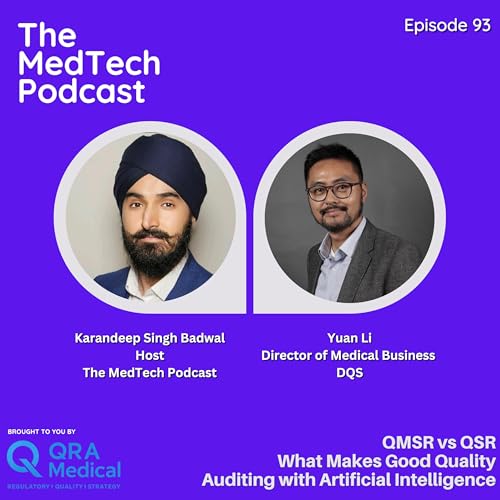
  • #93 How QMSR Is Reshaping U.S. MedTech: ISO 13485, FDA Inspections and AI in Auditing with Dr. Yuan Li
    Dec 9 2025

    Dr. Yuan Li, Director of Medical Business at DQS and a former medical device auditor with deep expertise across orthopaedic manufacturing and regulatory systems.

    In this episode, we discuss the sweeping regulatory transition coming to the U.S. with the introduction of the Quality Management System Regulation (QMSR), which formally aligns 21 CFR Part 820 with ISO 13485. Yuan unpacks what this shift means for U.S.-based manufacturers, why FDA is phasing out the QSR audit model and why contract manufacturers and software-based device firms are particularly vulnerable if they delay planning.

    We also explore the growing use of AI in QMS platforms, the pitfalls of template-driven compliance, and why “regulatory fatigue” is no excuse when patients’ lives are at stake. From post-market surveillance strategies to paperless QMS migrations and the validation grey zone, Yuan offers pragmatic, deeply informed advice for those navigating FDA audits, ISO certification and international expansion

    Timestamps

    [00:02:36] Why QMSR is a Big Deal for U.S. Manufacturers

    [00:04:09] Key Differences Between 21 CFR 820 and ISO 13485

    [00:05:09] Why Companies Wait Too Long to Comply

    [00:07:19] Impact on Contract Manufacturers and Supply Chains

    [00:08:36] Do You Really Need ISO 13485 Certification?

    [00:10:18] AI-Generated QMS Systems: Useful or Risky?

    [00:11:52] Most Memorable Audit Story: Iterative Design Gone Wrong

    [00:14:46] How to Spot Proactive vs Reactive Post-Market Surveillance

    [00:17:03] Why Software Companies Struggle with The Regulatory Mindset

    [00:20:57] What Validation Really Means Under ISO 13485


    Connect with Yuan - ⁠https://www.linkedin.com/in/yuan-li-phd-3bb14013/

    Learn more about DQS - ⁠https://www.dqsglobal.com/en/

    Get in touch with Karandeep Badwal - ⁠⁠https://www.linkedin.com/in/karandeepbadwal/ ⁠⁠

    Follow Karandeep on YouTube - ⁠⁠https://www.youtube.com/@KarandeepBadwal⁠⁠


    Subscribe to the Podcast

    Más Menos
    25 m
  • #92 From NASA to SaMD: Building Galen Data with Chris DuPont: Risk, Resilience & Regulatory Realities
    Nov 24 2025

    Chris DuPont, a seasoned MedTech engineer, entrepreneur, and co-founder of Galen Data, which was acquired by Matrix One in late 2024. With a background in aerospace software from NASA and a career dedicated to medical device connectivity, Chris shares a rare behind-the-scenes look at starting a cloud platform with just $600, scaling it into an FDA compliant infrastructure solution and navigating both technical and financial risk.

    In this episode, we dive into the unexpected similarities between outer space and inner space, how “Twiddler Syndrome” inspired a connected care solution and why the future of SaMD relies on proactive, cybersecure, cloud native design. Chris opens up about managing through the SVB collapse, regulatory war stories from his days at Cyberonics, and what he learned about entrepreneurship that no incubator can teach. From minimal viable features to medical-grade quality systems, this episode is packed with real lessons from a founder who’s seen it all.

    Timestamps

    [00:01:05] From Space Station Freedom to Inner Space: NASA to MedTech

    [00:02:56] Launching Galen Data with Just $600

    [00:06:21] Why They Built Their Own Incubator

    [00:08:36] Fundraising in a Non-VC Town (Houston)

    [00:11:33] The Silicon Valley Bank Collapse and Business Risk

    [00:16:25] Twiddler Syndrome and the Birth of a Connected Platform

    [00:19:35] Cybersecurity and Compliance in the Cloud

    [00:22:20] FDA Approval Without Reimbursement: A Regulatory War Story

    [00:24:32] Why Not Every Feature Deserves to Ship

    [00:29:13] “You Can’t Fake Science”: Betting on Yourself in MedTech

    Connect with Chris - https://www.linkedin.com/in/chris-dupont-38b5ba15/

    Learn more about MatrixOne - https://matrixone.health/

    Get in touch with Karandeep Badwal - ⁠https://www.linkedin.com/in/karandeepbadwal/ ⁠

    Follow Karandeep on YouTube - ⁠https://www.youtube.com/@KarandeepBadwal⁠


    Subscribe to the Podcast

    Más Menos
    29 m
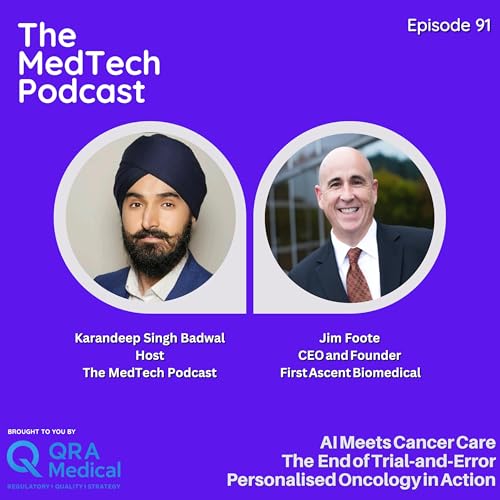
  • #91 Ending Trial and Error Cancer Care with Jim Foote: Functional Precision Medicine, AI and Personalised Oncology
    Nov 3 2025

    Jim Foote, CEO and Founder of First Ascent Biomedical a pioneer in functional precision medicine (FPM) that aims to eliminate guesswork from cancer treatment.

    After losing his son to cancer, Jim left a career in cybersecurity to build a data-driven platform that combines AI, robotics and real-time tumour testing to help doctors choose the right therapy for each patient.

    In this episode, we explore how FPM differs from traditional genomics-only testing, why tumours can respond differently even with the same patient and how AI can support rather than replace clinicians in treatment decisions.

    Jim also shares the economic impact of ineffective therapies, the challenges of scaling regulatory innovation in oncology, and why the future of cancer care depends on personalisation at the  cellular level.

    Timestamps:

    [00:00:45] What Is Functional Precision Medicine?

    [00:02:00] Jim’s Personal Journey from Tech to Healthcare

    [00:05:50] Overcoming Regulatory and Systemic Gatekeepers

    [00:08:13] From Reactive Care to Personalised Treatment

    [00:09:08] What Lab Findings Reveal about Cancer Cells

    [00:10:30] Why Genomics Alone Isn’t Enough

    [00:12:03] AI as Decision Support Not a Decision Maker

    [00:15:55] Cancer in Younger Populations and Misconceptions

    [00:20:25] Reducing Cost and Waste in Cancer Treatment

    [00:26:34] What Success Really Means to Jim Foote

    Connect with Jim - https://www.linkedin.com/in/jim-foote/

    Learn more about First Ascent Biomedical - https://www.linkedin.com/company/firstascentbio/

    Get in touch with Karandeep Badwal - https://www.linkedin.com/in/karandeepbadwal/

    Follow Karandeep on YouTube - https://www.youtube.com/@KarandeepBadwal


    Subscribe to the Podcast


    Más Menos
    25 m