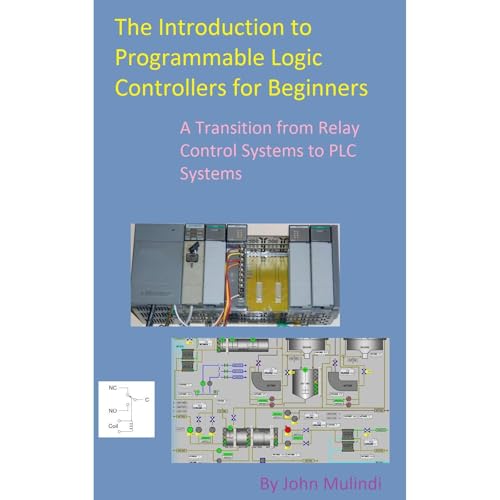
The Introduction to Programmable Logic Controllers for Beginners Audiobook By John Mulindi cover art

The Introduction to Programmable Logic Controllers for Beginners

A Transition from Relay Control Systems to PLC systems

Virtual Voice Sample

Audible Standard 30-day free trial

Try Standard free
Select 1 audiobook a month from our entire collection of titles.
Yours as long as you’re a member.
Get unlimited access to bingeable podcasts.
Standard auto renews for $8.99 a month after 30 days. Cancel anytime.

The Introduction to Programmable Logic Controllers for Beginners

By: John Mulindi
Narrated by: Virtual Voice
Try Standard free

$8.99 a month after 30 days. Cancel anytime.

Buy for $10.00

Buy for $10.00

Background images

This title uses virtual voice narration

Virtual voice is computer-generated narration for audiobooks.
With so many books and courses online that offer training in PLC programming, new learners/students, plant operators, technicians and engineers aspiring to learn PLCs may get confused where to get started. That is the reason why I came up with this book to help new PLC learners build good foundational knowledge before they embark on a serious PLC programming training. This book starts with a background into Relay control systems to help you appreciate why industries changed their control systems from Relays to PLCs. If you can understand how Relay systems was and is still used in industrial controls, it becomes easier for you to learn PLC systems. The author begins the Book by looking at Relay control systems and how they are applied in industrial control systems; switching mechanisms, relay logic, and relay ladder diagrams. After building a good foundation in relays logic, relay ladder diagrams, the author then introduces PLC systems: the basics of PLCs, and how they are used in sequential logic control. The author briefly covers PLC programming mainly focusing on ladder diagram programming, and shows you through examples how they are applied in industrial control. This is to equip the learners with basic knowledge in ladder programming which is essential especially for those who plan to pursue PLC programming and build expertise in this field. In summary the book covers:  Switching mechanisms  Relays, Relay Logic & Relay Ladder logic  Timers, Counters, and Sequencers as applied in Relay controls  PLC-basic introduction  PLC hardware  PLC operation  PLC memory structure  PLC programming  Ladder gates  Ladder logic  Ladder diagram programming and its industrial control application  Timers, counters and sequencers as applied in PLC systems  Lastly I discuss briefly how PLCs are connected in a network The main objective of this book is to show you how the transition from relays to PLCs, was done, and how a good understanding of relay logic can help you learn PLC ladder logic with ease. I highly recommend this book to anyone planning to study PLC programming or generally PLC application in industrial control. Automation & Robotics Engineering Programming
All stars
Most relevant
t requires the read along function to it. it does not have that so I don't know what the figures and function are visually

as a book that is supposed to educate you, it requires the read along function to it.

Something went wrong. Please try again in a few minutes.