

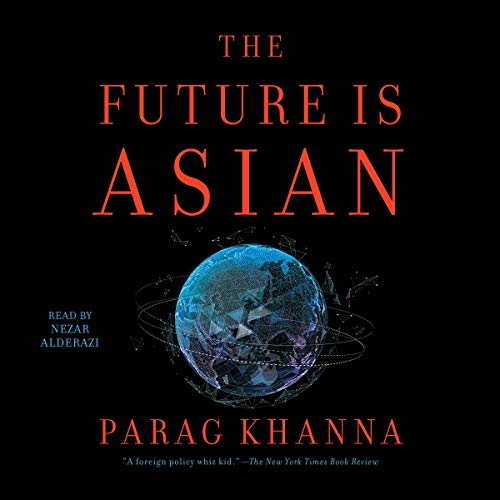
The Future is Asian
Commerce, Conflict and Culture in the 21st Century
No se pudo agregar al carrito
Solo puedes tener X títulos en el carrito para realizar el pago.
Add to Cart failed.
Por favor prueba de nuevo más tarde
Error al Agregar a Lista de Deseos.
Por favor prueba de nuevo más tarde
Error al eliminar de la lista de deseos.
Por favor prueba de nuevo más tarde
Error al añadir a tu biblioteca
Por favor intenta de nuevo
Error al seguir el podcast
Intenta nuevamente
Error al dejar de seguir el podcast
Intenta nuevamente
Prueba gratis de 30 días de Audible Standard
Selecciona 1 audiolibro al mes de nuestra colección completa de más de 1 millón de títulos.
Es tuyo mientras seas miembro.
Obtén acceso ilimitado a los podcasts con mayor demanda.
Plan Standard se renueva automáticamente por $8.99 al mes después de 30 días. Cancela en cualquier momento.

The Future is Asian
Narrado por:
Nezar Alderazi
Compra ahora por $22.49
-
Narrado por:
-
Nezar Alderazi
-
De:
-
Parag Khanna
The “Asian Century” is even bigger than you think. Far greater than just China, the new Asian system taking shape is a multi-civilizational order spanning Saudi Arabia to Japan, Russia to Australia, Turkey to Indonesia—linking five billion people through trade, finance, infrastructure, and diplomatic networks that together represent 40 percent of global GDP. China has taken a lead in building the new Silk Roads across Asia, but it will not lead it alone. Rather, Asia is rapidly returning to the centuries-old patterns of commerce, conflict, and cultural exchange that thrived long before European colonialism and American dominance. Asians will determine their own future—and as they collectively assert their interests around the world, they will determine ours as well.
There is no more important region of the world for us to better understand than Asia – and thus we cannot afford to keep getting Asia so wrong. Asia’s complexity has led to common misdiagnoses: Western thinking on Asia conflates the entire region with China, predicts imminent World War III around every corner, and regularly forecasts debt-driven collapse for the region’s major economies. But in reality, the region is experiencing a confident new wave of growth led by younger societies from India to the Philippines, nationalist leaders have put aside territorial disputes in favor of integration, and today’s infrastructure investments are the platform for the next generation of digital innovation.
If the nineteenth century featured the Europeanization of the world, and the twentieth century its Americanization, then the twenty-first century is the time of Asianization. From investment portfolios and trade wars to Hollywood movies and university admissions, no aspect of life is immune from Asianization. With America’s tech sector dependent on Asian talent and politicians praising Asia’s glittering cities and efficient governments, Asia is permanently in our nation’s consciousness. We know this will be the Asian century. Now we finally have an accurate picture of what it will look like.
Los oyentes también disfrutaron:


Las personas que vieron esto también vieron:


such a great book...
Se ha producido un error. Vuelve a intentarlo dentro de unos minutos.
Mr. Khanna talks about the movie Eat, Pray and Love, Beatles and Steve Jobs meditating India but does not mention Muhammad Yunus of Bangladesh, winner of Nobel Peace Prize, who introduced the concept of micro lending to the world. He founded Grameen Bank which is now all emulated all over the world including US, Africc and South America to uplift the lives of the poor.
He mentions Saudi Arabia and UAE because of their economic strengths which is very recent. However, he fails to mention monumental influences of the Arab scientists, astronomers, philosopher, physicians and mathematicians; The following are just a few examples.
Al-Biruni- ( 973 AD-1050 AD ) He calculated the circumference of the earth and predicted that there is a big land mass between the Atlantic and Pacific oceans ( the Americas )
Ibn Sina or Avicena ( 980 AD ) - His books ( The Book of Healing and Cannon of Medicine ) were taught in medical schools all over the world including Europe and USA up until 17th century. Was printed in the USA as recently as 1973.
Al-Haytham - Produced a fully functioning camera ( 1231-1288 )
Focussed on India and China
Se ha producido un error. Vuelve a intentarlo dentro de unos minutos.
The narration errors made it difficult for me not to focus on my irritation; that surprised me. If a person is sensitive to mispronunciation, be aware, going in.
A Different Lens
Se ha producido un error. Vuelve a intentarlo dentro de unos minutos.
Very good, comprehensive and sweeping
Se ha producido un error. Vuelve a intentarlo dentro de unos minutos.
Good book, bad narrator
Se ha producido un error. Vuelve a intentarlo dentro de unos minutos.