

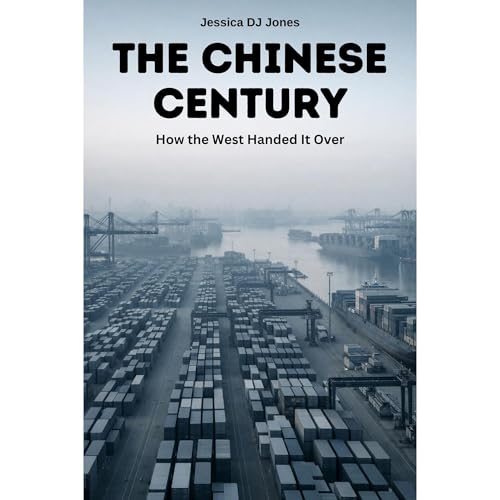
The Chinese Century
How the West Handed It Over
No se pudo agregar al carrito
Add to Cart failed.
Error al Agregar a Lista de Deseos.
Error al eliminar de la lista de deseos.
Error al añadir a tu biblioteca
Error al seguir el podcast
Error al dejar de seguir el podcast
 Exclusivo para miembros Prime: ¿Nuevo en Audible? Obtén 2 audiolibros gratis con tu prueba.
The Chinese Century
Compra ahora por $9.99
-
Narrado por:
-
Virtual Voice
-
De:
-
Jessica Jones

Este título utiliza narración de voz virtual
How the West Handed It Over
The rise of China is often described as sudden, aggressive, or inevitable. It is framed as a geopolitical shock that appeared without warning and overturned an established global order. This narrative is convenient—but incomplete.
The Chinese Century examines how decades of Western decisions gradually transferred industrial capacity, technological leverage, and strategic advantage to China without conquest, coercion, or a single decisive moment. Rather than focusing on confrontation or ideology, this book traces a pattern of voluntary concessions driven by profit, efficiency, and short-term political stability.
Through an analysis of trade policy, manufacturing offshoring, technology transfer, education, corporate behavior, and international fragmentation, the book shows how power can change hands quietly. Supply chains were optimized without regard for resilience, intellectual property flowed east under the language of partnership, and economic integration was mistaken for political convergence. Each decision appeared rational in isolation, yet collectively reshaped the global balance of power.
The book explores how Western corporations prioritized market access over strategic risk, how governments deferred difficult choices to future administrations, and how long-term planning consistently outperformed electoral cycles. It examines how ambiguity replaced boundaries, how dependency displaced self-sufficiency, and how rules were enforced only after they had lost their effectiveness.
Rather than portraying China as uniquely aggressive, The Chinese Century focuses on the structural conditions that made the transfer possible. It shows how disunity among Western states accelerated decline, how infrastructure investment became a tool of influence, and how information itself became contested terrain. Military strength, once underwritten by domestic industry, weakened as production capacity migrated elsewhere.
This book does not predict collapse, nor does it argue that the future is predetermined. Instead, it documents how present conditions were created—step by step—by choices that favored immediacy over foresight and convenience over control. The “Chinese Century” did not arrive through force; it emerged through permission, delay, and miscalculation.
Written for readers seeking explanation rather than alarm, The Chinese Century offers a clear account of how strategic advantage can be surrendered without acknowledgment. It is not a warning about what may come, but an examination of what has already occurred—and why reversing it is far more complex than recognizing it.