

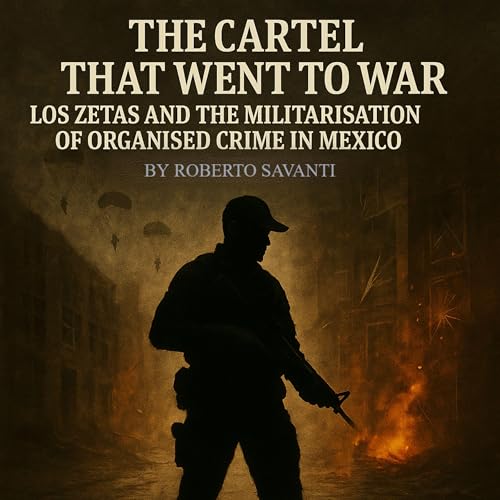
The Cartel That Went to War
Los Zetas and the Militarisation of Organised Crime in Mexico
No se pudo agregar al carrito
Add to Cart failed.
Error al Agregar a Lista de Deseos.
Error al eliminar de la lista de deseos.
Error al añadir a tu biblioteca
Error al seguir el podcast
Error al dejar de seguir el podcast
 Exclusivo para miembros Prime: ¿Nuevo en Audible? Obtén 2 audiolibros gratis con tu prueba.
The Cartel That Went to War
Compra ahora por $13.55
-
Narrado por:
-
Francisco Escobedo
-
De:
-
Roberto Savanti
The Cartel That Went to War is a forensic look at one of the most violent and militarised organised crime groups of the modern era: Los Zetas. Emerging from within Mexico’s own military ranks, Los Zetas redefined what a cartel could be – not just traffickers of drugs, but an armed, diversified, and fearsome paramilitary enterprise whose reach extended into politics, economics, and the daily lives of communities. This book traces their evolution from a secretive enforcement arm to an independent powerhouse, revealing how military discipline and training were turned to criminal ends, and how violence itself became a tool of governance.
Roberto Savanti, an investigative writer who specialises in organised crime and security, lays out the history of Los Zetas with clarity and precision. Beginning with their origins in the Mexican Army and their recruitment as enforcers for the Gulf Cartel, he charts how the group broke away to form its own empire. Listeners are taken inside their internal structure, their brutal strategies of intimidation, and the financial systems that sustained them. From kidnappings and extortion rackets to fuel theft and international smuggling, Los Zetas built a diversified criminal economy that embedded itself deep into Mexican society.
At the heart of their notoriety was violence – calculated, spectacular, and public. This was violence not just as a consequence of conflict but as deliberate strategy: messages carved into the social landscape through fear. Savanti explains how Los Zetas used displays of brutality to control communities, silence journalists, undermine governments, and deter rivals. He also shows how that reliance on terror sowed fragility within their own ranks, as succession battles and internal fractures broke apart what had once seemed an unstoppable force.
The book goes beyond Mexico’s borders, exploring the group’s operations in the United States and abroad. It also examines the tireless efforts of law enforcement and military units who confronted them, detailing landmark operations, arrests, and the eventual fragmentation of the organisation. Yet even in decline, the Zetas’ legacy lingers in the form of splinter groups and copycat organisations that continue to destabilise regions.
Each chapter combines investigative depth with accessible storytelling. From the soldiers who first crossed the line into organised crime, to the communities who bore the brunt of their rise, Savanti humanises a subject too often reduced to headlines. He does not sensationalise; instead, he documents. Corruption, money laundering, political complicity, and international ripple effects are all brought into view, revealing how a criminal group became a quasi-military threat to the Mexican state.
This is more than a history of a cartel. It is a study of how organised crime evolves when it militarises, how societies bend under the weight of fear, and how states struggle to respond when enemies blur the line between insurgents and criminals. By analysing Los Zetas, Savanti offers a window into the future of organised crime worldwide, where gangs and cartels increasingly adopt military tactics, advanced technology, and diversified portfolios to sustain themselves.
For listeners interested in true crime, geopolitics, security studies, or the dark intersections of state and criminal power, The Cartel That Went to War is an unflinching but essential account. It explains not only what Los Zetas did, but how and why – and what their rise and fall means for Mexico, for the region, and for the world.
©2025 Deep Vision Media t/a Zentara UK (P)2025 Deep Vision Media t/a Zentara UKEl oyente recibió este título gratis
From Soldiers to Criminal Empire
Se ha producido un error. Vuelve a intentarlo dentro de unos minutos.
El oyente recibió este título gratis
Violence as Strategy, Not Just Consequence
Se ha producido un error. Vuelve a intentarlo dentro de unos minutos.
El oyente recibió este título gratis
A Comprehensive Overview of Los Zetas
Se ha producido un error. Vuelve a intentarlo dentro de unos minutos.
El oyente recibió este título gratis
A Broader Look at Organised Crime’s Future
Se ha producido un error. Vuelve a intentarlo dentro de unos minutos.
El oyente recibió este título gratis
Strong Context Around Military Origins
Se ha producido un error. Vuelve a intentarlo dentro de unos minutos.