Episodios

  • Healthcare Needs Real Disruption, Not Incremental Change
    Apr 7 2026
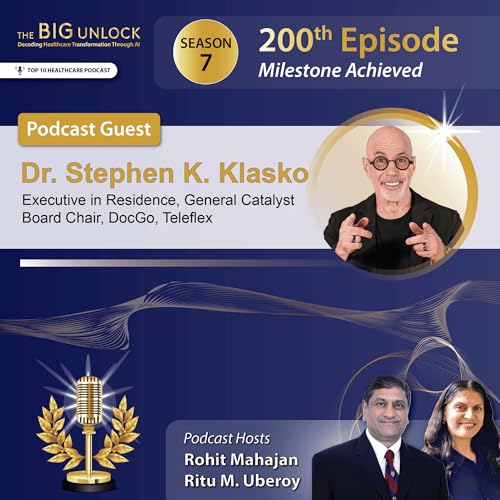
    The Big Unlock · Dr. Stephen K. Klasko, Executive in Residence, General Catalyst & Board Chair, DocGo, Teleflex

    In this episode, Dr. Stephen K. Klasko, former CEO of Jefferson Health, Executive in Residence at General Catalyst, Board Chair at DocGo, Teleflex, and one of healthcare’s most provocative voices, challenges the industry to rethink its fundamental assumptions and move toward a more sustainable, patient-centered future. He argues that despite years of discussion around value-based care and digital transformation, true disruption has been limited because stakeholders remain unwilling to fundamentally change existing business models.

    Dr. Klasko argues that the healthcare system is broken, fragmented, expensive, and inequitable and that true disruption, like what Uber did to taxis or Amazon to retail, will demand that some players fail. He makes the case that the annual physical visit is a farce, and that continuous health narratives powered by wearables and AI companions are the future of proactive, personalized care.

    On the tech-provider collaboration front, Dr. Klasko identifies – founder ego, misaligned incentives, and EHR-era skepticism as the biggest barriers. He advocates for co-developing solutions, sharing equity, and building genuine partnerships. Dr. Klasko’s message to healthcare leaders is unambiguous: stop turning things around 360 degrees and start making real, uncomfortable changes. Take a listen.

    This guest appearance was facilitated through conversations initiated at Health Tech Summit by Cornell Tech.

    Más Menos
    22 m
  • Autonomous AI Turning Evidence into Action
    Apr 1 2026


    The Big Unlock · Dr. Eric Stecker, Co-founder and Chief Medical Officer, Insight Health

    In this episode, Dr. Eric Stecker, Co-founder and Chief Medical Officer at Insight Health, explores how autonomous AI agents are reshaping cardiovascular care and population health in the United States.

    Dr. Stecker draws a critical distinction between autonomous action and autonomous decision-making, arguing that AI can deliver enormous clinical value today by acting autonomously on well-established care protocols, without waiting for fully autonomous diagnostic AI. He highlights that preventable conditions like hypertension and high cholesterol already have decades of evidence behind them; the real gap is in implementation, where AI-powered agents can identify at-risk patients, prompt appropriate prescriptions, and check in on medication adherence by reducing millions of avoidable cardiac events.

    Dr. Stecker emphasizes that clinician involvement, not just advisory oversight, is essential to avoid alert fatigue, documentation overload, and signal-to-noise failures. He states that meaningful AI adoption requires building trust with both healthcare workers and patients, starting with autonomous action today while responsibly advancing toward autonomous clinical decision-making tomorrow. Take a listen.

    This guest appearance was facilitated through conversations initiated at ViVE.

    Más Menos
    25 m
  • Moving Beyond Pilots to Scale Impact in Healthcare
    Mar 24 2026
    The Big Unlock · Rachel Feinman, SVP of Innovation and Managing Director of TGH Ventures, Tampa General Hospital

    In this episode, Rachel Feinman, SVP of Innovation and Managing Director, TGH Ventures at Tampa General Hospital, shares how the organization is breaking out of “pilot purgatory” to turn digital innovation into measurable impact. With a clear mandate to move beyond endless experimentation, the focus is on starting with a strong thesis, partnering intentionally, and scaling quickly when results are proven.

    Rachel reflects on her journey from law to healthcare, bringing a unique lens on strategy, execution, and deal-making. She highlights the balance healthcare must strike that is moving fast in operational and administrative workflows while taking a deliberate, governance-led approach to clinical innovation. This “go slow to go fast” mindset enables both safety and speed.

    She also underscores the growing role of AI in improving logistics, supporting care teams, and unlocking real-time insights, while emphasizing responsible deployment. Beyond technology, the real opportunity lies in connecting fragmented care journeys and extending care beyond hospital walls to create a more seamless, patient-centered experience. Through strategic investments and a focus on outcomes, Tampa General is building an innovation model designed to scale impact, not just ideas. Take a listen.

    Más Menos
    21 m
  • Turning AI Hype into Healthcare Execution
    Mar 2 2026
    The Big Unlock · Aditya Bansod, CTO & Co-Founder, Luma Health

    In this episode, Aditya Bansod, CTO and Co-Founder of Luma Health, about why healthcare AI often underdelivers — and what leaders must do to turn promise into performance.

    Aditya argues that AI’s challenge in healthcare isn’t ambition, but execution. While new tools are emerging rapidly, most remain point solutions that fail to integrate into the complex workflows that move patients from scheduling to care delivery. True impact, he says, depends on orchestrating the “last mile” of healthcare, referrals, intake, documentation, and the countless operational handoffs that determine whether care actually happens.

    He shares how Luma approaches AI adoption with flexible guardrails, allowing health systems to calibrate automation based on confidence thresholds and maturity. The conversation also explores the rise of agentic AI, the tension between human-in-the-loop oversight and autonomy, and why CIOs are navigating a messy but necessary consolidation phase.

    Looking ahead, Aditya is optimistic that AI will transform patient access and engagement, only if it’s deeply embedded into workflows, not layered on top of them. Take a listen.

    Más Menos
    25 m
  • Augmenting Care and Strengthening Trust with AI
    Feb 19 2026


    The Big Unlock · Dr. Andrea Willis, SVP & Chief Medical Officer, BlueCross BlueShield of Tennessee

    In this episode, Dr. Andrea Willis, SVP and Chief Medical Officer at BlueCross BlueShield of Tennessee, shares how payers can harness AI to advance affordable, accessible, and more human-centered care.

    From her clinical roots to leading population health, quality, and health equity initiatives, Dr. Willis brings a deeply personal commitment to service. She describes how AI is being deployed across care management and utilization management, not to replace clinicians or deny care, but to augment teams, accelerate evidence-based decisions, and close gaps in care. In care management, AI-powered summarization and prompting help staff stay fully present with members while improving engagement and measurable outcomes. In utilization management, transparency, evidence-based criteria, and clear documentation remain foundational to rebuilding provider trust. She also highlights that relevance matters more than data volume, and that guided self-service must balance automation with timely human escalation.

    Dr. Willis emphasizes transparency in prior authorization, cross-functional governance, AI literacy goals across the enterprise, and strong PHI protections. For here, scaling AI responsibly – through interoperability, collaboration, and measurable impact – is key to rebuilding trust and transforming the healthcare experience. Take a listen.

    Más Menos
    24 m
  • AI Must Strengthen a Clinician’s “Spidey Sense,” Not Replace It
    Feb 4 2026
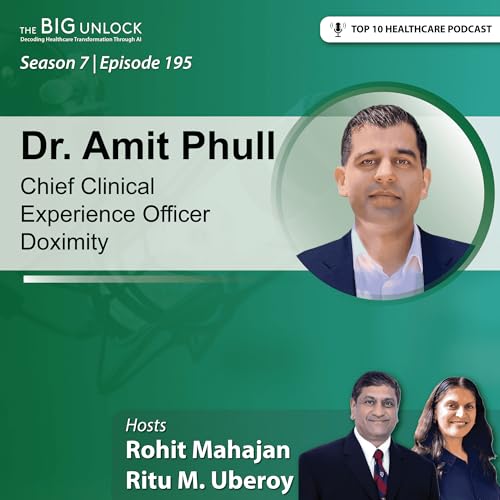
    The Big Unlock · Dr. Amit Phull, Chief Clinical Experience Officer, Doximity

    In this episode, Dr. Amit Phull discusses what responsible AI adoption in healthcare really looks like, starting with trust, usability, and preserving clinician judgment. He emphasizes that ease of use and confidence in outputs are non-negotiable for clinician adoption, especially in already time-constrained workflows.

    The discussion also explores why AI must be built with clinicians, not simply deployed for them, and how poorly integrated tools risk adding friction instead of value. Dr. Phull also talks about preserving a clinician’s “spidey sense”—the intuition developed through experience—while using AI to augment, not override, clinical judgment. The conversation also touches on how success should be measured beyond dashboards, including recurrent use, time savings, and reductions in burnout.

    Dr. Phull states that AI, when designed thoughtfully, can help clinicians reclaim time, sharpen expertise, and focus more fully on patient care, without losing the human edge that defines great medicine. Take a listen.

    Más Menos
    27 m
  • AI Succeeds Through Seamless Workflow Integration and Clinician Empowerment
    Jan 22 2026
    The Big Unlock · Chethan Sathya, MD., Vice President of Strategic Initiatives, Northwell Health

    In this episode, Dr. Chethan Sathya, Vice President of Strategic Initiatives at Northwell Health, unpacks why healthcare innovation only scales when clinicians, public health, and AI are designed to work together.

    Dr. Sathya shares his journey from surgery to journalism to public health advocacy, including leading gun violence prevention efforts. He explains why most AI pilots fail, because of poor workflow integration and clinician burden, and why ambient intelligence, tele-specialty care, and agentic AI are poised to scale. His message is clear: build technology alongside clinicians, not around them. Take a listen.

    Más Menos
    19 m
  • Fixing Healthcare’s “Blind Men and the Elephant” Data Problem
    Jan 12 2026
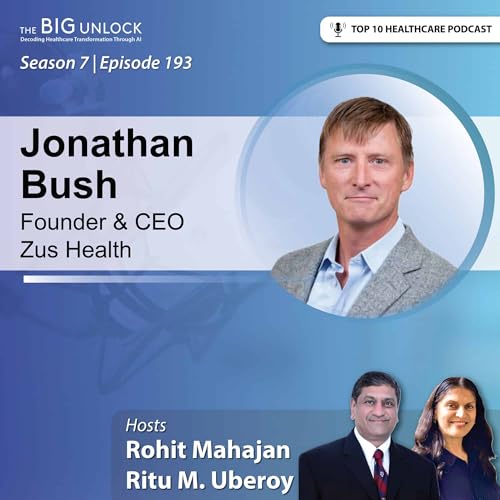
    The Big Unlock · Jonathan Bush, Founder & CEO, Zus Health

    In this episode, Jonathan Bush, Founder & CEO of Zus Health, shares a bold vision for the next phase of healthcare transformation. Drawing on decades of experience, Jonathan argues that while EHR adoption is largely complete, today’s systems remain fee-for-service–oriented, creating fragmented views of patients – what he describes as the “blind men and the elephant” problem. The result: clinicians still lack a complete, longitudinal picture of the patient and rely on repeated tests and “bags full of records.”

    Jonathan explains how Zus Health is re-architecting healthcare data by creating a longitudinal, always-on common patient record. Zus is an API-first platform built on an AI-enabled backbone that aggregates, structures, and continuously updates data across multiple EMRs. He emphasizes the power of network effects, where shared intelligence can eliminate redundant tests and unnecessary care.

    The conversation also explores why interoperability must move beyond regulatory compliance to become core infrastructure for value-based care, and how AI-driven summarization and agentic workflows can reduce clinician burden while enabling proactive, patient-centered care. Take a listen.

    Más Menos
    31 m