Episodios

  • The Man Behind the Camera
    Apr 10 2026

    What happens when the person documenting a fraud has no idea he’s filming evidence?

    In this episode of Tax Crime Junkies, Dominique sits down with Steve Beal, the videographer who spent years capturing the rise of DC Solar from the inside. Steve was hired to film the success story: the NASCAR sponsorships, the lavish holiday parties, the green-energy branding, and the larger-than-life image Jeff and Paulette Carpoff built around the company.

    But after the FBI raided DC Solar in December 2018, Steve’s footage took on a whole new meaning.

    This episode explores what it was like to be one of the people inside the company who believed in the mission, trusted the leadership, and only later realized he had been standing in the middle of one of the biggest renewable energy frauds in U.S. history.

    Dominique and Steve talk about the emotional side of fraud that rarely gets attention: the employees, contractors, and insiders who were not masterminds, not investors, and not whistleblowers — just people who believed they were helping build something real.

    Along the way, Steve shares how a traumatic experience at the Las Vegas Route 91 shooting deepened his bond with the DC Solar team, how the company culture discouraged questions, and what it felt like to slowly piece together the truth after everything collapsed.

    By the end, this becomes more than a fraud story. It becomes a story about belief, loyalty, hindsight, and what happens when the camera keeps rolling long after the illusion starts to crack.

    In this episode, we cover:
    • How Steve came to work for DC Solar
    • The emotional impact of surviving the Route 91 shooting while traveling with the DC Solar team
    • Why that experience deepened trust and loyalty inside the company
    • The “stay in your lane” culture at DC Solar
    • The warning signs Steve noticed before the collapse
    • What happened when the FBI raided the company
    • The personal fallout for employees left in the dark
    • How Steve’s footage later became useful to investigators
    • Why his documentary project, Fireball, tells a side of the story most people never hear
    Why this episode matters

    Fraud stories often focus on the architects of the scheme or the dollars lost. This episode focuses on the people caught in the middle — the employees who showed up to work, did their jobs, trusted the wrong people, and had their lives upended overnight.

    It’s a powerful reminder that when something looks wildly successful from the outside, the truth underneath may be something very different.

    Featured in this episode
    • Dominique Molina
    • Steve Beal, videographer and creator of Fireball - find it on youtube https://www.youtube.com/@fireballseries
    Mentioned in this episode
    • DC Solar
    • Jeff and Paulette Carpoff
    • Fireball documentary project on YouTube
    • The Las Vegas Route 91 Harvest Festival shooting
    • DC Solar’s NASCAR sponsorships and holiday party culture
    Listen if you love:
    • true crime
    • white collar crime
    • tax fraud stories
    • behind-the-scenes documentary storytelling
    • stories about the people left behind after financial scandal
    Closing thought

    Sometimes the people closest to the story do not realize what they are looking at until it is already over.

    And sometimes the camera captures more truth than anyone intended.

    Más Menos
    44 m
  • Your Call Is Very Important to Us (April Fool’s Special)
    Apr 2 2026

    In today’s special April Fool’s episode, Dominique and Tom take on one of the most universal experiences in tax practice… calling the IRS.

    If you’ve ever sat on hold, faxed the same POA three times, refreshed transcripts that don’t exist, or explained to a client (again) why nothing has changed in 48 hours… this one’s for you.

    No case study. No tax crime.

    Just the most accurate IRS phone call you’ve never heard.

    Hang in there, busy season is almost over.

    Más Menos
    8 m
  • The Carpoffs: Solar, Lies, and the Tax Credit Trap
    Mar 28 2026

    What starts as a rags-to-riches story—a mechanic turned clean-energy entrepreneur—quickly spirals into one of the largest tax fraud schemes in U.S. history.

    Jeff Carpoff built DC Solar into a billion-dollar empire fueled by lucrative federal tax credits, investor hype, and a story people wanted to believe. But behind the scenes? Fake generators, fabricated lease revenue, and a Ponzi scheme hiding in plain sight.

    In this episode, Dom and Tom break down the rise and fall of DC Solar—and ask the uncomfortable question:

    👉 Was this all Carpoff’s doing… or did the professionals around him help build the machine?

    ⚖️ What You’ll Learn
    • How solar tax credits became the perfect hook for investors
    • Why “too good to be true” tax strategies often are
    • How a sale-leaseback structure can be legitimate… or completely abused
    • The mechanics of a Ponzi scheme disguised as renewable energy investing
    • The role of lawyers, accountants, and advisors in complex fraud cases
    • Why “placed in service” rules are a major risk area in tax credit deals
    • How investor demand—not product demand—kept the scheme alive
    🧠 Key Takeaways
    • 💡 Tax credits can create powerful incentives—but also blind spots
    • 💰 When investors chase tax savings, due diligence often disappears
    • 🧾 Paperwork can look perfect—even when the underlying business is fiction
    • 🏎️ Sometimes fraud isn’t just about money… it’s about identity and ego
    • ⚠️ If the returns are high, guaranteed, and complex—it’s time to slow down and ask questions
    🕵️ The Scheme, Simplified
    1. Investors bought mobile solar generators for huge tax credits + depreciation
    2. Those generators were leased back through related entities
    3. Lease income? Mostly fake—funded by new investors
    4. Equipment? Often didn’t exist or wasn’t in service
    5. Result: Nearly $1 billion raised in a massive Ponzi scheme
    🎭 The Bigger Question

    This case isn’t just about one man.

    It raises a deeper issue for the tax and financial world:

    When deals are structured, marketed, and blessed by professionals… Where does responsibility actually lie?

    🏁 The Fallout
    • $912M+ raised from investors
    • ~17,000 generators sold (many nonexistent)
    • 95% of lease revenue = circular cash flow
    • Jeff Carpoff: 30 years in prison
    • Paulette Carpoff: 11 years
    • Advisors? Many settled… but avoided criminal charges
    🎬 What’s Coming Next…

    Just when you think this story couldn’t get stranger…

    🎥 Someone was filming everything.

    Next episode: The videographer who captured the rise and fall of DC Solar—and helped expose the truth.

    🎧 Listen If You Love:
    • True crime with a financial twist
    • Tax strategy gone wrong
    • Ponzi schemes and white-collar fraud
    • Stories that make you say: “Wait… how did no one catch this sooner?”
    Más Menos
    42 m
  • The Fine Line Files - Because I Got Sued: The Afroman Trial That Backfired
    Mar 20 2026

    This one’s a little off our usual path—but it’s too good (and too important) to ignore.

    In this bonus episode, Dominique breaks down the viral and bizarre lawsuit against rapper Afroman following a 2022 police raid on his home… a raid that led to no criminal charges, but did lead to something else:

    👉 A music video 👉 A public backlash 👉 And a $3.9 million lawsuit filed by the officers involved

    At the center of the case?

    • Claims that Afroman defamed officers by accusing them of taking his money

    • Allegations that he violated their privacy… using footage from his own home

    • And a bigger question that goes far beyond this case:

    👉 What happens when someone in power doesn’t like how you respond?

    This episode dives into:

    • 🎥 The police raid caught on Afroman’s home security cameras

    • 💰 The disputed cash seizure (and why it mattered)

    • ⚖️ The legal claims: defamation, privacy, and emotional distress

    • 🛡️ Governmental immunity—and why Afroman’s countersuit was thrown out

    • 🎤 The First Amendment defense: satire, music, and public criticism

    • 💥 The moment Afroman took the stand—and reframed the entire case

    • 🔥 Why the jury gave the officers nothing

    But more importantly…

    This isn’t just about a rapper and a lawsuit.

    It’s about power, accountability, and what happens when someone refuses to be quiet.

    Resources & References
    • Afroman testimony transcript: https://www.youtube.com/watch?v=rE8mtNCsihE

    • “Lemon Pound Cake” music video https://www.youtube.com/watch?v=9xxK5yyecRo

    • News coverage of the Ohio civil trial and verdict https://www.youtube.com/watch?v=kVyn2-YIgCo

    Más Menos
    15 m
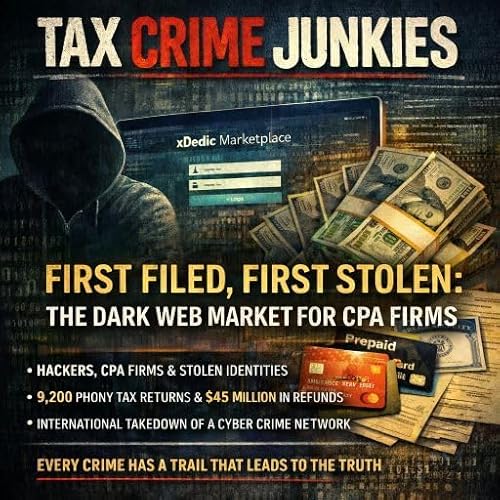
  • First Filed First Stolen: The Dark Web Market for CPA Firms
    Mar 11 2026

    A Florida CPA discovers something strange during tax season: the IRS keeps rejecting client returns because someone has already filed them.

    What begins as a routine tax season glitch soon reveals a massive cyber-enabled fraud scheme involving hacked CPA firms, a dark web marketplace selling remote server access, and thousands of stolen identities used to file fraudulent tax returns.

    In this episode of Tax Crime Junkies, Dominique Molina and Tom Gorczynski dive into the story behind RICH4EVER4430, a cybercrime operation that turned tax firms into inventory on the dark web.

    More than 9,200 fraudulent returns. $45 million in refund claims. An international investigation spanning multiple countries.

    And it all started with something surprisingly simple: an open Remote Desktop port and a weak password.

    Tax season is stressful enough for tax professionals.

    But imagine submitting a client’s return… and the IRS tells you it’s already been filed.

    That’s exactly what happened to one Central Florida CPA firm in 2017.

    At first, it seemed like a mistake. Duplicate filings happen. Sometimes clients file on their own.

    But when the same rejection started happening to multiple clients, the firm realized something far more serious had occurred:

    Their system had been breached.

    Hackers had accessed the firm’s servers, stolen thousands of taxpayer records, and used that data to file fraudulent returns months before legitimate filings were submitted.

    But the story doesn’t start there.

    It starts inside a Florida beauty supply store.

    Two cousins, Andi Jacques and Dickenson Elan, began their journey into tax fraud by opening a small tax preparation business that quietly fabricated W-2s to inflate client refunds.

    When that operation shut down, they took what they learned and built something far more ambitious.

    They partnered with a hacker who had discovered a dark web marketplace called xDedic.

    This platform didn’t sell stolen identities.

    It sold entire business networks.

    For as little as a few hundred dollars in Bitcoin, criminals could purchase access to compromised company servers around the world.

    Among the most valuable listings?

    CPA firms.

    Once inside a tax firm’s system, hackers could extract everything they needed:

    • Social Security numbers

    • prior-year AGI

    • dependent information

    • employer data

    • bank routing numbers

    • scanned tax documents

    In other words:

    Fully assembled identity kits.

    With that data, Jacques and his co-conspirators began filing fraudulent returns before the real taxpayers ever had a chance to file.

    Over the next several years, the group filed more than:

    • 9,200 fraudulent tax returns

    • requesting $45 million in refunds

    • successfully collecting over $7 million

    Meanwhile, an international investigation was quietly unfolding.

    The IRS Criminal Investigation division partnered with the FBI, Europol, and investigators across Europe to dismantle the xDedic dark web marketplace, ultimately tracing the fraud ring responsible for the stolen returns.

    The result:

    Eight conspirators convicted. Millions in restitution ordered. And a sobering reminder that tax firms are one of the most valuable targets in the cybercrime economy.

    In this episode, Dominique and Tom unpack the entire scheme and explain:

    • How hackers infiltrated CPA firm networks • Why tax firms are prime targets for cybercriminals • How dark web marketplaces sell access to business servers • The role of Remote Desktop Protocol (RDP) vulnerabilities • Why weak passwords and missing MFA still cause major breaches • How stolen tax data fuels refund fraud • What tax professionals can do to protect their firms and their clients

    Because in today’s world…

    Data isn’t just an asset. It’s a target.

    Resources Mentioned

    IRS Security Summit https://www.irs.gov

    Identity Theft Affidavit – Form 14039 https://www.irs.gov/forms-pubs/about-form-14039

    Más Menos
    29 m
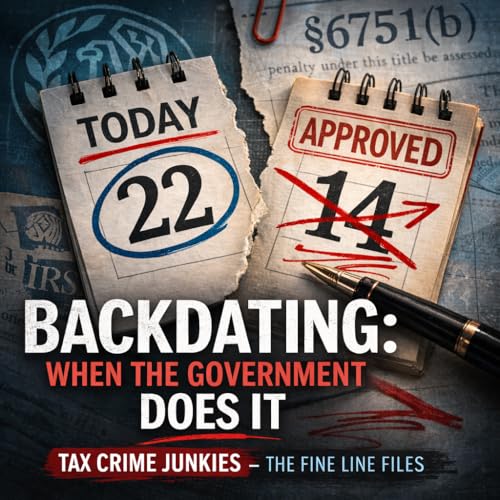
  • The Fine Line Files When the Government Backdates
    Mar 5 2026

    In this episode, Dominique breaks down a Tax Court case where the IRS was sanctioned by the court for backdating documents used to impose a penalty.

    Here’s what happened:

    • The IRS proposed a $15 million penalty against a partnership involved in a syndicated conservation easement.

    • Under IRC §6751(b), penalties must receive written supervisory approval before they are assessed.

    • The IRS agent failed to obtain that approval in time.

    • When the oversight was discovered, a supervisor called it a “HUGE oversight” in an internal email.

    • The approval was then backdated seven months to make it appear compliant.

    IRS attorneys continued to rely on that date in court.

    Tax Court Judge Christian Weiler was not impressed.

    The judge sanctioned the IRS for acting in bad faith and ordered the agency to pay the taxpayer’s legal fees and expenses.

    Why This Matters

    The debate over syndicated conservation easements (SCEs) has become one of the biggest tax enforcement battles of the last decade.

    The IRS labeled these transactions abusive and launched an aggressive crackdown beginning in 2016.

    But according to analysis cited in Tax Notes, when Tax Court judges have ruled on valuation disputes in these cases:

    Approximately 81% of reported deductions were upheld.

    That doesn’t mean abuse didn’t occur.

    It did.

    But it also means the legal landscape is far more complex than headlines suggest.

    In This Episode

    Dominique discusses:

    • The role of backdating in the Jack Fisher conservation easement case

    • The IRS sanctions in Lakepoint Land II LLC v. Commissioner

    • Internal emails suggesting document manipulation

    • Why Section 6751(b) exists

    • The pressure inside IRS enforcement campaigns

    • The risks when procedure gives way to outcomes

    Stay Connected

    Follow Tax Crime Junkies for updates and new episodes:

    Instagram: @TaxCrimeJunkies X: @TaxCrimeJunkies Website: TaxCrimeJunkies.com

    Más Menos
    12 m
  • Whistleblowers, Jury Drama, and the $50 Million Question Jack Fisher Part II
    Feb 28 2026
    Jack Fisher & Syndicated Conservation Easements — Part II Whistleblowers, Jury Drama, and the $50 Million Question

    Syndicated Conservation Easements started as a quiet tax strategy.

    They became a multibillion-dollar industry.

    Then they became one of the IRS’s top enforcement priorities.

    In Part II of our Jack Fisher series, Dominique Molina and Tom Gorczynski pull back the curtain on how this billion-dollar scheme unraveled — and why the fight over conservation easements is still far from over.

    Because this wasn’t just about one promoter.

    It was about a system.

    This episode zooms out to explain:

    • The landmark Kiva Dunes case

    • High-profile conservation easements, including Donald Trump’s

    • The explosion of SCE transactions between 2013–2014

    • IRS Notice 2017-10 designating SCEs as “listed transactions”

    • The intense lobbying battle in Congress

    • The repeated failure of reform bills

    For years, lawmakers tried to rein in abusive deals.

    For years, the bills failed.

    Lobbyists framed reform as:

    • Anti-conservation

    • Anti-property rights

    • Anti-environment

    Meanwhile, the IRS was fighting a valuation war in court — one appraisal at a time.

    In This Episode We Cover:
    • IRS whistleblower mechanics

    • How Form 211 cases actually work

    • The jury drama that almost collapsed the trial

    • Why reform bills failed for years

    • How lobbying reshaped the debate

    • What §170(h)(7) actually does

    • Why some easement cases survive and others implode

    Más Menos
    42 m
  • The Fine Line Files: The Tax Shelter You’re Not Supposed to Talk About
    Feb 17 2026

    In this episode of The Fine Line Files, Dominique Molina and Tom peel back the layers on one of the most controversial—and misunderstood—tax strategies in modern history: conservation easements.

    What started as a well-intentioned policy to protect land and promote environmental stewardship quietly transformed into one of the IRS’s most aggressively targeted tax battlegrounds. Billions of dollars. Explosive valuations. Senate outrage. And an audit spotlight so intense most tax professionals won’t even say the words out loud.

    Today, we break the silence.

    In this episode, we cover:
    • What a conservation easement actually is—and why it qualifies as a charitable deduction

    • How “highest and best use” valuations turned land preservation into a tax goldmine

    • Why syndicated conservation easements became the IRS’s public enemy number one

    • The four hallmarks that can land a deal on the listed transaction watchlist

    • How a 2.5x valuation multiple became the real tripwire

    • The difference between donating your own land and joining a syndicated deal

    • Audit risk, valuation risk, and penalty exposure—what’s real and what’s hype

    • Why conservation easements aren’t dead… just quieter, tighter, and evolving

    Between 2010 and 2017, taxpayers claimed over $26 billion in conservation easement deductions—and the IRS has been trying to claw them back ever since. The result? A legal minefield where one missing attachment or appraisal sentence can detonate an entire deduction.

    This episode doesn’t sell the strategy. It doesn’t condemn it either.

    Instead, it explains why conservation easements live squarely on the fine line—and why understanding that line matters more than ever for taxpayers and advisors alike.

    Coming next:

    We go deeper into how tax incentives meant to protect land became a battleground of auditors, appraisers, promoters, and regulators—and how to navigate this space without stepping on a financial landmine.

    Because in tax planning, the line between strategy and scheme is thinner than you think.

    Stay curious. Stay vigilant. Stay on the right side of the Fine Line.

    Más Menos
    12 m