Talking Billions with Bogumil Baranowski Podcast Por Bogumil Baranowski arte de portada

Talking Billions with Bogumil Baranowski

Talking Billions with Bogumil Baranowski

De: Bogumil Baranowski
Escúchala gratis

EVERY MONDAY A NEW EPISODE. I READ ALL MY EMAILS - contact form on my website - www.bogumilbaranowski.com. TELL ME YOUR STORY. I’m Bogumil Baranowski, an author, a TEDx speaker, an investor, and an investment advisor to families and individuals. Intimate conversations about money, wealth, and living a rich and fulfilling life. We talk about big ideas, big inspirations, big topics. We take on the hardest subject of all – money: how to make it, save it, keep it, but our conversations lead us to an even bigger question — what it means to live a rich life beyond money. NOT INVESTMENT ADVICE.Bogumil Baranowski Economía Finanzas Personales
Episodios
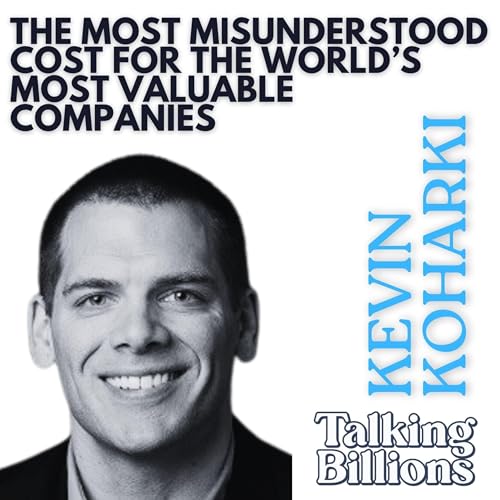
  • Kevin Koharki, PhD: What Stock-Based Compensation Really Costs -- The Billions That Never Show Up on the Books
    Apr 6 2026

    Kevin Koharki, MBA, PhD, is the founder of CAE Consulting (Capital Allocation Enhancement), associate professor of accounting at Purdue University, and expert financial analyst with a 20-year career — including M&A analysis — who consults with and advises Fortune 100 companies on understanding the true economic cost of stock-based compensation.

    The episode is sponsored by TenzingMEMO — the AI-powered market intelligence platform I use daily for smarter company analysis. Code BILLIONS gets you an extended trial + 10% off.

    https://www.tenzingmemo.com/

    3:00 — Kevin traces the origins of stock-based comp to the 1990s dot-com era; originally meant to conserve cash at startups and align employee incentives with shareholders.

    5:00 — The shift from stock options to RSUs and PSUs; accounting still at the expensing stage from 2002 FASB rules.

    7:00 — Why stock-based comp is concentrated in the tech sector, particularly Mag-7 companies — the very firms that don’t need to conserve cash.

    10:00 — Kevin walks through the mechanics: 100 RSUs granted at $30, expensed over three years, but if sold at $90, the $60 gap never appears on the P&L.

    14:00 — Cash flow distortion: compensation paid in shares shows up as a financing activity, not an operating expense — inflating free cash flow.

    17:00 — Why employees don’t truly become owners: tax liabilities force selling, and short-term vesting creates a “what’s my vest date?” mentality.

    19:00 — The Berkshire model: Greg Abel buys shares with after-tax salary. No stock-based comp. Buffett’s emphasis on intrinsic value per share.

    23:00 — Psychological toll: employees hired at the peak face crushing drawdowns; companies respond by issuing even more shares.

    28:00 — Real-world example: a company with $102B in operating cash flow shows $6.4B in GAAP SBC — but $7.9B just in tax withholdings. The tax cost exceeds the recorded expense.

    35:00 — Second example: 90% of a $26.3B share buyback was simply to offset dilution. True free cash flow drops from $46B to roughly $4B.

    42:00 — The private company test: “If you bought the whole company, you’d still have to pay those employees in cash.”

    50:00 — The IRS treats SBC as cash-basis: the $90 exercise price gets the deduction, not the $30 GAAP cost.

    58:00 — Kevin: “I just think there’s kind of a mass delusion going on right now.”

    1:03:00 — Wall Street Journal coverage and Nvidia’s disclosure change; the conversation is shifting.

    Podcast Program – Disclosure Statement

    Blue Infinitas Capital, LLC is a registered investment adviser and the opinions expressed by the Firm’s employees and podcast guests on this show are their own and do not reflect the opinions of Blue Infinitas Capital, LLC. All statements and opinions expressed are based upon information considered reliable although it should not be relied upon as such. Any statements or opinions are subject to change without notice.

    Information presented is for educational purposes only and does not intend to make an offer or solicitation for the sale or purchase of any specific securities, investments, or investment strategies. Investments involve risk and unless otherwise stated, are not guaranteed.

    Más Menos
    1 h y 14 m
  • Ryan Bunn: Why the Best Investors Think Like Collectors, Not Traders, What a 99-Year-Old Investor Taught Warren Buffett & The Mindset That Builds Generational Wealth
    Mar 30 2026

    Ryan Bunn is the lead portfolio manager at Reference Equity in Denver, a Northwestern-trained engineer and Kellogg MBA with 15+ years of global equity experience who implements a first-principles quality-value philosophy focused on businesses in non-competitive situations.

    Episode Sponsor: Fiscal AI is a modern data terminal that gives investors instant access to twenty years of financials, earnings transcripts, and extensive segment and KPI data—use my link for a two-week free trial plus 15% off: https://fiscal.ai/talkingbillions/

    3:00 — Ryan’s Midwestern upbringing outside Cincinnati; mother taught him investing in elementary school; family of savers focused on dividend yields and long-term wealth building.

    5:00 — 30-year investing evolution: private equity consulting training revealed wide range of business quality; reading Graham and Buffett cemented value conviction; experimented with options, angel investing in India, due diligence in Moscow, NFTs.

    7:00 — The NFT experiment: bought digital art in summer 2021, sold for 25x return in six weeks, watched it crash 95%+. Lesson: “It showed me that I’m not a growth investor… it was so stressful even as prices were going up.”

    9:00 — First principles of quality investing: competition is capitalism’s first principle; sustainable high returns require non-competitive scenarios. Challenges the broad definition of “quality” in today’s market.

    13:00 — Philip Carret’s legacy: founded Pioneer Fund in 1928, compounded ~13% annually over 60 years, wrote The Art of Speculation in 1930. Met Buffett in early 1950s — before Munger. Framework of “men, materials, and money” underlies all fundamental investing today.

    19:00 — Intellectual heritage: ideas passed between generations compound like capital. Carret appeared at the 1995 Berkshire meeting at age 99.

    22:00 — Generational wealth: someone must be the first generation to save and sacrifice. Modern retirement planning models spending to zero — the opposite of wealth transfer.

    27:00 — Capital vs. currency: truly long-term investing requires a pool of capital you never touch. Focus on yield, not the capital base itself. Bogumil shares his “forgotten money” account untouched for 20+ years.

    33:00 — Collecting mindset: Berkshire shareholders collect shares, not dollars. Reframing investing as collecting removes short-term anxiety.

    44:00 — Why value investing works structurally: cheaper stocks get more powerful buybacks; low multiples protect against destructive M&A; boring companies let management focus on operations, not investor relations.

    55:00 — Global small caps: 5,000+ stocks, ~150 meet Ryan’s non-competitive filter, 3-5 per year reach attractive valuations. International investing rewards those who understand what US-quality governance looks like.

    1:01:00 — Reference equity concept: European “reference shareholder” families as long-term partners to businesses. Ryan’s mission to bring this model to US public markets.


    Podcast Program – Disclosure Statement

    Blue Infinitas Capital, LLC is a registered investment adviser and the opinions expressed by the Firm’s employees and podcast guests on this show are their own and do not reflect the opinions of Blue Infinitas Capital, LLC. All statements and opinions expressed are based upon information considered reliable although it should not be relied upon as such. Any statements or opinions are subject to change without notice.

    Information presented is for educational purposes only and does not intend to make an offer or solicitation for the sale or purchase of any specific securities, investments, or investment strategies. Investments involve risk and unless otherwise stated, are not guaranteed.

    Más Menos
    1 h y 19 m
  • 100 Year Thinkers, Ep. 6 | Chris Mayer & Robert Hagstrom: Most Stocks Don’t Matter & The Outliers That Break Base Rates
    Mar 28 2026

    This episode brings together Robert Hagstrom and Chris Mayer to explore how investors should think about base rates, extreme outcomes, and the realities of long-term wealth creation in markets. Drawing on Michael Mauboussin's work, the conversation challenges conventional ideas like mean reversion and highlights why a small number of companies drive most stock market returns—and what that means for portfolio construction.

    Matt Zeigler and I had the privilege of hosting Robert Hagstrom (The Warren Buffett Way) and Chris Mayer (100 Baggers) for a special 100-Year Thinkers Edition of the Excess Returns Podcast.

    Available now on Excess Returns Podcast and Talking Billions. 🎧

    I’m excited to share this episode with you—it’s reposted here with permission and blessing from both Matt and Jack. Don’t miss it! And follow their work, links below.

    Chris’ New Book
    https://shop.generalsemantics.org/pro...
    Robert’s Book: Investing: The Last Liberal Art
    https://www.amazon.com/Investing-Libe...

    https://excessreturnspod.com/


    • Why markets are driven by extreme outcomes and power laws, not averages
    • The Best & Bessembinder research showing a handful of stocks create most wealth
    • Base rates vs outliers and when to trust historical probabilities
    • Why the 100 bagger framework focuses on studying winners, not predicting them
    • Portfolio construction as a way to capture asymmetric upside
    • Buffett’s approach to consistency, durability, and long-term operating history
    • Inside view vs outside view and how narratives distort investing decisions
    • Why AI may be breaking traditional base rate assumptions in software and tech
    • The limits of mean reversion and why it can lead investors astray
    • Return on invested capital and how competition erodes excess returns over time
    • Identifying durable moats and why most advantages eventually get attacked
    • Winner-take-all dynamics and how they shape long-term investing outcomes
    • The twin engines of returns: earnings growth and multiple expansion
    • Return on incremental capital as a key driver of long-term compounding
    • Intangible assets and why accounting understates true business value
    • Amazon as a case study in misunderstood profitability and reinvestment
    • AI CapEx cycle and why current spending may not be sustainable long term
    • Why great businesses matter more than great management in long-term investing


    Podcast Program – Disclosure Statement

    Blue Infinitas Capital, LLC is a registered investment adviser and the opinions expressed by the Firm’s employees and podcast guests on this show are their own and do not reflect the opinions of Blue Infinitas Capital, LLC. All statements and opinions expressed are based upon information considered reliable although it should not be relied upon as such. Any statements or opinions are subject to change without notice.

    Information presented is for educational purposes only and does not intend to make an offer or solicitation for the sale or purchase of any specific securities, investments, or investment strategies. Investments involve risk and unless otherwise stated, are not guaranteed.

    Information expressed does not take into account your specific situation or objectives, and is not intended as recommendations appropriate for any individual. Listeners are encouraged to seek advice from a qualified tax, legal, or investment adviser to determine whether any information presented may be suitable for their specific situation. Past performance is not indicative of future performance.

    Más Menos
    1 h y 12 m
Todavía no hay opiniones