

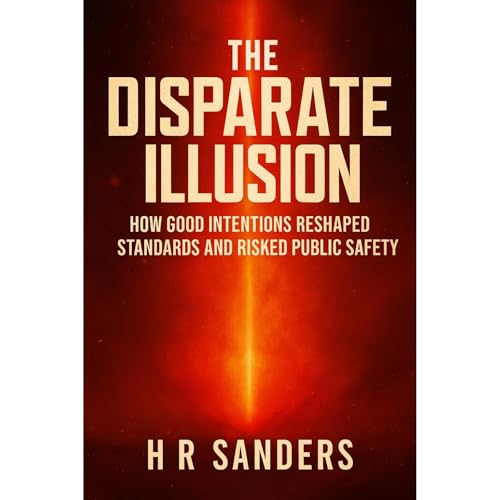
THE DISPARATE ILLUSION
HOW GOOD INTENTIONS RESHAPED STANDARDS AND RISKED PUBLIC SAFETY
No se pudo agregar al carrito
Add to Cart failed.
Error al Agregar a Lista de Deseos.
Error al eliminar de la lista de deseos.
Error al añadir a tu biblioteca
Error al seguir el podcast
Error al dejar de seguir el podcast
 Exclusivo para miembros Prime: ¿Nuevo en Audible? Obtén 2 audiolibros gratis con tu prueba.
THE DISPARATE ILLUSION
Compra ahora por $3.99
-
Narrado por:
-
Virtual Voice
-
De:
-
H R SANDERS

Este título utiliza narración de voz virtual
Disparate impact began as a legal doctrine designed to confront discrimination where intent was difficult to prove. Over time, it became one of the most powerful and controversial tools in American civil rights law. Supporters argue it protects fairness and equal opportunity. Critics argue it quietly reshapes standards, alters incentives, and produces consequences far removed from its original purpose.
This book examines the full arc of disparate impact, from its origins to its real-world effects.
Beginning with the Civil Rights Act of 1964 and the landmark Supreme Court decision in Griggs v. Duke Power Co. (1971), The Disparate Illusion traces how a doctrine focused on outcomes rather than intent reshaped hiring, promotion, testing, and credentialing across public and private institutions. Through clear explanation and historical context, the book explores how disparate impact standards expanded through courts, regulatory agencies, and compliance frameworks, influencing everything from employment practices and education to public safety roles and risk-sensitive professions.
Rather than treating disparate impact as purely theoretical, this book focuses on how the doctrine operates in practice. It examines major court cases, enforcement mechanisms, statistical thresholds, and the concept of “business necessity.” It also explores how organizations respond to legal pressure, how standards evolve under litigation risk, and how decisions made to avoid liability can affect competence, safety, morale, and public confidence.
Importantly, this book does not argue from slogans or assumptions. It presents the strongest arguments on all sides, including why disparate impact was created, what injustices it sought to address, and why it continues to be defended by many legal scholars and policymakers. At the same time, it critically examines concerns raised by judges, professionals, and researchers who question whether outcome-based enforcement can unintentionally incentivize lower standards, obscure merit, or introduce new forms of inequity.
Written for readers who want depth without legal jargon, The Disparate Illusion is accessible to professionals, students, policymakers, and engaged citizens alike. Whether you see disparate impact as an essential safeguard or a flawed framework with unintended consequences, this book provides the historical grounding and analytical clarity needed to understand one of the most consequential legal doctrines shaping modern institutions.
When fairness is measured by outcomes alone, what happens to standards, safety, and trust?
This book invites readers to examine that question with evidence, context, and intellectual rigor.