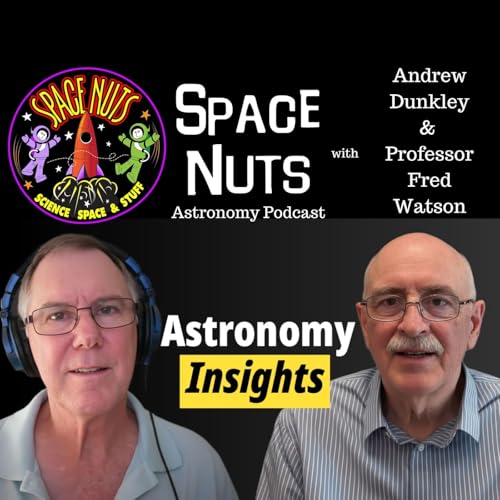
Space Nuts: Astronomy Insights & Cosmic Discoveries Podcast By Professor Fred Watson and Andrew Dunkley cover art

Space Nuts: Astronomy Insights & Cosmic Discoveries

Space Nuts: Astronomy Insights & Cosmic Discoveries

By: Professor Fred Watson and Andrew Dunkley
Listen for free

Join Professor Fred Watson and Sci-Fi Author Andrew Dunkley on Space Nuts as they delve into astronomy, space travel, and cosmic mysteries. Explore groundbreaking discoveries and listener Q&A in captivating discussions. Follow us on social media to engage with our community!

Two episodes a week with news and explainer focused editions published on Thursday's and our Listener Q&A focused edition on Monday's.

Become a supporter of this podcast: https://www.spreaker.com/podcast/space-nuts-astronomy-insights-cosmic-discoveries--2631155/support.Copyright bitesz.com
Astronomy Astronomy & Space Science Natural History Nature & Ecology Science
Episodes
  • Cosmic Questions: Dark Energy, Stellar Birth & the Nature of Black Holes
    Feb 16 2026
    Sponsor Link:
    This episode of Space Nuts is brought to you with the support of NordVPN. When it's time to do something about your online privacy, use the one we trust - NordVPN. To get our special deal visit nordvpn.com/spacenuts

    Dark Matter Theories, Solar Origins, and Black Hole Temperatures
    In this milestone 600th episode of Space Nuts, hosts Andrew Dunkley and Professor Fred Watson celebrate with a captivating Q&A session, tackling a variety of thought-provoking questions from listeners around the globe. Prepare to dive deep into the mysteries of the universe as they explore intriguing theories and concepts that challenge our understanding of cosmology.
    Episode Highlights:
    - Dark Matter and Dark Energy: Daryl from South Australia presents a unique theory suggesting a connection between dark matter and dark energy, likening them to opposites with gravitational effects. Andrew and Fred dissect this idea and discuss the fundamental differences between these two cosmic phenomena.
    - Where Was the Sun Born? Slaty Bartfast from Norway asks if we could see the Sun's birth by pointing a telescope at its historical coordinates. The hosts explain why this wouldn’t yield any observable results and discuss the concept of solar siblings born in the same gas cloud.
    - Black Hole Temperatures: Bjorn from Gothenburg seeks clarification on the temperature of black holes and the material that spirals into them. Andrew and Fred clarify how the extreme heat of accreting material contrasts with the near-absolute zero temperature of the black hole itself.
    - The Expansion of Space: Peter from Falun poses a complex question about the nature of space and time in an expanding universe. The hosts unravel the intricacies of how our measurements of distance and time are affected by the universe's expansion.

    For more Space Nuts, including our continuously updating newsfeed and to listen to all our episodes, visit our website. Follow us on social media at SpaceNutsPod on Facebook, Instagram, and more. We love engaging with our community, so be sure to drop us a message or comment on your favorite platform.
    If you’d like to help support Space Nuts and join our growing family of insiders for commercial-free episodes and more, visit spacenutspodcast.com/about.
    Stay curious, keep looking up, and join us next time for more stellar insights and cosmic wonders. Until then, clear skies and happy stargazing.

    Become a supporter of this podcast: https://www.spreaker.com/podcast/space-nuts-astronomy-insights-cosmic-discoveries--2631155/support.
    Show more Show less
    33 mins
  • Cosmic Dust in a Jar, Volcanic Eruptions on Io & Following the Coal to Find Extraterrestrial Life
    Feb 13 2026
    Sponsor Link:
    www.incogni.com/spacenuts

    Cosmic Dust in a Jar, Volcanic Eruptions on Io, and the Quest for Intelligent Life
    In this exciting episode of Space Nuts, hosts Andrew Dunkley and Professor Fred Watson delve into a series of captivating cosmic stories that will spark your imagination. From the groundbreaking creation of cosmic dust in a lab to the simultaneous volcanic eruptions on Jupiter's moon Io, this episode is a treasure trove of astronomical insights.
    Episode Highlights:
    - Cosmic Dust in a Jar: A Sydney PhD student has synthesized cosmic dust in a laboratory setting. Andrew and Fred discuss the implications of this breakthrough for our understanding of how complex organic molecules form in space, and whether this could reduce the need for future space missions to gather samples from asteroids.
    - Simultaneous Volcanic Eruptions on Io: The hosts explore the extraordinary event of five volcanoes erupting at once on Io, revealing insights into the moon’s geological activity. They discuss the gravitational forces at play and how this discovery challenges previous theories about Io's solid interior.
    - Follow the Coal to Find Intelligent Life: A new theory suggests that the presence of coal may be a key factor in the development of intelligent civilizations. Andrew and Fred unpack the idea that access to natural resources could influence technological advancement, raising questions about the rarity of intelligent life in the universe.

    For more Space Nuts, including our continuously updating newsfeed and to listen to all our episodes, visit our website. Follow us on social media at SpaceNutsPod on Facebook, Instagram, and more. We love engaging with our community, so be sure to drop us a message or comment on your favorite platform.
    If you’d like to help support Space Nuts and join our growing family of insiders for commercial-free episodes and more, visit spacenutspodcast.com/about.
    Stay curious, keep looking up, and join us next time for more stellar insights and cosmic wonders. Until then, clear skies and happy stargazing.

    Become a supporter of this podcast: https://www.spreaker.com/podcast/space-nuts-astronomy-insights-cosmic-discoveries--2631155/support.
    Show more Show less
    32 mins
  • Theia's Fate, Galaxy Mergers & the Mysteries of Mars' Atmosphere | Q&A
    Feb 9 2026
    Sponsor Link:
    This episode of Space Nuts brought to you by Incogni.Reduce the volume of spam calls and emails. They can't spam you if the can't find you. To find out more and to take up our 60% off offer, visit incogni.com/spacenuts and use the cou[on code SPACENUTS at checkout.

    Theia's Fate, Galactic Mergers, and the Mysteries of Hydrogen
    In this captivating Q&A edition of Space Nuts, hosts Andrew Dunkley and Professor Fred Watson tackle a range of intriguing questions from listeners, diving deep into cosmic mysteries and scientific theories. From the fate of the former planet Theia to the dynamics of galaxy mergers and the origins of hydrogen, this episode is packed with insights that will expand your understanding of the universe.
    Episode Highlights:
    - The Fate of Theia: Rusty from Donnybrook poses a thought-provoking question about Theia, the planet that collided with Earth. Andrew and Fred discuss the most accepted theories regarding Theia's remnants and how they may have been absorbed into Earth's mantle, leaving behind intriguing geological evidence.
    - Galaxy Mergers Explained: New listener Melina asks about the merging of spiral galaxies in an expanding universe. The hosts explain how gravity can overcome the universe's expansion on galactic scales, leading to fascinating interactions and eventual mergers between galaxies.
    - Olympus Mons and Mars' Atmosphere: Kevin wonders if the colossal eruptions of Olympus Mons could have contributed to Mars' atmospheric loss. Andrew and Fred explore the volcanic activity on Mars and clarify that while Olympus Mons is impressive, the planet's lack of a magnetic field is a more significant factor in its atmospheric decline.
    - Hydrogen's Cosmic Origins: Five-year-old Yuki asks why hydrogen is the only element not formed in stars. The hosts explain that hydrogen was created shortly after the Big Bang, making it the most abundant element in the universe, while other elements formed later through stellar processes.

    For more Space Nuts, including our continuously updating newsfeed and to listen to all our episodes, visit our website. Follow us on social media at SpaceNutsPod on Facebook, Instagram, and more. We love engaging with our community, so be sure to drop us a message or comment on your favorite platform.
    If you’d like to help support Space Nuts and join our growing family of insiders for commercial-free episodes and more, visit spacenutspodcast.com/about.
    Stay curious, keep looking up, and join us next time for more stellar insights and cosmic wonders. Until then, clear skies and happy stargazing.

    Become a supporter of this podcast: https://www.spreaker.com/podcast/space-nuts-astronomy-insights-cosmic-discoveries--2631155/support.
    Show more Show less
    30 mins
No reviews yet