

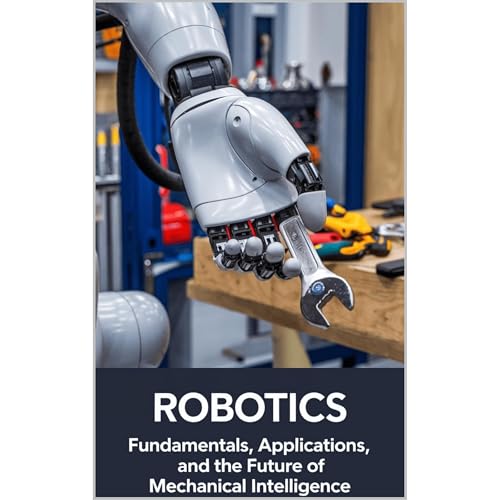
Robotics
Fundamentals, Applications, and the Future of Mechanical Intelligence
No se pudo agregar al carrito
Add to Cart failed.
Error al Agregar a Lista de Deseos.
Error al eliminar de la lista de deseos.
Error al añadir a tu biblioteca
Error al seguir el podcast
Error al dejar de seguir el podcast
Obtén 30 días de Standard gratis

Robotics
Compra ahora por $9.99
-
Narrado por:
-
Virtual Voice
-
De:
-
Luis Tejada

Este título utiliza narración de voz virtual
Robotics is a multidisciplinary field that focuses on the design, construction, programming, and operation of robots, autonomous machines, or mechatronic systems that can perform tasks autonomously or semi-autonomously. This discipline combines elements of engineering, computer science, electronics, and artificial intelligence to create machines capable of carrying out a variety of tasks in diverse environments.
A robot is a programmable machine that can perform tasks autonomously or semi-autonomously. Robots can be mobile or stationary and can come in various shapes and sizes, depending on their function and design. They also can be mobile or stationary, meaning they can move around or remain fixed in one place. Robots play an important role in a wide variety of industries and fields.
Manufacturing: In the manufacturing industry, robots are commonly used on assembly lines for tasks such as assembly, welding, painting, and material handling. These robots increase efficiency and precision in production.
Medicine: Surgical robots are used in surgeries to perform precise procedures with less invasion and shorter recovery times. They are also used in rehabilitation to help patients regain mobility.
Space Exploration: In space exploration, robots, such as rovers and space probes, are essential for investigating planets, asteroids, and other celestial bodies, as they can operate in extreme environments where humans cannot.
Agricultural Automation: Agricultural robots are used for tasks such as planting, harvesting, and monitoring crops, helping to increase efficiency and reduce waste.
Logistics and Warehousing: In warehouses and distribution centers, autonomous robots are used to move goods, reducing the time and effort required for inventory management and shipping.
Military Industry: Robots are used in military applications, such as drones and unmanned vehicles, for surveillance and data collection in dangerous areas.
Autonomous Vehicles: Autonomous vehicles, which use robotic technology, are being developed to revolutionize the transportation industry and reduce the need for human drivers.
Education: Educational robots are used to teach programming and STEM concepts to students of all ages, fostering interactive learning.
- Automation
- Artificial Intelligence (AI)
- Machine Learning
- Sensors
- Actuators
- Humanoid
- Autonomy