

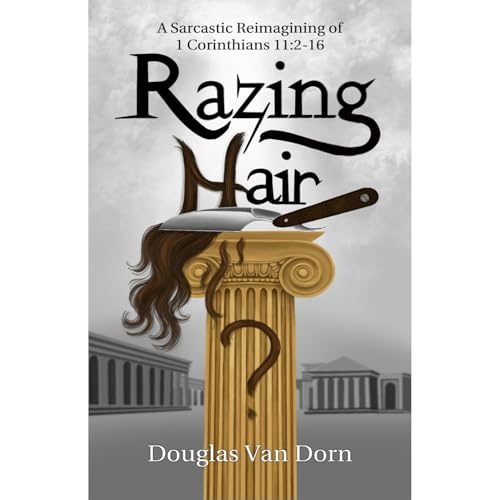
Razing Hair
A Sarcastic Reimagining of 1 Corinthians 11:2-16
No se pudo agregar al carrito
Add to Cart failed.
Error al Agregar a Lista de Deseos.
Error al eliminar de la lista de deseos.
Error al añadir a tu biblioteca
Error al seguir el podcast
Error al dejar de seguir el podcast
Prueba gratis de 30 días de Audible Standard

Razing Hair
Compra ahora por $12.99
-
Narrado por:
-
Virtual Voice
-
De:
-
Douglas Van Dorn

Este título utiliza narración de voz virtual
For over twenty years, pastor and author Douglas Van Dorn avoided preaching 1 Corinthians—its conundrums, factionalism, and bizarre debates made it feel inexplicable. Then a single verse in Acts (18:18) began to change all that: Paul cuts his hair right after leaving Corinth, where he had worn it long during his entire ministry there. This glaring contradiction with 1 Cor 11:14 (“long hair… a disgrace”) cracked open the passage.
In Razing Hair, Van Dorn argues that Paul is not delivering transcendent rules about head coverings, hair length, or gender hierarchy. Those are issues of "disputable matters" and Christian liberty. He is being sarcastic—mocking the Corinthians’ obsession with outward appearances, cultural propriety, and contentious debates while their church is imploding morally. Only the core theological affirmations (Christ as head, mutual interdependence, God as ultimate covering) are spoken straight-faced; the rest skewers the vanity of these Christians with biting irony.
Drawing on Paul’s Nazirite vow and the cultural backdrop of Corinth (including Aphrodite’s mirror-shield statue and the city’s mirror industry), Van Dorn offers a fresh, provocative reading that sidesteps modern egalitarian-complementarian wars. Instead, it recenters the text on the real issue: love, unity, and inward integrity over superficial primping.
Short, accessible, and unapologetically bold, Razing Hair invites readers to laugh uncomfortably at Corinthian folly—and to see their own. Paul’s sarcasm still has the last laugh.
Las personas que vieron esto también vieron:



Rather than situating the passage within the familiar complementarian versus egalitarian debate, Van Dorn proposes that Paul is critiquing the Corinthians’ misplaced focus. According to his reading, the issue is not primarily the establishment of a timeless natural hierarchy, but the Corinthians’ tendency to elevate cultural symbols of honor and shame while neglecting deeper moral failures and disorder within their assembly. This reframing shifts attention from external markers to internal fidelity and unity.
The author engages competing interpretations with precision, presenting them fairly before advancing his own conclusions. His analysis is logical, textually attentive, and rhetorically aware. Whether one ultimately agrees with his conclusions or not, the work stimulates careful reconsideration of a notoriously difficult passage.
Regarding the audiobook performance, the AI narrator is surprisingly strong. The delivery is clear, well-paced, and natural in tone—above average compared to many automated readings. It handles theological terminology competently and maintains a consistent cadence throughout. Overall, both the content and the production quality make this audiobook a worthwhile listen for those interested in Pauline rhetoric and interpretive method.
Refresh and Scholarly Analysis of 1 Corinthians 11
Se ha producido un error. Vuelve a intentarlo dentro de unos minutos.