

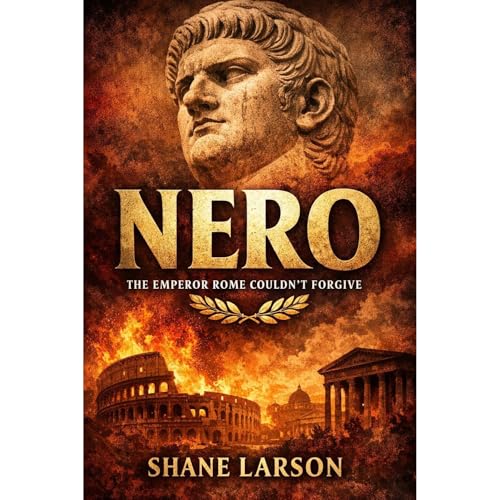
Nero
The Emperor Rome Couldn't Forgive
No se pudo agregar al carrito
Add to Cart failed.
Error al Agregar a Lista de Deseos.
Error al eliminar de la lista de deseos.
Error al añadir a tu biblioteca
Error al seguir el podcast
Error al dejar de seguir el podcast
Obtén 30 días de Standard gratis

Nero
Compra ahora por $5.99
-
Narrado por:
-
Virtual Voice
-
De:
-
Shane Larson

Este título utiliza narración de voz virtual
He killed his mother, his wife, and his teacher Seneca. He may or may not have set fire to Rome. He blamed the Christians for it and launched the first Roman persecution. He built the largest private residence in the ancient world. He competed in the Olympic Games as a performer, sang for crowds of thousands, and ended his life on a roadside — stabbed in the throat by a frightened freedman as the Senate's horsemen closed in.
His last words, as he bled out: Qualis artifex pereo — "What an artist dies in me."
This is the full story of the emperor Rome could not forgive.Nero is the most famous monster in Roman history. He is also the most heavily libelled. Almost everything we know about him comes from three authors — Tacitus, Suetonius, and Cassius Dio — who were writing decades or centuries after his death, under emperors whose own legitimacy depended on Nero's reputation staying bad.
Peel those sources apart, read the coins and inscriptions, follow what the provinces actually did with his name, and a second Nero appears underneath the legend. In much of the eastern empire he was genuinely popular. His rebuilding of Rome after the fire was the biggest urban engineering project between Augustus and Hadrian. For nearly a century after his death, impostors claiming to be the returned Nero drew real followings. Christian writers turned him into the Antichrist — the beast of Revelation 13, whose number 666 is a Hebrew numerological rendering of "Nero Caesar."
What you'll find in this book:- The making of an emperor by his mother Agrippina, one of the most politically formidable women in Roman history
- The five good years (54–59 CE) that Trajan, a century later, called the best administration Rome had ever seen
- The matricide at Baiae — the collapsing pleasure boat, the failed drowning, the letter Nero wrote blaming his mother for her own death
- The Great Fire of 64 CE and the question that will not go away: did Nero start it?
- The first Roman persecution of Christians, and what "Christian" actually meant in Rome in 64 CE
- The Domus Aurea — a palace the size of a small city, with a lake, a colossus, and a revolving ceiling
- The Pisonian conspiracy and the forced suicide of Seneca
- The Greek tour of 66–67 CE — Olympic chariot race, Pythian poetry contest, every prize in every city
- The roadside suicide in June 68 CE and the end of the Julio-Claudian dynasty
- The afterlife — the three false Neros, the Antichrist legend, and two thousand years of revisionism
Shane Larson's Nero: The Emperor Rome Couldn't Forgive takes the sources with skepticism, the legend with curiosity, and the man himself as exactly what he was: a product of the most dysfunctional family in the ancient world, placed on the throne of the largest empire on earth before his brain was fully formed, and crushed by the weight of what that combination meant.
He did kill his mother. He did force Seneca to open his veins. He did blame the Christians for a fire he almost certainly did not start. Both the legend and the man are present in this book, neither flattered.
For readers of:- Dynasty: The Rise and Fall of the House of Caesar by Tom Holland
- SPQR and Emperor of Rome by Mary Beard
- Augustus and Caesar by Adrian Goldsworthy
- Nero by Edward Champlin (the academic counterpart to this book's accessible treatment)