Navigating the Customer Experience Podcast Por Yanique Grant Customer Experience Strategist Entrepreneur arte de portada

Navigating the Customer Experience

Navigating the Customer Experience

De: Yanique Grant Customer Experience Strategist Entrepreneur
Escúchala gratis

Join host Yanique Grant as she takes you on a journey with global entrepreneurs and subject matter experts that can help you to navigate your customer experience. Learn what customers really want and how businesses can understand the psychology of each customer or business that they engage with. We will be looking at technology, leadership, customer service charters and strategies, training and development, complaint management, service recovery and so much more!

© 2026 Navigating the Customer Experience
Desarrollo Personal Economía Exito Profesional Gestión y Liderazgo Liderazgo Éxito Personal
Episodios
  • 269: Faith Over Fear: Leading with Humanity in the Age of AI with Victoria Mensch
    Mar 3 2026

    Send a text

    In this insightful episode of Navigating the Customer Experience, we welcome Victoria Mensch, Founder & CEO of the Silicon Valley Executive Academy, for a powerful conversation on leadership, innovation, and thriving in the age of AI.

    With a PhD in Psychology, an MBA from UC Berkeley, and more than 25 years in Silicon Valley, Victoria has built her career at the intersection of human behavior, executive performance, and technological transformation. Arriving in Silicon Valley during the dot-com boom, she was inspired by its bold, world-changing mindset. That culture of innovation shaped her journey from working across semiconductor and software companies to launching her own executive academy, where she helps global leaders apply Silicon Valley’s innovation principles within their own organizations.

    A central theme of the episode is how leadership must evolve in today’s fast-changing 2026 environment. Victoria emphasizes that leadership isn’t limited to job titles—it exists at every level. She outlines three essential qualities leaders must cultivate:

    Self-Responsibility & Agency – Great leaders take ownership of their choices and focus on what they can control, even amid disruption.

    Curiosity – With technological, political, and economic shifts happening constantly, leaders must stay open, adaptable, and willing to explore new perspectives.

    Continuous Learning – In the age of AI, growth is non-negotiable. Leaders must embrace learning, develop new skills, and view change as an opportunity rather than a threat.

    One of the most powerful discussions centers on reframing failure. Victoria explains that fear of failure is often driven by imagined future scenarios. The key practice is returning to the present moment and rationally assessing reality. She also offers a mindset shift: the probability of success is equal to the probability of failure—yet we tend to focus only on what could go wrong. By consciously balancing those possibilities, leaders can make decisions rooted in clarity instead of fear.

    When asked for one word leaders should adopt for 2026, Victoria chooses humanity. As organizations increasingly integrate artificial intelligence, she believes leaders must keep the human element at the forefront. Technology should create space for deeper creativity and stronger connections—not replace them. The goal isn’t simply to be faster or more efficient, but to be better in how we serve and relate to others.

    Victoria also shares her excitement about AI-driven automation and tools that eliminate time-draining tasks, freeing leaders to focus on high-value work. She recommends exploring Lovable, a platform that allows users to build applications and landing pages without coding skills. A book that influenced her thinking is Digital Darwinism: Surviving the New Age of Business Disruption by Tom Goodwin, which examines how companies navigate digital transformation.

    Her personal guiding quote? “Faith over fear.”

    This episode delivers practical leadership insights for executives, entrepreneurs, and professionals ready to embrace change, lead with intention, and remain human in a rapidly evolving digital world.

    Connect with Victoria at www.svexecutive.academy and join the conversation on X @navigatingcx or in the Navigating the Customer Experience community.

    Más Menos
    20 m
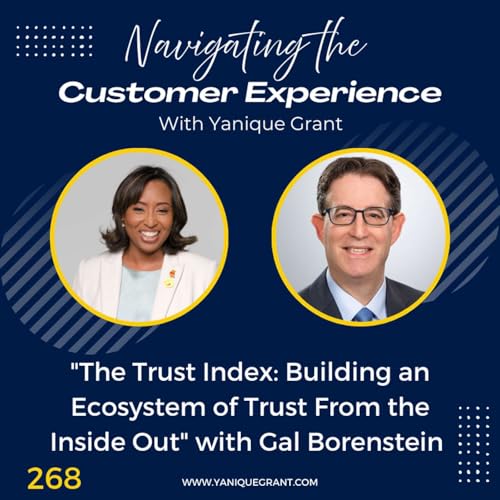
  • 268: The Trust Index: Building an Ecosystem of Trust From the Inside Out with Gal Borenstein
    Feb 17 2026

    Send a text

    In this episode of Navigating the Customer Experience, Gal Borenstein, Founder and CEO of The Borenstein Group, joins us for a powerful conversation on trust, branding, and customer experience in the digital and AI era. With nearly 30 years of experience advising growth-oriented organizations in complex and regulated industries, Gal shares how leaders can protect credibility and build sustainable brands when trust is on the line.

    Gal’s journey is a true immigration success story. Born and raised in Israel, he served as a military journalist before moving to the United States at 21 to pursue his education. After completing his undergraduate degree at Temple University in just two and a half years and earning a master’s degree from George Mason University, he quickly recognized a major gap in the marketplace: highly technical companies struggled to communicate their value clearly.

    Armed with a $2,000 loan and a vision, he launched The Borenstein Group in the Washington, DC area, focusing on helping B2B technology firms connect complex solutions to clear messaging. Over the past three decades, he has worked closely with CEOs and executive teams navigating cybersecurity, AI, advanced analytics, and government contracting—industries where trust, precision, and differentiation are critical.

    In this episode, Gal discusses his latest book, Don’t Believe the Hype: When Trust Is On The Line in the Age of Digital and AI, and explores what’s driving the breakdown of trust between brands and customers today.

    From his perspective, the erosion of trust accelerated with digital transformation and automation. As companies adopted CRM systems, AI tools, and scripted customer service processes, they unintentionally removed the human element that once anchored relationships. What used to be human-to-human trust has often become process-driven interaction—efficient, but emotionally disconnected. AI can execute tasks faster, but it cannot replace empathy, judgment, or values.

    Gal emphasizes that customer experience failures are rarely external problems alone. They usually reflect internal disconnects. Leadership may believe they are communicating clearly, while employees feel unheard or misaligned. Without internal trust, external trust collapses. He challenges organizations to develop a measurable “trust index” that identifies strengths, weaknesses, and perception gaps across departments.

    We also explore one of today’s biggest CX threats: fake reviews and AI-generated misinformation. In the past, companies largely controlled their narrative. Today, anonymous posts on review platforms and social media can shape perception overnight. Gal explains that reacting defensively is not enough. Brands must actively monitor conversations, engage in social listening, and integrate feedback into internal systems. Trust must become an ecosystem—shared by executives, middle management, and frontline employees alike.

    When asked about tools he relies on, Gal highlights LinkedIn as an essential knowledge hub, connecting professionals across industries and geographies. He also leverages AI platforms like OpenAI, while cautioning leaders to “trust but verify” due to AI hallucinations and inaccuracies.

    What excites him most right now is helping companies operationalize trust—turning it from an abstract value into a measurable, monetizable strategy that aligns culture, communication, and customer experience.

    His guiding mindset, inspired by Seinfeld, is both humorous and profound: “It’s not a lie if you believe it.” For Gal, this reflects the power of vision. When leaders truly believe in their narrative—and back it with integrity and proof points—they inspire teams, partners, and customers alike.

    This episode challenges CX leaders and business professionals to see trust as a cr

    Más Menos
    36 m
  • 267: The CX Imperative: 5 Critical Practices for Making Customer Centricity a Core Business Value with Mark Fithian and Jeff Rosenberg
    Jan 27 2026

    Send a text

    In this episode of Navigating the Customer Experience, we sit down with Mark Fithian and Jeff Rosenberg, cofounders of WideOpen, a strategic customer experience (CX) consulting firm, and authors of the book The CX Imperatives: Five Strategic Practices for Renewal of the Customer-Centered Enterprise. With more than 30 years of experience each, Mark and Jeff bring deep insight from working across industries including healthcare, technology, automotive, consumer goods, and professional services.

    Mark and Jeff share their professional journeys and the “red thread” that has guided their careers: a commitment to understanding customers as humans, not just data points. From early roles in marketing, operations, and consulting, both authors describe moments when they realized organizations often make decisions without considering how customers truly experience them. That realization ultimately led to the founding of WideOpen and the development of the frameworks outlined in their book.

    The conversation centers on The CX Imperatives and its purpose as a practitioner’s guide for CX leaders and professionals who already care about customer experience and want to embed customer centricity across the enterprise. Rather than focusing on one-off “wow moments,” the book emphasizes creating consistent, meaningful experiences across the entire customer journey that align with business strategy and drive growth and innovation. Importantly, the authors stress that the principles are industry-agnostic, applicable to both B2B and B2C organizations of all sizes.

    Mark outlines the book’s five strategic CX practices:

    1. Insights – deeply understanding customers as emotional, human beings, not just metrics;
    2. CX Strategy – aligning customer insights with business objectives to focus effort where it matters most;
    3. Blueprinting – translating strategy into operationally actionable designs;
    4. Operating Model – enabling cross-functional collaboration through roles, processes, and shared accountability; and
    5. Culture – ensuring employees understand, believe in, and are equipped to deliver the intended experience.

    Through real-world examples, including healthcare, Mark and Jeff demonstrate how engaging frontline employees and embedding CX into culture can generate both tangible outcomes (cost savings, growth initiatives) and intangible benefits (employee ownership, sustainability, and trust).

    The discussion also explores the connection between internal culture and external customer experience, with both guests agreeing that consistently poor CX is often a symptom of internal organizational challenges. They share practical advice for CX leaders navigating varying levels of leadership support, emphasizing the importance of meeting stakeholders where they are and addressing resistance with empathy and clarity.

    To bring CX to life, Mark and Jeff each share standout customer experiences—from thoughtful airline journey improvements to an unexpectedly empowering healthcare onboarding experience—illustrating how intentional design can transform how customers feel.

    The episode wraps with personal insights into the tools, books, and mindsets that inspire them today, reflections on why this is an exciting time for the CX discipline, and where listeners can connect with them and learn more about their work, workshops, and book.

    This episode is a must-listen for leaders and practitioners looking to move beyond surface-level CX and build customer-centered enterprises that deliver sustainable value for both customers and the business.

    Más Menos
    31 m
Todavía no hay opiniones