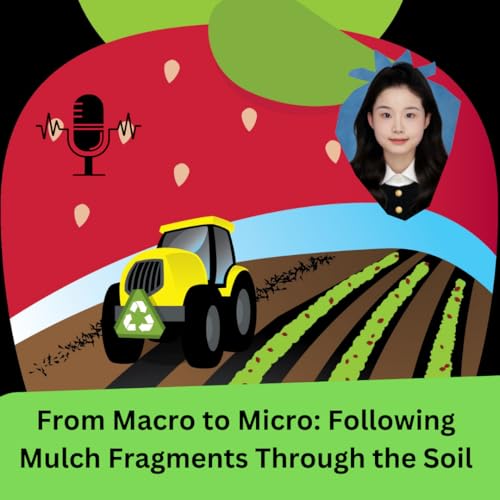
Mulch Matters Podcast Podcast Por Nataliya Shcherbatyuk arte de portada

Mulch Matters Podcast

Mulch Matters Podcast

De: Nataliya Shcherbatyuk
Escúchala gratis

OFERTA POR TIEMPO LIMITADO | Obtén 3 meses por US$0.99 al mes

$14.95/mes despues- se aplican términos.
We are here to update you on the latest research about BDM and recycling options for PE mulch, as well as help you answer any questions you might have. In each episode, we'll dive into the latest research, trends, news, and insights on why mulch matters and how we can improve plastic mulch end-of-life options. We'll also branch out and discuss other plastics as well as talk to researchers, experts, and practitioners in the field who will share their insights and experiences on how to use mulch effectively in different settings.2023
Episodios
  • Beyond the Plastic: How Social Values Shape Mulch Decisions in Agriculture
    Dec 18 2025

    In this episode of Mulch Matters, we are joined by Dr. Beth Prosnitz, a postdoctoral research associate and sociologist at Washington State University, to explore the human side of plastic mulch decisions in agriculture.

    Rather than focusing only on materials or technology, this conversation dives into how economic realities, social values, land tenure, environmental responsibility, and farmer identity all intersect when growers decide whether to use polyethylene or biodegradable plastic mulch particularly in strawberry production systems.

    Beth introduces the concept of relational work, explaining how farmers balance price, labor, environmental stewardship, food safety, land leases, and peer expectations when making real-world decisions. The discussion also highlights why biodegradable mulch adoption is not always feasible, the role of waste management and recycling markets, and how skepticism around recycling affects grower trust.

    This episode offers valuable insight for growers, researchers, policymakers, waste management professionals, and anyone interested in sustainable agriculture, showing that plastic mulch decisions are not just technical choices, but deeply relational ones shaped by people, policies, and long-term realities in the field.

    This work is supported by Specialty Crops Research Initiative Award 2022-51181-38325 from the USDA National Institute of Food and Agriculture. Any opinions, findings, conclusions, or recommendations expressed on this podcast are those of the author(s) and do not necessarily reflect the view of the U.S. Department of Agriculture.  

    Note: intro and outro music credit to Zakhar Valaha from Pixabay https://pixabay.com/music/introoutro-motivational-ident-main-9923/  

    Más Menos
    24 m
  • Plastic Waste to Soil Wealth: A Microbial Makeover with Sam Baker
    Nov 19 2025

    In this episode of Mulch Matters, we sit down with Sam Baker, CEO of Wriggle Brew, for a compelling conversation that bridges soil science, sustainability, and the future of plastic waste management. What began as a quest to develop organic fertilizers using earthworms evolved into a groundbreaking exploration of how larval microbes can digest plastic - offering a novel, biologically driven solution to one of the planet's most pressing environmental challenges.

    Sam shares the origin story of his work, from his background in chemistry and economics to the moment a fishing trip with his grandfather sparked a mission to combat fertilizer runoff and soil degradation. Through trial, error, and innovation, his team discovered that certain worm species and their gut microbes could not only process food and farm waste into nutrient-rich vermicompost, but also break down polystyrene and other plastics. This led to the development of a bioreactor system capable of converting plastic into microbe-ready material, ultimately producing shelf-stable, microplastic-free organic fertilizer.

    The conversation dives deep into the science behind pyrolysis, microbial digestion, and the challenges of scaling up this technology. Sam also reflects on the importance of affordability in sustainable innovation, arguing that eco-friendly solutions must be accessible to truly make an impact.

    This episode offers a rare glimpse into the intersection of agricultural innovation, plastic recycling, and environmental entrepreneurship - highlighting how worms and waste might just hold the key to a more regenerative future.

    This work is supported by Specialty Crops Research Initiative Award 2022-51181-38325 from the USDA National Institute of Food and Agriculture. Any opinions, findings, conclusions, or recommendations expressed on this podcast are those of the author(s) and do not necessarily reflect the view of the U.S. Department of Agriculture. 

    Note: intro and outro music credit to Zakhar Valaha from Pixabay https://pixabay.com/music/introoutro-motivational-ident-main-9923/ 

    Más Menos
    30 m
  • Recycling Roots: Theron Smith's Journey from Metal to Mulch in the Plasticulture Revolution
    Oct 20 2025

    This podcast episode from Mulch Matters features an in-depth conversation with Theron Smith, co-owner of Flipping Iron—a California-based recycling company that has evolved from metal recovery to becoming a key player in agricultural plastic recycling. The episode traces Theron's personal and professional journey, beginning with his grandfather's metal recycling business and expanding into the complex world of plasticulture, including mulch film, fumigation film, and drip tape.

    Theron shares insights into the challenges of recycling agricultural plastics, the evolution of Flipping Iron's operations, and the importance of adaptability in a rapidly changing industry. He discusses the company's expansion across multiple states, the role of family in the business, and the strategic shift toward plastics despite initial resistance. The conversation also explores the limitations of domestic recycling infrastructure, the reliance on international export markets.

    Throughout the episode, Theron emphasizes the value of collaboration over competition, highlighting partnerships with growers, engineers, and institutions like Washington State University and the Monterey Bay Marine Sanctuary. He also reflects on the broader implications of plastic use, sustainability, and the need for innovative solutions—whether through mechanical recycling, advanced technologies, or alternative applications like construction materials and fuel sources.

    This episode is both a personal narrative and a technical exploration of the recycling landscape, offering listeners a nuanced understanding of the plasticulture industry, its environmental stakes, and the entrepreneurial spirit driving change.

    This work is supported by Specialty Crops Research Initiative Award 2022-51181-38325 from the USDA National Institute of Food and Agriculture. Any opinions, findings, conclusions, or recommendations expressed on this podcast are those of the author(s) and do not necessarily reflect the view of the U.S. Department of Agriculture. 

    Note: intro and outro music credit to Zakhar Valaha from Pixabay https://pixabay.com/music/introoutro-motivational-ident-main-9923/ 

    Más Menos
    57 m
Todavía no hay opiniones