Episodios

  • #106 - CRUSH Yield Season With a Simple Google Doc w/ John Azoni
    Mar 25 2026

    In this solo episode, John addresses a critical gap in how colleges use video content during yield season. Most institutions have great video content scattered across platforms, but admissions counselors often don't have easy access to share it in one-on-one conversations with prospective students—exactly when it could make the biggest impact.

    Key takeaways:

    • Video shouldn't just be a broadcast tool measured by views—it's a powerful one-to-one communication asset
    • Five strategic views from an admissions counselor to fence-sitting students may be more valuable than 5,000 algorithm-driven views
    • Marketing, social media, and admissions teams often operate in silos, missing opportunities to leverage existing content
    • A simple Google Doc library organized by student questions can bridge this gap in an afternoon
    • Don't just rely on the algorithm to deliver your content—be the algorithm by hand-delivering the right video at the right moment
    • Measure success not just through broadcast metrics, but through counselor feedback on whether videos helped close enrollment gaps

    Resources mentioned:

    • Free Google Doc template: https://unveild.tv/strategytoolbox


    Connect with John:

    • LinkedIn: https://www.linkedin.com/in/johnazoni
    • Email: john@unveild.tv
    • Website: https://unveild.tv
    • Newsletter: https://unveild.tv/newsletter
    Más Menos
    24 m
  • #105 - How Pratt Institute is Helping Change the Narrative on Creative Education w/ Jolene Travis
    Mar 11 2026

    My guest today is Jolene Travis, Assistant Vice President for Communications and Marketing at Pratt Institute. In this episode, Jolene shares how Pratt built a comprehensive campaign to combat negative headlines about creative arts education and shift public perception.


    Jolene discusses the "Power of a Creative Education" framework that emerged from a single question from her president: "What are we going to do about these headlines?" She walks through the internal process of building messaging that all stakeholders could see themselves in, the importance of listening to faculty pushback, and how strategic media relations generated nine top-tier placements including The New York Times, NBC Nightly News, and WNYC—all amplifying a counter-narrative that painting and drawing programs have waiting lists while critics claim art school is dead.

    Key Takeaways:

    • GEO (Generative Engine Optimization) is critical for higher ed—95% of AI citations come from earned media, not your website.
    • A creative education teaches critical questioning and problem-solving, not just technical skills—it prepares graduates to pivot across industries.
    • Internal alignment on messaging is non-negotiable—if faculty and staff don't see themselves in your framework, it won't work externally.
    • Success in creative fields isn't always a Google salary—art residencies, grants, and having a "bar gig that supports your creative work" are valid markers of success.
    • The most compelling messages often come from proximity to leadership—Jolene captured "there's a waiting list for painting and drawing" from staffing her president at an event.
    • A single data point (applications up in fine arts) became the foundation for 9 major media placements when paired with proper media prep and relationship building.
    • Partner with peer institutions rather than compete—a chorus is stronger than a single voice when shifting narratives.
    • NBC produced a full campus segment without ever visiting campus because Pratt had organized B-roll in their digital asset management system.
    • Zoom waiting room videos are an overlooked touchpoint—Pratt's 30-second video plays in 60,000 meetings annually, creating brand impressions before conversations even start.
    • Start your campaign by listening, not by pushing out your message—understand what the other side is saying first.
    • Holiday breaks are ideal times to think through big strategic challenges.

    Connect With Jolene:

    • LinkedIn: https://www.linkedin.com/in/jolenetravis/

    Resources Mentioned:

    • Pratt Institute website
    • Bynder (Digital Asset Management system)
    • Muck Rack GEO report
    • The New York Times: "Pratt School of Art applications up" coverage
    • WNYC/Gothamist: Trend piece on NYC art school applications
    • NBC Nightly News segment on AI and creativity
    • Blog post on Zoom waiting room videos: https://unveild.tv/blog

    Connect With John:

    • LinkedIn: https://www.linkedin.com/in/johnazoni
    • Website: https://unveild.tv
    • Newsletter: https://unveild.tv/newsletter
    Más Menos
    48 m
  • #104 - Why College Websites Are Failing Prospective Students and How to Fix It w/ Pez Perry from Squiz
    Feb 25 2026

    My guest today is Pez Perry (Robert Perry), Principal Consultant at Squiz. In this episode, Pez shares his expertise on why most higher education websites fail prospective students and what institutions need to do differently.

    Pez discusses the fundamental disconnect between how universities organize their websites (around internal structures and stakeholder priorities) versus how prospective students actually search for information. He explains why the future of university websites looks more like ChatGPT than traditional navigation menus, and offers practical advice for making websites more user-centered.

    Key Takeaways:

    • Most university websites are organized around internal departments and leadership priorities rather than user questions and needs.
    • Red flags of poor website design include president statements on the homepage, navigation by department names, heavy jargon, and homepage carousels with drone footage.
    • Prospective students don't understand university terminology like "provost," "dean," "bursar," or "vice chancellor."
    • The future of university websites is moving toward ChatGPT-style interfaces where users ask questions in natural language and receive immediate answers.
    • Gen Z students (your future applicants) already expect AI-powered, conversational interfaces in their daily lives.
    • University of Edinburgh embeds scholarship information directly on course pages, eliminating the need for students to navigate away to find financial aid details.
    • Monash University gives departments freedom to experiment with content within clear brand guidelines.
    • Universities are innovation hubs in research but surprisingly conservative in their digital communication strategies.
    • The quickest win: eliminate jargon, acronyms, and high readability levels from your website content.
    • Don't assume you know what students want—ask them through surveys, webinar registration questions, and intake forms.
    • Content should answer user questions first, then deliver brand messaging second.

    Connect With Pez:

    • LinkedIn: https://www.linkedin.com/in/robertpezperry/

    Resources Mentioned:

    • University of Edinburgh website: https://www.ed.ac.uk/
    • Monash University website: https://www.monash.edu/
    • Squiz: https://www.squiz.net/

    Connect With John:

    • LinkedIn: https://www.linkedin.com/in/johnazoni
    • Website: https://unveild.tv
    • Newsletter: https://unveild.tv/newsletter
    Más Menos
    52 m
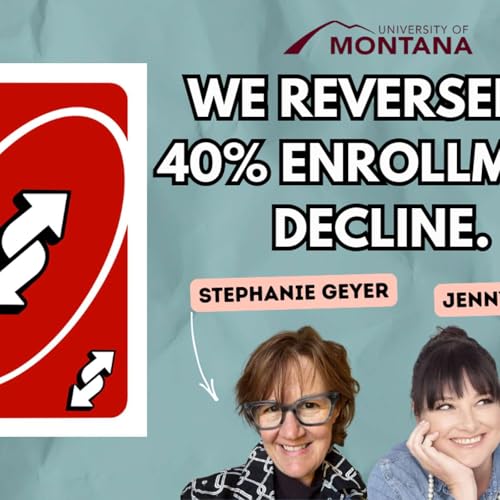
  • #103 - Reversing a 40% Enrollment Drop at Montana University w/ Jenny Petty & Stephanie Geyer
    Feb 11 2026

    In this episode, Jenny Petty and Stephanie Geyer talk about their experiences in higher education marketing, focusing on their collaborative efforts at the University of Montana. They discuss the challenges of enrollment decline, the importance of storytelling, and the revitalization of campus traditions. The conversation also touches on the significance of indigenous representation and the future of marketing strategies in higher education.


    Takeaways

    • The importance of mentorship in career development.
    • Building a modern marketing team requires collaboration and innovation.
    • Revitalizing campus traditions can enhance community engagement.
    • Storytelling is a powerful tool in higher education marketing.
    • Indigenous representation is crucial for fostering belonging.
    • Enrollment strategies must adapt to changing demographics.
    • Creating a brand identity requires input from the entire campus community.
    • Digital marketing strategies are essential for modern enrollment efforts.
    • Emphasizing retention is as important as recruitment.
    • Continuous learning and adaptation are key in higher education marketing.


    Links:
    Jenny’s Linkedin: https://www.linkedin.com/in/jennydurnanpetty/
    Stephanie’s Linkedin: https://www.linkedin.com/in/stephanie-geyer-553a862/


    Subscribe to the Higher Ed Storytellers Digest. A weekly newsletter for higher ed MarCom leaders: unveild.tv/newsletter

    Más Menos
    1 h y 2 m
  • #102 - The Tiny Team Behind Felician University’s Viral Short-Form Video Hits w/ Christine Albano
    Jan 28 2026

    In this conversation, Christine Albano discusses her journey in social media management within higher education, particularly at Felician University. She shares insights on the importance of social media as a research tool for prospective students, the creative processes behind successful campaigns, and the challenges of managing a student content team. Christine emphasizes the need for authenticity in content creation and the role of AI as a supportive tool in marketing strategies. The discussion also covers engagement strategies, including giveaways and contests, and the future direction of Felician's content strategy, including a new podcast initiative.


    Key Takeaways:

    1. Social media is how prospective students research colleges: Platforms like Instagram and TikTok function as search engines, giving students a real look at campus life before they ever visit a website.

    2. Strong engagement comes from relevance and creativity: Content performs best when it highlights real experiences, hands-on learning, and student voices rather than polished marketing clichés.

    3. Student content teams need structure, trust, and training: Clear guardrails, hands-on coaching, and shared creative processes help students contribute effectively while staying on brand.

    4. Giveaways and interactive formats can drive real momentum: Well-designed campaigns (like Felician’s anti-melt giveaway) can sustain interest, boost engagement, and support enrollment goals.

    5. Authenticity and smart use of AI strengthen content strategy: Honest storytelling resonates most, while AI works best as a supportive tool for ideation, captions, and efficiency—not a replacement for human creativity.

    Relevant links:

    Instagram: https://www.instagram.com/felician_university/
    TikTok: https://www.tiktok.com/@felicianuniversity
    Youtube: https://www.youtube.com/@FelicianUniversity

    Linkedin: https://www.linkedin.com/school/felician-university/

    Facebook: https://www.facebook.com/felicianuniversity

    Más Menos
    45 m
  • #101 - Why Advancement MarCom Is Still the Underdog (And Why That Needs to Change) w/ Dan Giroux
    Jan 14 2026

    In this episode, host John Azoni sits down with Dan Giroux, independent consultant and former senior advancement communications leader at Drexel University, to explore why Advancement Marketing & Communications (MarCom) is one of the most overlooked — yet most critical — functions in higher education today.


    Dan shares insights from his three-act career journey (agency, in-house, and independent consulting), discusses the structural challenges holding advancement teams back, and outlines practical, realistic ways institutions can create more authentic, impactful content — even with limited resources. The conversation dives deep into storytelling, leadership alignment, donor engagement, and why higher ed can learn a lot from modern creators like MrBeast when it comes to community-driven philanthropy.

    This episode is a must-listen for advancement leaders, MarCom professionals, and anyone navigating fundraising, alumni engagement, or institutional storytelling in a rapidly changing higher-ed landscape.

    Key takeaways:

    1. Advancement MarCom plays a bigger role than many institutions realize: When it’s treated as tactical support instead of a strategic function, schools miss opportunities to drive engagement, loyalty, and giving.
    2. Collaboration starts with leadership alignment: Strong partnerships between Central MarCom and Advancement leaders make cross-team collaboration possible; misalignment at the top creates silos everywhere else.
    3. Authentic storytelling comes from specificity, not polish: Donors and alumni connect more deeply with real, detailed stories than with highly produced, generic campaign messaging.
    4. Stewardship is a growth strategy, not an afterthought: Post-gift communication and impact storytelling strengthen relationships and increase long-term support.
    5. Limited resources don’t have to limit impact: Small teams can scale by prioritizing the right work, using freelancers strategically, and building repeatable content systems.
    Más Menos
    56 m
  • #100 - Reddit for Higher Ed 101: Why Every College Needs a Subreddit (AI Search, SEO, and Enrollment Strategy) w/ Ross Simmonds
    Dec 17 2025

    In this episode, Ross Simmonds, CEO of Foundation Marketing and Distribution.ai, unpacks why Reddit has become one of the most influential platforms in the student decision-making process—shaping search rankings, AI responses, and campus reputation in ways most institutions aren’t tracking. He explains how universities can strategically participate without sounding promotional, how to build karma and credibility, and why owning your subreddit is now essential brand hygiene. Ross shares practical steps for teams of any size to start distributing content effectively, encourages leveraging student-generated stories, and highlights how repurposing existing assets can drive massive impact. He also discusses his book, Create Once, Distribute Forever, and offers low-lift strategies to help higher ed marketers turn Reddit from a risk into an unmatched opportunity.

    Links:

    Ross’ book: Create Once, Distribute Forever
    Ross’ companies: Foundation Marketing and Distribution.ai

    Key takeaways:

    1. Reddit now shapes both search results and AI-generated answers used in the college search.
    2. Universities must own and actively manage their subreddits to influence student perception.
    3. Zero-click storytelling outperforms link-dropping and builds trust on Reddit.
    4. Studying subreddit culture and tailoring content to it prevents bans and boosts engagement.
    5. Consistency—15 minutes a day of authentic activity—compounds into real visibility and impact.
    Más Menos
    56 m
  • #99 - How to Write Blogs and Emails Prospective Students Might Actually Read w/ Erin Fields from Ologie
    Dec 3 2025

    In this conversation, Erin Fields, the marketing director at Ology, discusses her journey in higher education marketing, emphasizing the importance of authentic content and understanding student needs. She shares insights on leveraging LinkedIn for thought leadership, the role of Reddit in gathering student feedback, and effective strategies for email marketing and blog content. Erin highlights the significance of spotlighting real student stories to build trust and relatability, and encourages higher ed professionals to embrace experimentation in their content creation efforts.


    Key takeaways:

    1. Authentic, human-sounding conversations should lead higher ed marketing.
    2. Student needs and real questions must drive all content decisions.
    3. Platforms like LinkedIn and Reddit are essential for understanding student sentiment.
    4. Content should prioritize clarity, simplicity, and genuine value.
    5. Building helpful, student-centered resources strengthens brand trust over time.
    Más Menos
    1 h y 1 m