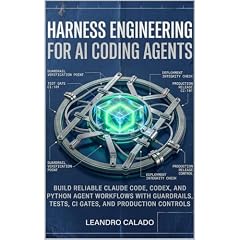
Harness Engineering
Designing the Systems That Make AI Coding Agents Reliable
No se pudo agregar al carrito
Add to Cart failed.
Error al Agregar a Lista de Deseos.
Error al eliminar de la lista de deseos.
Error al añadir a tu biblioteca
Error al seguir el podcast
Error al dejar de seguir el podcast
Obtén 30 días de Standard gratis

Harness Engineering
Compra ahora por $12.99
-
Narrado por:
-
Virtual Voice

Este título utiliza narración de voz virtual
Model capability does not guarantee reliable software outcomes. This book is for hands-on software engineers and technical leaders who want to move from ad hoc AI coding assistance to harness engineering—designing the execution system around the model: tools, control loops, state and continuity, verification, observability, recovery, and governance.
Across foundations, design and build, operate and scale, and governance and adoption you will learn how to:
- Define the split between model reasoning and harness design, and build minimum viable control loops with checks and escalations.
- Set acceptance criteria, failure thresholds, and escalation rules before you automate; then implement a baseline single-agent harness with approvals, tests, and policy checks.
- Introduce multi-agent roles and handoffs with explicit contracts, and structure repository-native artefacts for consistent retrieval and execution.
- Combine deterministic checks with independent evaluation in verification pipelines; instrument cost and throughput; and design interruption-safe, resumable workflows.
- Apply least privilege, approvals, and safety boundaries for risky actions and secrets.
- Encode standards as deterministic checks, choose metrics that reflect reliability and maintainability as well as throughput, and roll harness practices out across teams with clear ownership—including a ninety-day adoption roadmap.
The tone is practical and source-aware: verification pairs deterministic checks with independent evaluation; governance is treated as an architectural default, not a late add-on; and autonomy is discussed with explicit human checkpoints and measurement—without promising unsupervised production coding.
If you need a disciplined, engineering-first approach to agentic coding workflows, this book delivers the concepts, patterns, and operating discipline to match.
Los oyentes también disfrutaron:


Las personas que vieron esto también vieron: