Episodios

  • Why Netflix, Uber, and Spotify Never Lag: The Database Nobody Talks About | Aaron Katz
    Mar 31 2026

    "Companies designing for agents, not humans, are going to get a lot of lift."

    ClickHouse started as an internal tool at Yandex. Today it's the database Anthropic, OpenAI, Meta and Tesla all run on.

    In this episode, CEO Aaron Katz joins Lukas Biewald to talk about how he turned an open source project into a $15B company, why he acquired LangFuse knowing it could cost him customers, and what he's actually building for the agent era.

    Snowflake, Datadog and Databricks all come up. He doesn't shy away.

    Connect with us here:

    Aaron Katz: https://www.linkedin.com/in/aaron-katz-5762094

    ClickHouse: https://www.linkedin.com/company/clickhouseinc/

    Lukas Biewald: https://www.linkedin.com/in/lbiewald/

    Weights and Biases: https://www.linkedin.com/company/wandb/

    00:00 Trailer

    00:57 The Origin Story: From Yandex to ClickHouse Inc.

    04:43 Building ClickHouse Cloud & Raising $300M

    10:36 Growing Up Around Xerox PARC

    12:51 Salesforce, Mark Benioff & the Dot-Com Bust

    15:32 Cloud Skeptics vs. AI Skeptics | History Repeating

    18:05 Building a Modern Go-To-Market Playbook

    21:57 The SaaS Crash, Agents & the Future of Infrastructure

    27:09 The Datadog Love-Hate Story

    35:21 Hardest Moments: Russia, SVB & Sleepless Nights

    43:16 Outro

    Más Menos
    44 m
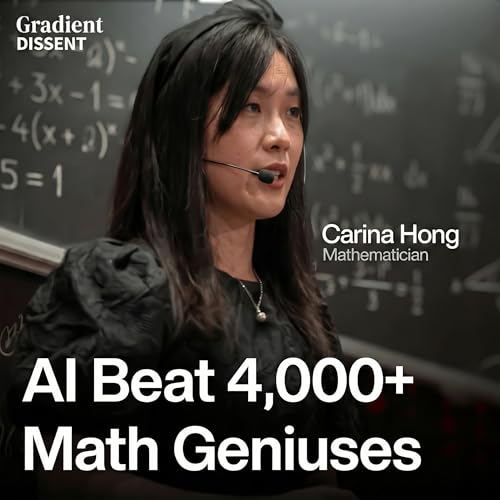
  • The $64M Bet on an AI That Has to Be Right | Carina Hong, CEO of Axiom
    Feb 5 2026

    Formal verification already consumes years of human effort.

    In this episode, Lukas Biewald talks with Carina Hong, Founder & CEO of Axiom, about why verification is becoming the real bottleneck in high stakes AI systems.

    They discuss how Axiom uses AI to take on the tedious checking that stretches verification cycles across years, starting with formal mathematics and extending to hardware and software.

    Carina also explains why Axiom’s approach to auto-formalization mirrors spec driven models like Kiro from AWS.

    Connect with us here:

    Carina Hong: https://www.linkedin.com/in/carina-hong/

    Axiom: https://www.linkedin.com/company/axiommath/

    Lukas Biewald: https://www.linkedin.com/in/lbiewald/

    Weights & Biases: https://www.linkedin.com/company/wandb/

    Más Menos
    51 m
  • What a $42B Software Co. Really Spends on AI Tools
    Jan 20 2026

    “I don't worry about being replaced by AI. I worry about being replaced by someone who's really good at using AI.”

    Atlassian has 10,000+ engineers currently split-testing the world’s top AI coding tools, from GitHub Copilot and Cursor to Claude Code.

    In this episode, Co-Founder & Co-CEO Mike Cannon-Brookes joins Lukas Biewald to share what their data reveals about the world's best AI tools today.

    Hear how 24 years of building a tech giant and a massive internal study on AI productivity have shaped Mike's vision for the future of dev jobs.

    Connect with us here:


    Mike Cannon-Brookes: https://www.linkedin.com/in/mcannonbrookes/?originalSubdomain=au

    Atlassian: https://www.linkedin.com/company/atlassian/?viewAsMember=true

    Lukas Biewald: https://www.linkedin.com/in/lbiewald/

    Weights & Biases: https://www.linkedin.com/company/wandb/


    00:00 Trailer

    01:08 Introduction

    03:11 Connecting Technology and Business Teams

    07:22 The Impact of AI on Business Workflows

    13:26 Developer Productivity and AI

    21:03 Measuring Developer Efficiency

    25:41 Future of AI in Development

    34:59 Legacy Technology and Code Changes

    39:29 AI's Role in Developer Productivity

    47:40 AI and Junior Developers

    52:30 Product-Led Growth and Business Strategy

    01:00:29 Core Metrics for Sustainable Growth

    01:06:56 Staying Creative in the Tech Industry

    Más Menos
    1 h y 8 m
  • Inside the $41B AI Cloud Challenging Big Tech | CoreWeave SVP
    Jan 6 2026

    The future of AI training is shaped by one constraint: keeping GPUs fed.

    In this episode, Lukas Biewald talks with CoreWeave SVP Corey Sanders about why general-purpose clouds start to break down under large-scale AI workloads.

    According to Corey, the industry is shifting toward a "Neo Cloud" model to handle the unique demands of modern models.

    They dive into the hardware and software stack required to maximize GPU utilization and achieve high goodput.

    Corey’s conclusion is clear: AI demands specialization.


    Connect with us here:

    Corey Sanders: https://www.linkedin.com/in/corey-sanders-842b72/

    CoreWeave: https://www.linkedin.com/company/coreweave/

    Lukas Biewald: https://www.linkedin.com/in/lbiewald/

    Weights & Biases: https://www.linkedin.com/company/wandb/


    (00:00) Trailer

    (00:57) Introduction

    (02:51) The Evolution of AI Workloads

    (06:22) Core Weave's Technological Innovations

    (13:58) Customer Engagement and Future Prospects

    (28:49) Comparing Cloud Approaches

    (33:50) Balancing Executive Roles and Hands-On Projects

    (46:44) Product Development and Customer Feedback

    Más Menos
    53 m
  • Why Physical AI Needed a Completely New Data Stack
    Dec 16 2025

    The future of AI is physical.

    In this episode, Lukas Biewald talks to Nikolaus West, CEO of Rerun, about why the breakthrough required to get AI out of the lab and into the messy real world is blocked by poor data tooling.

    Nikolaus explains how Rerun solved this by adopting an Entity Component System (ECS), a data model built for games, to handle complex, multimodal, time-aware sensor data. This is the technology that makes solving previously impossible tasks, like flexible manipulation, suddenly feel "boring."

    Connect with us here:

    Nikolaus West: https://www.linkedin.com/in/nikolauswest/

    Rerun: https://www.linkedin.com/company/rerun-io/

    Lukas Biewald: https://www.linkedin.com/in/lbiewald/

    Weights & Biases: https://www.linkedin.com/company/wandb/

    Más Menos
    1 h y 1 m
  • The Engineering Behind the World’s Most Advanced Video AI
    Dec 1 2025

    Is video AI a viable path toward AGI?

    Runway ML founder Cristóbal Valenzuela joins Lukas Biewald just after Gen 4.5 reached the #1 position on the Video Arena Leaderboard, according to community voting on Artificial Analysis.

    Lukas examines how a focused research team at Runway outpaced much larger organizations like Google and Meta in one of the most compute-intensive areas of machine learning.


    Cristóbal breaks down the architecture behind Gen 4.5 and explains the role of “taste” in model development. He details the engineering improvements in motion and camera control that solve long-standing issues like the restrictive “tripod look,” and shares why video models are starting to function as simulation engines with applications beyond media generation.


    Connect with us here:

    • Cristóbal Valenzuela: https://www.linkedin.com/in/cvalenzuelab
    • Runway: https://www.linkedin.com/company/runwayml/
    • Lukas Biewald: https://www.linkedin.com/in/lbiewald/
    • Weights & Biases: https://www.linkedin.com/company/wandb/

    Más Menos
    15 m
  • The CEO Behind the Fastest-Growing AI Inference Company | Tuhin Srivastava
    Nov 18 2025

    In this episode of Gradient Dissent, Lukas Biewald talks with Tuhin Srivastava, CEO and founder of Baseten, one of the fastest-growing companies in the AI inference ecosystem. Tuhin shares the real story behind Baseten’s rise and how the market finally aligned with the infrastructure they’d spent years building.

    They get into the core challenges of modern inference, including why dedicated deployments matter, how runtime and infrastructure bottlenecks stack up, and what makes serving large models fundamentally different from smaller ones.

    Tuhin also explains how vLLM, TensorRT-LLM, and SGLang differ in practice, what it takes to tune workloads for new chips like the B200, and why reliability becomes harder as systems scale.

    The conversation dives into company-building, from killing product lines to avoiding premature scaling while navigating a market that shifts every few weeks.

    Connect with us here:

    Tuhin Srivastva: https://www.linkedin.com/in/tuhin-srivastava/

    Lukas Biewald: https://www.linkedin.com/in/lbiewald/

    Weights & Biases: https://www.linkedin.com/company/wandb/

    Más Menos
    59 m
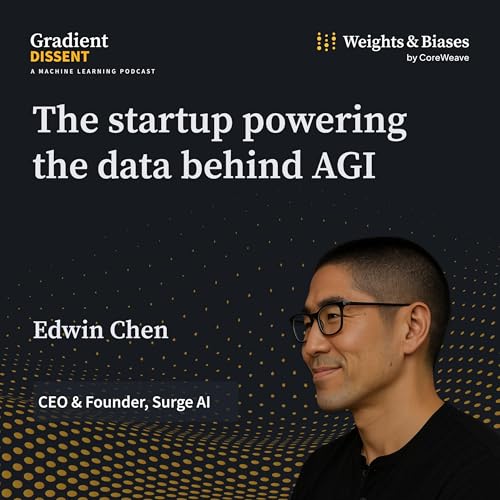
  • The Startup Powering The Data Behind AGI
    Sep 16 2025

    In this episode of Gradient Dissent, Lukas Biewald talks with the CEO & founder of Surge AI, the billion-dollar company quietly powering the next generation of frontier LLMs. They discuss Surge's origin story, why traditional data labeling is broken, and how their research-focused approach is reshaping how models are trained.

    You’ll hear why inter-annotator agreement fails in high-complexity tasks like poetry and math, why synthetic data is often overrated, and how Surge builds rich RL environments to stress-test agentic reasoning. They also go deep on what kinds of data will be critical to future progress in AI—from scientific discovery to multimodal reasoning and personalized alignment.


    It’s a rare, behind-the-scenes look into the world of high-quality data generation at scale—straight from the team most frontier labs trust to get it right.


    Timestamps:

    00:00 – Intro: Who is Edwin Chen?

    03:40 – The problem with early data labeling systems

    06:20 – Search ranking, clickbait, and product principles

    10:05 – Why Surge focused on high-skill, high-quality labeling

    13:50 – From Craigslist workers to a billion-dollar business

    16:40 – Scaling without funding and avoiding Silicon Valley status games

    21:15 – Why most human data platforms lack real tech

    25:05 – Detecting cheaters, liars, and low-quality labelers

    28:30 – Why inter-annotator agreement is a flawed metric

    32:15 – What makes a great poem? Not checkboxes

    36:40 – Measuring subjective quality rigorously

    40:00 – What types of data are becoming more important

    44:15 – Scientific collaboration and frontier research data

    47:00 – Multimodal data, Argentinian coding, and hyper-specificity

    50:10 – What's wrong with LMSYS and benchmark hacking

    53:20 – Personalization and taste in model behavior

    56:00 – Synthetic data vs. high-quality human data


    Follow Weights & Biases:

    https://twitter.com/weights_biases

    https://www.linkedin.com/company/wandb

    Más Menos
    56 m