Faith Full Catholic Podcast Podcast Por Tony Ganzer arte de portada

Faith Full Catholic Podcast

Faith Full Catholic Podcast

De: Tony Ganzer
Escúchala gratis

The Faith Full Catholic Podcast tells true stories about the Catholic faith in today's world through compelling, narrative audio journalism. Episodes include interviews, narrative storytelling, and a blend of high-quality production techniques. The independent, listener-supported project is hosted and produced by Tony Ganzer. He's a long-time public media journalist and writer by trade, and a Catholic by choice and upbringing. Ganzer has reported on many things over 15 years in the US and Europe, from Swiss Parliament to the plight of refugees. Religion and faith have always held a special place. We were featured in Our Sunday Visitor's article on quality Catholic podcasts. We've also won two Gabriel Awards from the Catholic Media Association in 2020 and 2021. (For Episode 6 and Episode 9!) 'The best antidotes to falsehoods are not strategies, but people: people who are not greedy but ready to listen, people who make the effort to engage in sincere dialogue so that the truth can emerge; people who are attracted by goodness and take responsibility for how they use language..' Pope Francis, 24 January 2018Faith Full Podcast Cristianismo Espiritualidad Ministerio y Evangelismo
Episodios
  • Is online gambling a health crisis? Bishops in the Philippines concerned
    Sep 1 2025

    Catholic Bishops in the Philippines say online gambling has become a new plague or virus that is destroying families, and even causing a kind of slavery. While illegal gambling has always existed in the shadows of society, this new crisis takes place in the smartphones of anyone, including children. The cure to this plague needs to come from every level of society, including at the parish level:

    Msgr Pedro Quitorio: "It's become a sickness. With all these addictions, people, children, teenagers are becoming, you know… some, some we hear news of taking their lives because of this, so much debt."

    Faith Full is a Catholic podcast hosted by Tony Ganzer. In this episode we hear from Msgr. Pedro Quitorio, the Director of the Media Office for the Catholic Bishops' Conference of the Philippines.

    Visit our website: https://www.faithfullpod.com
    Donate: https://www.faithfullpod.com/support/
    Subscribe on iTunes: https://itunes.apple.com/us/podcast/faith-full-podcast/id1363835811
    YouTube: https://youtu.be/sjFA9QtxwEg
    Spotify: https://open.spotify.com/show/34sSHs8hHpOCi5csuTtiIv

    Today we will learn about the heated issue of online gambling in the Philippines, and what lessons Catholics anywhere might learn from the example there, especially with the rise of online casinos and sports betting in places like the US. To be clear, the Church doesn't say all gambling is wrong or sinful–not at all. But when addiction takes over lives, then the hands and feet of Christ on earth need to be mobilized.

    Msgr. Pedro Quitorio: "This has become a very strong part now of our new evangelization. It's a matter of, you know, putting the faith in context now, concretely, by the way people move, because this is affecting even, even our faith, even how we practice our faith."

    In some corners of the internet or even on TV, it can seem impossible to avoid gambling ads. In the US at least, online sports betting has exploded as states have moved to regulate it more, and capture potential tax revenue.

    Or some social media influencers will stream high-stakes online slot machine sessions, and win seemingly astronomical amounts. Clips of these wins then sell the dream of winning big. Maybe these people are winning, or maybe these companies offer influencers money to promote the site. Having access to gambling of all sorts from the safety of your smartphone is as convenient as it can be risky, especially for impressionable kids. The Philippines is a country that is generally very Catholic, and very online, especially on social media.

    The explosion of online gambling just this year has spiraled into a crisis leading the Catholic Bishops Conference of the Philippines to sound the alarm and call for action from the government and the faithful. One of the most troubling issues has been children's ability to access e-wallets, which can ensnare children and their families in debt.

    After all, this is big business and e-games or e-bingo were the biggest chunk of gross gambling revenue in the first quarter of the year at 51.39 billion Philippine Pesos, or nearly 900 million US dollars.

    Msgr. Pedro Quitorio said this problem has gotten much worse in just the last year, the last months really, and the reactions are coming just as fast. Since this interview, the Philippines Central Bank ordered e-wallets to be decoupled from online gambling, and the issue has been discussed in the media, by lawmakers, and the president. In listing recommendations though, the Catholic Bishops also called on Catholics to actively help people affected by gambling, which may give some food for thought no matter where you're watching or listening to this from.

    Más Menos
    21 m
  • What a village cemetery says about Catholicism in France
    Jun 8 2025
    A cemetery in northern France tells us something about Catholicism in this country. I've been here many times over the last 15 years…a tiny slice of this village's lifetime, stretching to the 12th century. In 2013, broken crucifixes and stones littered the grounds of St. Martin church. Flowers and vegetation reclaimed many plots, and at least to me the site felt forgotten. But something changed, bringing some well-needed love and attention to St. Martin...at a time when there are some glimpses of hope for the faith in France. Pope Leo XIV has called for a missionary renewal in France, and baptisms are on the rise. Faith Full is a Catholic podcast hosted by Tony Ganzer. Visit our website: https://www.faithfullpod.com Donate: https://www.faithfullpod.com/support/ Subscribe on iTunes: https://itunes.apple.com/us/podcast/faith-full-podcast/id1363835811 YouTube: https://youtu.be/sjFA9QtxwEg Spotify: https://open.spotify.com/show/34sSHs8hHpOCi5csuTtiIv In society in general, coming to a cemetery like this is a sacred place. This is a place where people should show reverence. It's only natural that this is where loved ones and all of us can remember people we may have known, or at least acknowledge that fellow brothers and sisters in Christ existed. But over time some cemeteries face neglect. And in France especially, with a complicated history with its religion, we can ask why did it fall in disrepair? Was it part of a general turning away from the church, or from religion, that these places fell into disrepair? Or that people forgot, and didn't pay attention to cemeteries like this one at St. Martin, in the village of Mauregny-en-Haye. This village has only about 400 residents, and it's lost many of the staples of village life. Decades ago it had things you might expect in a village including two butchers, a market, and even a traveling clothing seller named "the carrier pigeon" would show up. But no longer..no bakery, no traditional grocery store, but farmers do sell fresh produce. And St. Martin itself isn't the hub it surely used to be. A pamphlet with some local history says big changes to St. Martin's operations began in the 1960s. At that time, falling parishioner numbers limited the number of priests regularly coming to the area, and thus reduced the number of church services, which thus reduced the number of Catholics, which reduced the number of services, etc. Even though the Catholic faith in France has changed a lot over time, and my most recent trip to France has proved that there's a general curiosity about religion. What happened? Why did Catholicism fall off so abruptly? As we learned in our episode about the nuns of Compiegne, it's a complicated history, often related to the revolution, but even before. The complicated relationship between the church and the monarchy, the rise of laicite within France. The changing of just how France operates through multiple world wars. What role does the church play amid such devastation? It's hard, it's a hard question to answer. But to pay respect in a cemetery like this just seems natural, it's what should be done. And there are people who have taken care of St. Martin. There was an effort to raise money for this place to restore headstones and dress it up a bit. But it doesn't change the larger trend against the church, against maintenance of places like this as a church as opposed to part of the patrimoine, collective heritage of France. And that's something that the faithful have to wrestle with, and people who are not particularly religious have to wrestle with. The French subscribe to a kind of hyper secularism as a social "religion" called laicite, extreme separation of church and state. And interesting enough, a desire to preserve civic history may have helped save St. Martin. Residents and officials worked to secure about 350-thousand-euros to repair the church roof, doors and other improvements in the name of preserving heritage, as opposed to preserving a House of God because it's a house of God. Some naysayers may not much care about this. "It is just a building," one might say, or "why should religious groups spend money on property when they can feed the poor?" The physical church building can serve as a hub for feeding the poor, and act as a space for people to contemplate themselves, and God. It also serves as a cultural marker, and an historical marker. In May 2025 Pope Leo said France's "Christian heritage" … "still profoundly permeates [French] culture and remains alive in many hearts." This came on the heels of a report that France's Catholic Church planned to welcome more than 10,300 adult catechumens at Easter, marking a 45% increase from 2024 figures. This is incredible news. Put simply I think it's a good thing to maintain churches and cemeteries. Yes for the religious part of it, and I happen to be Catholic so it's a holy place to me, but also as part of the fabric that holds the community together.
    Más Menos
    8 m
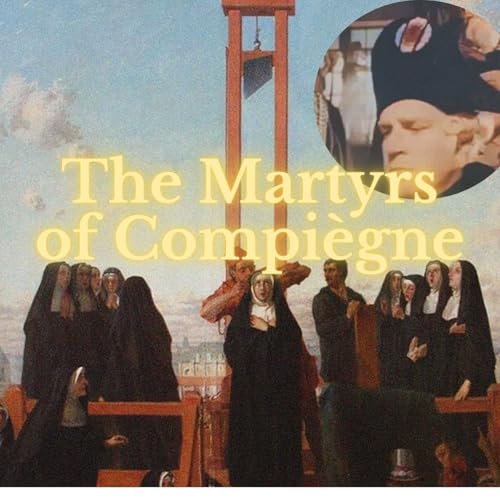
  • Remember Catholic martyrs of the French Revolution: the Carmelite Saints of Compiègne
    Jan 2 2025

    You may not realize it, but the Catholic faith was one of the great targets of the French Revolution, birthing martyrs and saints from persecution and bloodshed. Sixteen Carmelite nuns were beheaded in 1794 for remaining true to their vows, and nothing more. During the so-called Reign of Terror which saw revolutionaries sniffing out real and imagined conspiracies, these nuns were expelled from their monastic life and offered a choice: renounce their faith, and submit to extreme secularism, or be deemed enemies of the state.

    The prioress Mother Teresa of St. Augustine proposed the sisters offer their lives for the salvation of France, fulfilling a prophetic dream from another sister a hundred years before. The act of sacrifice was offered while the nuns sang hymns and prayed, guillotined in front of a crowd faced with the consequence of madness.

    Faith Full is a Catholic podcast hosted by Tony Ganzer. This episode features Jonathan O'Brien, author of "Called to Compiègne": https://www.amazon.com/Called-Compi%C3%A8gne-Jonathan-Michael-OBrien/dp/B0D72K2F5F

    Visit our website: https://www.faithfullpod.com
    Donate: https://www.faithfullpod.com/support/
    Subscribe on iTunes: https://itunes.apple.com/us/podcast/faith-full-podcast/id1363835811
    YouTube: https://youtu.be/sjFA9QtxwEg
    Spotify: https://open.spotify.com/show/34sSHs8hHpOCi5csuTtiIv

    On a rainy night in Paris, the Catholic Bishop strikes the door of Notre Dame with his crozier, or staff, as French President Emmanuel Macron and mayor Anne Hidalgo look on. This ceremony on December 7, 2024, reconsecrated the Cathedral after the devastating fire in 2019.

    To a Catholic, Notre Dame is God's house. But to the French, it is part of the patrimoine, the collective French heritage and cultural identity of France. Yes, it's still God's house, but following the French Revolution France developed into a society governed by laicite—hyper secularism. During the Revolution, this Cathedral of Notre Dame was declared a temple of reason. Effigies were constructed on her floors. The traditional symbols and characteristics of true Catholicism, which is interwoven with France's history, were eyed with suspicion. Priests and nuns were forced to take oaths to the republic, and those who didn't were arrested.

    I took a pilgrimage to France recently, and visited minor and major holy sites all over the country. I celebrated Mass at the cathedrals of Tours and Orleans, I prayed at the Marian apparition site of Pontmain, at the Abbaye of Mont Saint Michel, at Joan of Arc's birthplace of Domremy La Pucelle, and where she saw the Dauphin crowned king in the cathedral of Reims. These and many other sites were powerful reminders of just how Catholic France was, and is, if you know where to look.

    Americans often find a kinship in the idea of the French Revolution because a democracy emerged from the ruins of monarchy. But the story of the martyrs, now saints, of Compiegne, reminds us of the brutality. To learn more about these brave women religious I spoke with Jonathan O'Brien, a Catholic convert who was touched by the story of the nuns in Compiegne and wrote his book: Called to Compiegne. We spoke before Pope Francis formally declared the nuns as saints through what's called equipollent canonization: the Church believes these women are in Heaven, without reported modern miracles, as is usually required.

    I asked Jonathan what inspired him to dig deep into their history:

    Más Menos
    29 m
Todavía no hay opiniones